Monday, June 30, 2008

Ethel Waters


Found this in Brick Lane I think some years ago - once the property of Camden Library. It's on the Biograph label from the 60's - a compilation of songs from 1921 to 1927.

Waters was the first black Superstar...an innovator who opened all the theatrical doors hitherto closed to black performers of her day, to attain the towering position she reached as a headliner. She fought hard and long to achieve solo star status in the white world of vaudeville, night clubs, Broadway theater, radio, films and television. More than any other black performer of the century, Ethel Waters was a woman of the theater, and the celebrity she attained in maturity as an actress tended at times to overshadow-at least in memory-the importance of her accomplishments and influence as a singer.
Her talents defied categorical limits. She was the fountainhead of all that is finest and most distinctive in jazz and popular singing. Widely imitated during the 30's and 40's, one still hears echoes of Ethel Waters in many singers who came after her. Joe Turner, Bing Crosby, Ivie Anderson, Lee Wiley, Mildred Bailey, Connie Boswell, and Ella Fitzgerald have acknowledged their debt to her. Her range soared easily from a low, chest tone to a high, clear head voice: on records she sang from a low E to high F, just over two octaves, and on "Memories of You" she hits a spectacular high F sharp. Her diction was clear and impeccable, coloring the lyrics with the proper emotion necessary to express the feelings she wanted to convey.

Born October 31, 1896, in Chester, Pennsylvania, her eighty year life was a turbulent one filled with low valleys and high peaks. In her autobiography, His Eye is on the Sparrow, she frankly detailed the squalor of her sordid childhood and early struggles. Her singing career began with amateur night performances in Philadelphia, then slowly moved in the black theater circuit, where she was billed as "Sweet Mama Stringbean."

She began recording in 1921 for the Black Swan label, continuing with that company through 1924. When she introduced "Dinah" at the famous Plantation Club (Broadway and 50th Street) in New York City in 1925, she met with such success that she was signed by Columbia Records, for whom she was to make many of her most famous recordings during the next decade. Her career continued to escalate in such black shows as Africana, The Blackbirds of 1928 (and 1930) and Rhapsody in Black. In 1929, she made her film debut in the new talking films, singing "Am I Blue?" and "Birmingham Bertha" in On with the Show, remade a few years later as Forty-Second Street

In 1933, her sensational rendition of "Stormy Weather" at the Cotton Club made her the talk of the town; when Irving Berlin heard her sing it, she was signed for his As Thousands Cheer, a revue starring Marilyn Miller and Clifton Webb. She stopped the show with "Heat Wave" and "Suppertime" and was elevated to co-starring status. At the same time, she became the first Negro to star in a sponsored coast-to-coast radio show, accompanied by the Jimmy Dorsey orchestra. Her Broadway career continued its spectacular ascent with the hit shows At Home Abroad, Mamba 's Daughters, Cabin in the Sky, and Member of the Wedding. Later, she filmed the latter two, appearing also in Gift of Gab, Cairo, Tales of Manhattan, Pinky, and The Sound and the Fury. These films and her numerous recordings remain a legacy for audiences too young to have been or heard this legendary performer at her peak.

Her last years were spent touring with the evangelist Billy Graham, still performing occasionally, until her death on September 2, 1977, in Chatsworth, California."


Ethel Waters - The New York Glide

Ethel Waters - At The New Jump Steady Ball

Ethel Waters - Dyin' With The Blues

Ethel Waters - Kiss Your Pretty Baby Nice

Ethel Waters - Jazzin' Babies Blues

Ethel Waters - Kind Lovin' Blues


These SendSpace files are available for seven days or until exhausted.

Wednesday, June 25, 2008

Les Bantous De La Capitale


The Bantous from a Fiesta label LP released in 1978.

"Les Bantous de la Capitale is one of the longest-lasting and most influential groups in the musical history of the Congo (now Democratic Republic of the Congo). Formed in 1959, the band played a major role in the introduction and growing popularity of boucher, which vitalized the Cuban-influenced rumba, and soukous. Initially co-led by saxophonists Dieudonne "Nino" Malapet and Jean Serge Essous, Les Bantous de la Capitale made their mark with a series of dance-inspiring singles that are reprised on the three-CD collection Les Merveilles Du Passe. Les Bantous de la Capitale has withstood several personnel changes. When Essous elected to remain in Paris after recording with the group, Malapet assumed leadership. Despite geographical obstacles, Essous has continued to perform with the band. Although the Congolese government's issuing of an official cultural policy, Authenticit '67, resulted in the loss of several musicians, substitutes were found and Les Bantous de la Capitale has continued to tour and record. Singers have included Kosmos Kapitza, Pamelo Mounk'a, and Tchico Tchicaya. Guitarists have included former Franco & Ok Jazz member Nedule Papa Noel and Samba Mascott. Les Bantous de la Capitale can be found on solo albums by Mascott, Mounk'a, and Essous."


Les Bantous - Riamana

Les Bantous - Sisi

Les Bantous - Zala Reconnaissant

Les Bantous - Mome Yombo


These SendSpace files are available for seven days or until exhausted.

Monday, June 16, 2008

The City Quads


I can't believe I haven't uploaded some tracks from this LP before. Its one I found at Brick Lane flea market many years ago for a few pence. Its on the Polydor label and made in what was Rhodesia and is now a troubled Zimbabwe. Sleeve printed in Germany. No date but imagine it would be late 50's or early 60's.

No info. on the internet so just a little information on the sleeve notes.

" Polydor presents a unique collection of popular African tunes sung ina variety of native languages by one of the best known vocal groups in Rhodesia, The City Quads. The performance you hear on this LP could be called a mixture of African folklore and pop songs of a kind one is always likely to hear wherever people gather together in an African township."

The music in particular-

LINDEA - (sung in Shona ) Love songs are always popular, and this one is a most tender example.

LIZOFIKANINI LANGA - (sung in Sindebele ) This is a sort of non-political spiritual and tells of an oppressed people's longing for the day when they will be free.

IDALALAKECE - (sung in Sindebele ) Now we have a gay wedding song. There is much shouting and cheering because the young girl is to be married.

BALELE EYAYA - (sung in Sindebele ) This is a son g about a policeman who is alays pounding the beat and writin g in his little book, but who never has time to write home to his family.

LA MULELA - ( sung in Xhosa ) Here we have a song about animals fighting; "unless they are broken apart one of them will have his tail cut off!"

RUDO - (sung in Shona ) The lyrics of this song say: "There couldn't be anyone better than you. Your love haunts me even when you are not there."

NYATELU UGIHILE - (sung in Xhosa ) Another wedding song. Here we are told it is customary for a girl to sing the first song.


The City Quads - Lindea

The City Quads - Lizifikanini Langa

The City Quads - Idalalakece

The City Quads - Balele Ekaya

The City Quads - La Mulela

The City Quads - Rudo

The City Quads - Nyatelu Ugihile


These SendSpace files are available for seven days or until exhausted.

Sunday, June 15, 2008

Allan Sherman


Found this 1964 LP by Allan Sherman at the roadside bookstall in All Saints in Manchester at the weekend. A few good novelty songs based on old standards given a Jewish twist. The only thing that spoils it for me is the canned laughter and applause on each track.

Wikipedia says-

"Employed as a producer by Mark Goodson-Bill Todman Productions, Sherman was the creator and original producer of the popular I've Got a Secret from 1952 to 1958. During this time, he recorded a 78RPM single, containing A Satchel And A Seck (to "A Bushel And A Peck" from Guys And Dolls, and Jake's Song. This single sold poorly and, when time came to write his autobiography, Sherman didn't even acknowledge it. He also produced a short-lived 1954 game show, What's Going On? Sherman was fired after a particularly unsuccessful episode of I've Got a Secret featuring Tony Curtis that aired June 11, 1958. But later, after becoming a celebrity himself, Sherman would make some return appearances on the program.

Later, he found that the little song parodies he performed to amuse his friends and family were taking a life of their own. Sherman had the good fortune to live in the Brentwood section of West Los Angeles next door to Harpo Marx, who invited Sherman to perform his song parodies at parties attended by Marx's show-biz friends. After one such party, George Burns phoned a record executive and persuaded him to sign Sherman to a contract. The result was an LP of these parodies, My Son, the Folk Singer, in 1962. The album was so successful that it was quickly followed by My Son, the Celebrity.

In 1962, capitalizing on his success, Jubilee Records re-released the 1951 single on the album More Folk Songs by Allan Sherman and His Friends, which was a compilation of material by various Borscht Belt comedians, such as Sylvia Froos, Fyvush Finkle and Lee Tully, along with the Sherman material.

As suggested by the albums' titles, Sherman's first two LPs were mainly Jewish-folk-culture rewritings of old folk tunes. His first minor hit was "Sarah Jackman" (pronounced "Jockman"), a takeoff of "Frère Jacques" in which he and a woman (Christine Nelson) exchange family gossip ("Sarah Jackman, Sarah Jackman, How's by you? How's by you? How's by you the family? How's your sister Emily?" etc.) By his peak with My Son, the Nut in 1963, however, Sherman had broadened both his subject matter and his choice of parody material and begun to appeal to a larger audience.

Sherman wrote his parody lyrics in collaboration with Lou Busch. A few of the Sherman/Busch songs are completely original creations, featuring original music as well as lyrics, rather than new lyrics applied to an existing melody. The Sherman/Busch originals — notably "Go to Sleep, Paul Revere" and "Peyton Place" — are delightful novelty songs, showing genuine melodic originality as well as deft lyrics."

Discover more about Allan Sherman HERE.


Allan Sherman - Grow, Mrs. Goldfarb

Allan Sherman - Your Mother's Here To Stay

Allan Sherman - Pills

Allan Sherman - Shine On, Harvey Bloom

Allan Sherman - J.C. Cohen


These SendSpace files are available for seven days or until exhausted.

Monday, June 09, 2008

Laff Blasts From The Past


A great Lp I found a few years back in Brick Lane in East London. It's a compilation of amusing r&b songs from the archives of Herb Abramson. Released in 1985 on the Red Lightnin' label.

"He was born in 1916 in Brooklyn, New York City and initially studied to be a dentist. But he landed a job with National Records producing such performers as The Ravens, Billy Eckstine and Joe Turner. Herb founded his first record company, Jubilee Records, in 1946 with Jerry Blaine. Herb aspired to record jazz, R&B and Gospel recordings. Though Blaine was having some success recording Jewish novelty records, this genre did not interest Abramson, so he sold his interest in Jubilee to Blaine. Herb and his wife Miriam were close friends with fellow jazz buff Ahmet Ertegun and together they founded Atlantic Records in 1947. Herb was president of Atlantic and Ahmet was vice-president. Both Herb and Ahmet handled the creative end of the business and Miriam handled the business end."

Discover more about Herb Abramson HERE.


The Essentials - Sha-He-Be

Otis Blackwell - Back Trail

The Cashmeres - Daddy, Can I Go To The Hop?

The Jarmolettes - Yes, We Have No Bananas

The Magnetics - Sardines

Tony Middleton & Jack Hammer - Earth Cousins

The Dovers - The Invasion


These SendSpace files are available for seven days or until exhausted.

Tuesday, June 03, 2008

Bo Diddley 1928 - 2008


Sad news about Bo Diddley who died yesterday from heart failure. A few tracks here from an old Pye International LP just called "Bo Diddley" from 1963.

"Born in McComb, Mississippi as Ellas Otha Bates, he was adopted and raised by his mother's cousin, Gussie McDaniel, whose surname he assumed, becoming Ellas McDaniel. The family moved to Chicago when he was seven. He took violin lessons as a youth, but was inspired to become a guitarist after seeing John Lee Hooker.

He worked as a carpenter and mechanic, but also began a musical career playing on street corners with friends, including Jerome Green (c. 1934–1973), as a band called the Hipsters (later the Langley Avenue Jive Cats). In 1951, he landed a regular spot at the 708 Club on Chicago's South Side, with a repertoire influenced by Louis Jordan, John Lee Hooker, and Muddy Waters. He adopted the stage name, Bo Diddley, which is probably a southern black slang phrase meaning "nothing at all," as in "he ain't bo diddley." Another source says it was his nickname as a teenage Golden Gloves boxer. The nickname is also linked to the diddley bow, a two-stringed instrument that was used in the south by black musicians working in the fields.

In late 1954, he teamed up with harmonica player Billy Boy Arnold, drummer Clifton James and bass player Roosevelt Jackson, and recorded demos of "I'm A Man" and "Bo Diddley". They re-recorded the songs at Chess Studios with a backing ensemble comprising Otis Spann (piano), Lester Davenport (harmonica), Frank Kirkland (drums) and Jerome Green (maracas). The record was released in March 1955, and the A-side, "Bo Diddley", became a #1 R&B hit."

Discover more about Bo Diddley HERE.


Bo Diddley - You Can't Judge A Book By The Cover

Bo Diddley - Babes In The Wood

Bo Diddley - Sad Sack

Bo Diddley - Mama Don't Allow No Twistin'.

Bo Diddley - You All Green

Saturday, May 31, 2008

Anna Russell


I found this book by Anna Russell at a flea market in the car park of Southend United football club some years ago. At the time I was drawn to the grimacing face on the cover and was delighted to find a pocket in the back of the book contained a 45 r.p.m. disc featuring two songs and a skit about learning to play the french horn.
Anna Russell was born in London in 1911 and attended the Royal College of Music. She pursued the concert career as a lyric soprano and when the war broke out in 1939 she and her family moved to Canada. She appeared on local radio stations and entertained the troups and was soon writing and arranging her own songs. She moved to New York to further her career but wasn't getting very far so took the bold step in 1948 of hiring the New York Town Hall with a capacity of 1,500. Only 250 of her friends turned up but the critics gave her some good reviews. In 1951 she tried again and this time the venue was almost full and the critics acclaimed her as one of the funniest women of her generation. She has sung with many great orchestras and in many operas and her own Broadway show.
She has since retired and moved to Australia.


Anna Russell - Dripping With Gore

Anna Russell - Miserable

Anna Russell - French Horn


These SendSpace files are available for seven days or until exhausted.

Tuesday, May 27, 2008

Bobby Thompson ( The Little Waster )


I found this today in the Age Concern shop for 75p. The accent is a bit hard going at times and one can see why he really didn't mean much outside of his North East England patch.

"Famous for his broad North-east accent, self-deprecating humour and mastery of the mother-in-law joke, Thompson was affectionately known as The Little Waster due to his short stature. His most famous outfit was a worn out stripey jumper and flat cap. His ever-present Woodbine cigarette stub, hanging from the corner of his mouth, was also an integral part of his on-stage persona.

His attempts to move beyond North East England were limited by his accent and the regional bias of his humour, although he did enjoy some success with the BBC show, Wot Cheor Geordie, and with regular appearances on Sunday Night at the London Palladium."

He was also renowned for his problems with the tax man. He incorporated this in his stage act.

Problems with drink, finances and his health affected his career in the 1970s, but he remained a North East favourite, particularly on the club scene, until shortly before his death.

Discover more about Bobby Thompson HERE.


Bobby Thompson - The Little Waster


These SendSpace files are available for seven days or until exhausted.

Thursday, May 22, 2008

Slim Pickins


Found this LP today at the Oxfam in Chester for a couple of quid ( three actually ) which is more than I would usually pay but I was intrigued by some of the song titles and the toxic green vinyl! Also it was signed by Slim and dedicated to someone called Hazel or maybe even Hank? Not to be confused with the american film star of the same name!

Not much to be gleaned about him on the tinternet but he still gigs around the Midlands it seems. This album is on the Westwood Recordings label in Wales and came out in 1975. It reminds a bit of The Two Ronnies when they did that spoof C&W act "Jahosophat & Jones". A nice mixture of comedy and country and western.
Other musicians on the Lp are Stewart Barnes - Lead guitar, acoustic guitar. Steve Hughes - Bass. Alan Holmes - Drums, backing vocals. Jeannie Denver - Backing vocals. Tony Cervi - Piano and an unkown ukulele player. On the sleeve nots it states "None of the musicians have been seen since".


Slim Pickins - I'm A Ladies Man

Slim Pickins - Hoot & Holler Bar & Grill

Slim Pickins - 15 Beers Ago

Slim Pickins - Kansas City Star

Slim Pickins - Make Me A Star


These SendSpace files are available for seven days or until exhausted.

Monday, May 12, 2008

Singing Dogs


Another 78 from the boot on Sunday. I remember this oddity being played on Children's Favourites on the radio when I was a nipper.

"Carl Weismann - Danish legendary pioneer bird voice recording engineer, working for the Danish State Radio in Copenhagen - HATED dogs!
Yeah, well - he hated their barking spoiling every other of his recordings of singing birds - he became a master in cutting them out of his bird tapes - in those days - the 50's - there was no other way to do it than with a pair of scissors!
So he ended up with two piles of tapes - one with bird voices and one with dog voices.
The dogs really were doomed to be thrown out - but then Carl got an idea! He cut together a tape of various toned dog barks set to the music of 'Jingle Bells'.
He had no further intentions, than it might be fun for a Danish children radio show.
HOW it in 1955 ended up on a 45 rpm with 3 other tunes 'Patty Cake', 'Three Blind Mice' and 'Oh Susanna' as a four-tune medley - I simply don’t know. But the disc was released by RCA in USA and sold 500.000 copies.
Release in Britain around the same time was on Pye-Nixa label, on a 78 rpm disc.
In Sweden it has been seen on the Metronome label.
Howard Smith, host of a four-hour talk-music show over WABC-New York FM outlet, WPLJ who liked to play anything weird or new on his program first started playing the original 45 rpm disc at Christmas 1970.
Someone found it in a Boston used record store and gave it to the father of his girlfriend. Smith played the disc for many weeks prior to Christmas 1971 and told some RCA executives at a record party about the public response to his playing their old record. RCA unearthed the original parts at their plant in Indianapolis and rushed the disc into release in early December 1971.
In 3 weeks alone it sold 420,000 copies, the combined sales through the years thus making it a million seller."


Singing Dogs - Pata-A-Cake etc.

Singing Dogs - Oh Susanna


These SendSpace files are available for seven dyas or until exhausted.

Sunday, May 11, 2008

Cranes Skiffle Group


Another 78 from the boot sale today. On the Embassy label from 1957. Cranes Skiffle Group was actually Chas McDevitt and His band who had a big hit with "Freight Train" with Nancy Whiskey singing the lead vocal that same year.

"The group had already recorded 'Freight Train' for Oriole Records; thanks to the demo discs produced by their new manager, Bill Varley. Bill ran Trio Recordings, a small studio in Tin Pan Alley. It was Varley who suggested that to get an edge over the other skiffle groups they should include a girl in their line-up. Folksinger, Nancy Whiskey, who had also appeared on the Radio Luxembourg talent competition was invited to join the group. At first reluctant to give up her folksinging, she joined the boys at the end of December 1956. They re-recorded 'Freight Train' with Nancy taking the vocals. On the same session they recorded; 'Cotton Song', 'New Orleans' and 'Don't You Rock Me Daddy O'. The last track was released on Embassy records, Oriole Records' cheap subsidiary that sold in Woolworth's. They used the pseudonym 'The Cranes Skiffle Group'. 'Worried Man', originally recorded for Embassy, whilst Jimmie MacGregor was with the group, was substituted on their second Oriole release."

Discover more about Chas McDevitt HERE.


Cranes Skiffle Group - Freight Train

Cranes Skiffle Group - Cumberland Gap


These SendSpace files are available for seven days or until exhausted.

Bobby Kimber


Found this old 78 at a boot sale today for 20p. It was recorded "Under the auspicesof the English Folk Dance and Song Society". Solo concertina. I didn't find much about Billy but a quote here about him sheds some light on his songs and his friends.

"Billy's concertina wasn't accepted by all in the side, either, being somewhat new-fangled (patented in 1844 by Sir Charles Wheatstone, though the “anglo” Billy played was probably based on a patent of 1884), but he could do Laudnum Bunches, The Blue-Eyed Stranger, Constant Billy, Country Garden, Rigs of Marlow, How D'Ye Do Sir, Bean Setting, Haste To The Wedding, Rodney, Trunkles, what some called Trunk Hose, and Draw Back. But the side's fiddler, Mark Cox, had gone off for a servant's job at Magdalen College up at Oxford, so they'd have to follow along of Merry Kimber's squeezebox, with young William Washington, the well-digger, him they called Sip, playing the fool. Youngest dancer'd be Charlie Massey, a brickmaker like his father, William, both of them known rather confusingly by the same nickname – Mac – then the two Coppocks, George, known as Spuggle, and George, known as Curly, the latter with great ambitions, later fulfilled, to have a load of men working for his building business, Billy's brother, Richard Kimber, known as Dobbin, making a great career for himself as a worker with the local district council, John Ward, known as Waggle (and you'd soon know why, if you saw him dancing), a labourer, Jim Hedges, known as Gran, a laundry delivery man, and the oldest man in the side, 54-year-old John Horwood, whose brickmaking trade gave him his nickname of Brickdust.

Discover more about Bobby Kimber HERE.


Bobby Kimber - Rodney

Bobby Kimber - Rigs Of Marlow

Bobby Kimber - Beansetting

Bobby Kimber - 29th May


These SendSpace files are available for seven days or until exhausted.

Wednesday, May 07, 2008

Sir Harry Lauder


A 10" LP on the HMV label issued in the late 50's or early 60's. The songs themselves are probably not the originals but his "hits" re-made in the 30's and 40's.

"Sir Harry Lauder (1870 - 1950), the popular singer and entertainer, who won international renown, was born at Number 4 Bridge Street, Portobello.

As a boy Lauder worked in a flax-spinning mill in Arbroath, where he attended school, and for a time he was a miner. It was in Arbroath that he first appeared on stage. He had a natural singing voice and a talent for composing simple and tuneful songs.

His stage persona depended heavily on the kilt, a curly walking-stick, and much talk of bawbees and allusions to tight-fistedness, and Lauder's critics complained that he caricatured the Scot. Be that as it may, Lauder was just as popular in his own country as he was in England and innumerable countries overseas.

Songs like Roaming in the Gloaming and Keep Right On to the End of the Road retain their magic and have become part of Scotland's folk music. He was knighted in 1919, and in 1927 received the Freedom of Edinburgh."

Something very irritating about a professional scotman like Lauder who played the part to the hilt, but nevertheless I find the mixture of music hall song and stirring highland sentiment and wimsy very attractive in an odd kind of way. Maybe I have some scottish blood in my veins somewhere?

Discover more about Sir Harry lauder HERE.


Sir Harry Lauder - Roaming In The Gloaming

Sir Harry Lauder - I Love A Lassie

Sir Harry Lauder - Stop Yer Tickling Jock

Sir Harry Lauder - The waggle O' The Kilt


These SendSpace files are available for seven days or until exhausted.

Roy Hudd


This LP is on the Flash Back series on Precision Record label from 1976.

"A famous face in showbiz for thirty five years, Roy Hudd is natural comedy entertainer, a talented actor, playwright, sketch-writer, and performer.

He broke into TV appearing on Not So Much A Programme, More A Way of Life, but found wider fame with 1969’s The Roy Hudd Show.

Since 1975 The News Huddlines has had an amazing run on Radio 2, and is something of an institution. Although it's currently off-air, it will be back next year.

Roy's work as a dramatic actor in television has also won him praise. Dennis Potter's Lipstick on your Collar proved a huge success. This led to his most endearing dramatic role, again written for him by Potter, that of Spoonerism-afflicted Ben Baglin in Karaoke. "
So says the BBC website of profiles of the stars.

Discover more about Roy Hudd HERE.


Roy Hudd - Where Did You Get That Hat?

Roy Hudd - While London Sleeps

Roy Hudd - It's A Great Big Shame

Roy Hudd - The Future Mrs. Awkins

Roy Hudd - The Hole In The Elephant's Bottom


These SendSpace files are available for seven days or until exhausted.

Sunday, May 04, 2008

Chris Barber


An LP on the Decca "Ace Of Clubs" label from the late 50's with songs from guests Lonnie Donegan who also plays banjo on some tracks and Ottilie Patterson.

"British jazz trombonist Chris Barber celebrated his 50th year as a bandleader in 1999. Inspired by the King Oliver Creole Jazz Band, Chris formed his first Barber New Orleans Band in 1949 at the age of nineteen. In 1953, along with Monty Sunshine and Lonnie Donegan, he joined forces with Ken Colyer. Then, with the replacement of Colyer by Pat Halcox, Ken Colyer's Jazzmen became Chris Barber's Jazz Band in 1954 and has been one of Europe's most successful traditional jazz bands ever since.
Over the years, Chris Barber's Jazz Band evolved into the Chris Barber Jazz and Blues Band, a rich eight-piece group, blending brass, reeds, and electric guitar into a unique and unmistakable mix of blues and jazz. And despite being 'on the slide' since 1949, having performed over 10,000 concerts and made thousands of recordings, the Chris Barber Jazz & Blues Band keeps marching on, right into the 21st century. At the end of 2001 Chris extended his band with three more musicians into The BIG Chris Barber Band."

Discover more about Chris Barber HERE.


Chris Barber - Bobbie Shaftoe

Chris Barber - Rock Island Line

Chris Barber - New Orleans Blues

Chris Barber - John Henry

Chris Barber - Stevedore Stomp


These SendSpace files are available for seven days or until exhausted.

Friday, May 02, 2008

Wout Steenhuis


Found this today in a charity shop for a few pence. I remember Wout in the 60's guesting on radio shows like "Saturday Club" and "Forces favourites". It's a bit too MOR for me but I know a lot of people love this sort of thing. He's still going strong apparently and recently featured on the Cannon & Ball website -

"Wout hails from Holland but settled in England shortly after the war. In his native country he was already known as the guitarist of the famous Orchestra of the Dutch Swing College (still going strong today). At the end of the war his Dutch Resistance activities caught up with him and a serious shot wound could well have ended his career. But, thanks to treatment in a British Army hospital, his arm was saved and he could play his guitar again,

His early reputation was as a solo Jazz, Ballad and Hawaiian guitarist, but in addition his claim to fame now are his multi-track performances. Shades of Les Paul, maybe, but there is one vital difference: Wout sings and plays everything himself, using a choir of his own voices, guitars, Hawaiian guitar, drums, bass, electric and acoustic pianos, organ, ukelele, and latin-american rhythm instruments, all recorded in his own stereo studios. A one-man orchestra and choir is the end product.

From the stage/cabaret floor Wout controls the playing of backing tapes which contain his own pre-recorded orchestral and vocal accompaniments. At the same time, live through his own mixer/amplifier/mike equipment he adds the melody lines on guitar, Hawaiian guitar and vocals. It is not just a gimmick, but an impressive live performance in which he reproduces the sounds and songs audiences know so well from his records and broadcasts. AND: he is self-contained - needs no backing, bandcalls or p.a.

His material ranges from top-twenty songs to ballads and Hawaiian (Wout's speciality) and includes vocals, not just in English but where required in French, Dutch, German, Spanish, Hawaiian and Maori. His easy-going chat and amusing stories linking his songs and his sounds deserve special mention. Altogether a style which particularly suits "middle of the road" audiences in theatres and clubs."

You can find the whole album at Rapidshare HERE.

Thursday, May 01, 2008

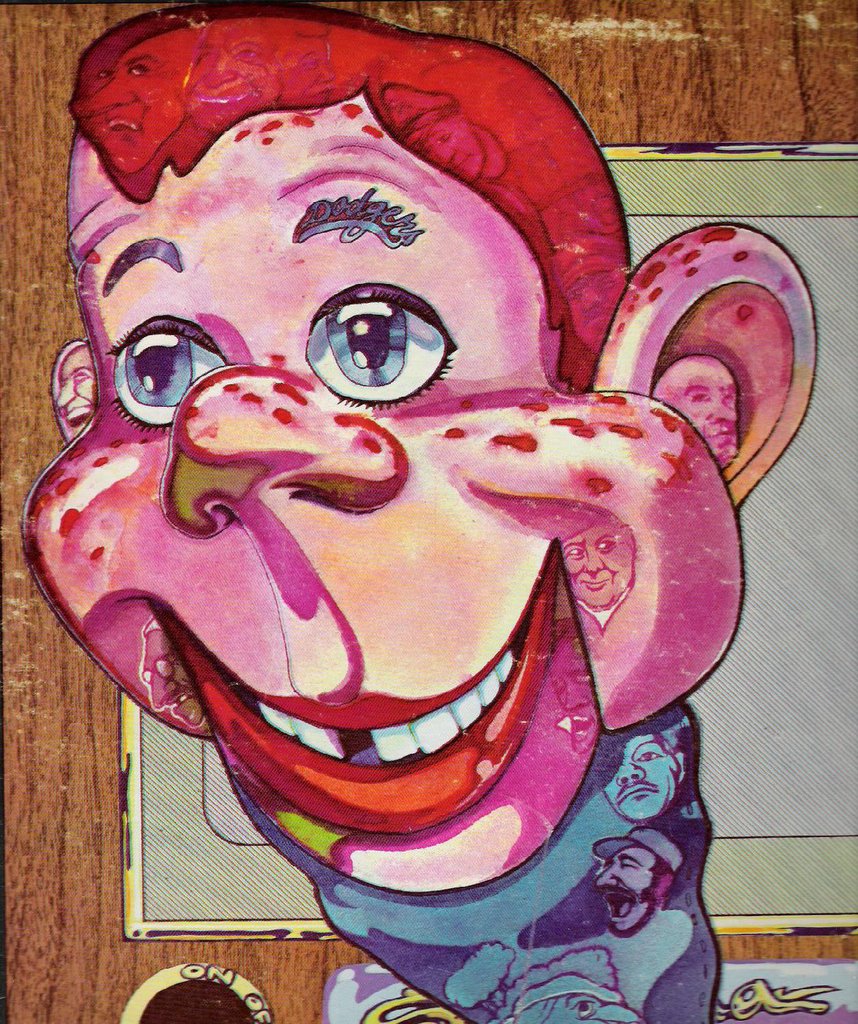
Howdy Doody Time


"The Howdy Doody Show was one of the first and easily the most popular children's television show in the 1950s and a reflection of the wonder, technical fascination, and business realities associated with early television. While Howdy and his friends entertained American children, they also sold television sets to American parents and demonstrated the potential of the new medium to advertisers.

The idea for Howdy Doody began on the NBC New York radio affiliate WEAF in 1947 with a program called The Triple B Ranch. The three Bs stood for Big Brother Bob Smith, who developed the country bumpkin voice of a ranch hand and greeted the radio audience with, "Oh, ho, ho, howdy doody." Martin Stone, Smith's agent, suggested putting Howdy on television and presented the idea to NBC televi-sion programming head Warren Wade. With Stone and Roger Muir as producers, Smith launched Puppet Playhouse on 17 December 1947. Within a week the name of the program was changed to The Howdy Doody Show."

A strange record on the the Leslee label from the 60's I would guess by the graphics. A weird mixture of newsreel from the 50's and 60's and cut between songs and segments of a puppet show for children! Not quite sure who it is aimed at. Certainly a curiosity and I uplaod both sides here for your bewilderment!


Howdy Doody Time - Side One

Howdy Doody Time - Side Two


These SendSpace files are available for seven days ot until exhausted.

Monday, April 28, 2008

George Melly's Bubbling Over Four


This tape was sent to me some years ago by persons unknown. It's a programme called Saturday Skiffle Club hosted by Brian Matthew and went out on BBC Light Programme , as it was then, on 23rd. November 1957. Others on the programme are Dick Bishop's Sidekicks and The City Ramblers.

"He was born in Liverpool and was educated at Stowe public school, where he discovered his interest in modern art, jazz and blues and started coming to terms with his sexuality. This period of his life is described in Scouse Mouse, a volume of his autobiography.
He joined the Royal Navy at the end of the Second World War because, as he quipped to the recruiting officer, the uniforms were 'so much nicer'. As he related in his autobiography, Rum, Bum and Concertina, he was crestfallen to discover that he would not be sent to a ship and was thus denied the "bell-bottom" uniform he desired. Instead he received desk duty and wore the other Navy uniform, described as "the dreaded fore-and-aft". Later, however, he did see ship duty. He never saw active combat, but was almost court-martialled for distributing anarchist literature."

Discover more about George Melly HERE.


Bubbling Over Four - Casey Jones/Kansas City

Bubbling Over Four - This Train/Sporting Life

Bubbling Over Four - I Want A Butter And Egg Man


These SendSpace files are available for seven days or until exhausted.

Max Bacon - Requested Re-Up


"Max was the larger-than-life drummer with the Ambrose Orchestra for many years, who also had a unique Jewish-style humour. Prior to joining Ambrose in late 1927, he had been with Leon van Straten's band in 1926 and also was briefly with Fred Elizalde's band (which seems to be made up of Ambrose musicians) and Al Starita's Kit-Cat band (probably a temporary substitute for Eric Little). He was a regular member of Ronnie Munro's band which recorded for Parlophone and Imperial from 1926 to 1929, and also with Arthur Lally's band at Decca in the early 1930s. His stint with Ambrose lasted until 1940 and his wry comments may be heard on a number of comedy titles, including the famous number "Cohen the Crooner (The Crosby of Mile-End)" which is extant on film. On leaving Ambrose, Max went into variety, and also acting, taking small parts in films and television shows."


Max Bacon - William T. Hell

Max Bacon - Little Red Hooding Ride

Max Bacon - Even A Crooner Must Eat


These SendSpace files are available for seven days or until exhausted.

Saturday, April 26, 2008

Golden Voices Of The Music Hall


An old early 60's compilation on the budget Ace Of Clubs label of music hall artistes from the 30's and 40's I imagine. Not much information on the sleeve.

Ella Shields.
"Ella Shields (September 27, 1879 – August 05, 1952[1]) was a music hall singer and male-impersonator. Her famous signature song, "Burlington Bertie from Bow", written by her manager and first husband, William Hargreaves, was an immediate hit that is still sung to this day. Though American-born, Ella achieved her greatest success in England."

Nellie Wallace
"Nellie Wallace was one of the most famous and best loved music hall performers and is one of the stars commemorated in the new Theatre of Variety at the Grand Theatre Blackpool. She was a 'grotesque', one of a genre that also included Lily Morris, who famously sang 'Why Am I Always the Bridesmaid?' These women made themselves look bizarre and illustrated their comic songs and patter with outlandishly grotesque dances that actually required great dancing skills. They were as loveable and appealing as they were extraordinary to look at and since the characters they portrayed were usually down on their luck, audiences took them to their hearts."


Ella Shields - Burlington Bertie

Ella Shields - The Army

Tom Leamore - Mick MacDonald

Tom Leamore - Percy From Pimlico

Nellie Wallace - The Blasted Oak

Nellie Wallace - Three Times A Day


These SendSpace files are available for seven days or until exhausted.