Thursday, August 18, 2011

Fela Kuti


Two short sides on an LP in the wrong sleeve I just discovered but has been in my collection for a long time. Fela seems to be going through a resurgeance now due to the West End stage show "Fela". Some typically danceable afrobeat here from 1970.

Wikipedia says -

"Fela was born Olufela Olusegun Oludotun Ransome-Kuti in Abeokuta, Ogun State, Nigeria into a middle-class family. His mother, Funmilayo Ransome-Kuti was a feminist activist in the anti-colonial movement and his father, Reverend Israel Oludotun Ransome-Kuti, a Protestant minister and school principal, was the first president of the Nigerian Union of Teachers. His brothers, Beko Ransome-Kuti and Olikoye Ransome-Kuti, both medical doctors, are well known in Nigeria. Fela was a first cousin to the Nigerian writer and Nobel laureate Wole Soyinka, the first African to win a Nobel Prize for Literature.

Fela was sent to London in 1958 to study medicine but decided to study music instead at the Trinity College of Music. While there, he formed the band Koola Lobitos, playing a fusion of jazz and highlife. In 1960, Fela married his first wife, Remilekun (Remi) Taylor, with whom he would have three children (Femi, Yeni, and Sola). In 1963, Fela moved back to Nigeria, re-formed Koola Lobitos and trained as a radio producer for the Nigerian Broadcasting Corporation. He played for some time with Victor Olaiya and his All Stars. In 1967, he went to Ghana to think up a new musical direction. That was when Kuti first called his music Afrobeat. In 1969, Fela took the band to the United States. While there, Fela discovered the Black Power movement through Sandra Smith (now Izsadore)—a partisan of the Black Panther Party—which would heavily influence his music and political views and renamed the band Nigeria '70. Soon, the Immigration and Naturalization Service was tipped off by a promoter that Fela and his band were in the U.S. without work permits. The band then performed a quick recording session in Los Angeles that would later be released as The '69 Los Angeles Sessions.

After Fela and his band returned to Nigeria, the band was renamed The Africa '70, as lyrical themes changed from love to social issues. He then formed the Kalakuta Republic, a commune, a recording studio, and a home for many connected to the band that he later declared independent from the Nigerian state. Fela set up a nightclub in the Empire Hotel, named the Afro-Spot and then the Afrika Shrine, where he performed regularly. Fela also changed his middle name to Anikulapo (meaning "he who carries death in his pouch"), stating that his original middle name of Ransome was a slave name. The recordings continued, and the music became more politically motivated.[citation needed] Fela's music became very popular among the Nigerian public and Africans in general. In fact, he made the decision to sing in Pidgin English so that his music could be enjoyed by individuals all over Africa, where the local languages spoken are very diverse and numerous. As popular as Fela's music had become in Nigeria and elsewhere, it was also very unpopular with the ruling government, and raids on the Kalakuta Republic were frequent."


Fela Kuti - Expensive Shit

Fela Kuti - Water Got No Enemy

Tuesday, August 16, 2011

City Quads


I uploaded the first side some months back so as a treat here's the second side. Its one I found at Brick Lane flea market many years ago for a few pence. Its on the Polydor label and made in what was Rhodesia and is now a troubled Zimbabwe. Sleeve printed in Germany. No date but imagine it would be late 50's or early 60's.

No info. on the internet so just a little information on the sleeve notes.

" Polydor presents a unique collection of popular African tunes sung ina variety of native languages by one of the best known vocal groups in Rhodesia, The City Quads. The performance you hear on this LP could be called a mixture of African folklore and pop songs of a kind one is always likely to hear wherever people gather together in an African township."

Tracks are as follows -

1. Abazali - The hero of this song has always been "sitting pretty". He was looked after well in childhood and received many presents, and now he is riding from the township to the city of Salisbury on top of the only double decker bus on the route.

2. Zonki Ntsuku - A rather anxious young man sings: "You know that I have always told you how I love you - and now I am worried about you".

3. Mbaravozi - A song of bad omens, of things Africans would not like to find - indeed, are not likely to find:
A monkey sitting in a fireplace.
A large tiger fish turning round and round dodging the fisherman until it looks like a small sardine.
Finding a fish where the kingfisher should be and a bird where the fish lives.

4. Wacitu Mozi - Among the many existing songs about the supernatural, we have chosen this one which describes how a woman destroyed a village by witchcraft and how she herself was later killed by her husband.

5. Ndafuna Funa - A lover's lament.
6. Mai Ndarira - When a African child is ill it always asks to be carried on it's mother's back rather than be put to bed.

7. Chipo - In this song the child is lost. "Where are you? Father and Mother are looking for you in the hills and dales, but you are nowhere to be found".


City Quads - Side Two

Sunday, August 14, 2011

G.H. Elliot


Another hissy 78 from the 20's or perhaps even earlier. This disc is a mini 78 - only 8 inches across. I have featured G.H. Elliot before and happy to do so again despite the rather politically uncorrect nick name he used.

Wikipedia says -

"G. H. Elliott (1882–1962) was a British music hall singer and dancer. He was born George Henry Elliott in Rochdale, Lancashire in 1882. Known as the "Chocolate Coloured Coon", he came on stage with a painted black face but dressed entirely in white. He had a white top hat, a white tail-coat which came down well below the knees, white gloves, white tie or cravat, white trousers, white shoes and a white cane.

He and his family emigrated to the United States when he was four. There he played juvenile parts on stage including the title role in Little Lord Fauntleroy. He was a member of the Primrose West Minstrels at the age of nine where he first blacked up.


The family returned to England in 1901 where he continued to perform on the music hall stage. After a number of years treading the boards he rose to top of the bill. He was influenced by Eugene Stratton who also used to black up and he sang some of Stratton’s songs particularly Lily of Laguna which he sang in tribute to his hero. Among the songs particularly associated with him are Idaho, I Used To Sigh For The Silvery Moon and Sue, Sue, Sue.

He appeared in two films Music Hall (1934) and Those Were the Days (1934 film) and in This is Your Life as Himself in 1957.

He appeared in two Royal Variety Performances, in 1925 and 1948. He made over 100 records, his first on a wax cylinder and his last in 1960.

He was married twice, first to Emily Hayes who died in 1940 and then to Florence May Street, known as June. She had been an acrobat in acts as various as the Martinez Troupe/Duo and Sereno (Harry Sereno) and June.

G. H. Elliott retired to Rottingdean, Brighton where he lived in a cottage he named Silvery Moon after his song I Used to Sigh for the Silvery Moon. He is buried in the churchyard of St Margaret's Church, Rottingdean[3] and his gravestone shows a stage with curtains drawn back. It bears the words: "The last curtain call for G H Elliott The Chocolate Coloured Coon who passed peacefully away 19 November 1962. Dearly loved R.I.P."


G.H.Elliot - So Long As The Sun Keeps Shining

G.H.Elliot - I'm Going Back Again To Old Nebraska

Flanagan & Allen


An old scratchy 78 from the boot sale today. I think I may have this already but couldn't find it on here so here it is in all it's hissy fizzy glory.

Wikipedia says -

"As music hall comedians, they would often feature a mixture of comedy and music in their act; this led to a successful recording career as a duo and roles in film and television. Just prior to and throughout the Second World War they appeared in several films helmed by Marcel Varnel and John Baxter. Flanagan and Allen were both also members of The Crazy Gang and worked with that team for many years concurrently with their double-act career.

Flanagan and Allen's songs featured the same, usually gentle, humour for which the duo were known in their live performances, and during the Second World War they reflected the experiences of ordinary people during wartime. Songs like 'We're Gonna Hang out the Washing on the Siegfried Line' mocked the German defences (Siegfried Line), while others like 'Miss You' sang of missing one's sweetheart during enforced absences. Other songs, such as their most famous, 'Underneath the Arches' (which Flanagan co-wrote with Reg Connelly), had universal themes such as friendship. The music was usually melodic, following a binary verse, verse chorus structure, with a small dance band or orchestra providing the accompaniment. The vocals were distinctive because while Flanagan was at least a competent singer and sang the melody lines, Allen used an almost spoken delivery to provide the harmonies.

The recordings of Flanagan and Allen remain popular, and the duo are frequently impersonated by professionals and amateurs. Royal Variety Performances often feature people 'doing a Flanagan and Allen', notably Roy Hudd and Christopher Timothy, Bernie Winters and Leslie Crowther. In 1980 the latter two featured in a one-off musical drama about the duo produced by ATV for the ITV network.

The later comedy team Morecambe and Wise, who often expressed their admiration for Flanagan and Allen, recorded a tribute album, Morecambe and Wise Sing Flanagan and Allen (Phillips 6382 095), in which they performed some of the earlier team's more popular songs in their own style, without attempting to imitate the originals. Fans of either comedy team may be slightly disappointed by this album, since all of the selections are performed absolutely straight, with no comedy except for a brief amount of banter after one of the songs. Run Rabbit Run was one of their best hits in World War Two."


Flanagan & Allen - F.D.R.Jones

Flanagan & Allen - If A Grey Haired Lady Says "How's Yer Father?"

Russ Henderson


A strange mixture of styles on this Allegro Lp from 1966 I bought today at a boot sale. Mostly generic calypso but padded out with steel band and west indian drums on a couple of instrumental tracks. Also some ska thrown in for good measure.

His website says -

"Russ Henderson was born in the Belmont Neighbourhood of Port of Spain, Trinidad, in 1924. By the 1940s he had formed his own band, the Russ Henderson Quartet. The group became well known and loved throughout the island, delighting dance halls and clubs with their rhythm and soul.

Russel came to England from his home town of Port of Spain in 1951 to study piano tuning at the North London Polytechnic in Holloway Road. An agent persuaded him to form another band after hearing him play the steel pan. So, Russ Henderson and his Trinidadian Steel Band was formed and a gloomy post-war Britain lit up to the sound of the Caribbean.

Russ Henderson receiving an MBE for Services to Music

Over the coming years, Russ set about embedding Caribbean music in the British culture. He taught school children how to play steel pan and lead his band into starting the Notting Hill Carnival. He toured the country with his band, playing on television shows, in films, in clubs, at Cambridge University balls and even at Prince Andrew's 21st birthday party at Windsor Castle. He was recently knighted as MBE by Prince Charles and now in his 80s, he is still a regular performer at the jazz connisseur's 606 Club in Lots Road, Chelsea."

Tracks are -

Side One.

1. Walking The Dog
2. Coconut Woman
3. Yellow Bird
4. Stone Cold Dead In De Market
5. Peanut Vendor

Side Two.

1. Sammy Dead Oh!
2. Non Ho L'eta Per Amarti
3. Marienne
4. Jamaica Farewell
5. West Indian Drums


Russ Henderson - Side One

Russ Henderson - Side Two

Saturday, August 13, 2011

Homer & Jethro


Another comedy country Lp from the charity shop the other day. I have featured Homer and Jethro before but happy to share this side which is a compilation of some of their best from the 50's and 60's on RCA.

Wikipedia says -


"Homer and Jethro were the stage names of American country music duo Henry D. Haynes (1920–1971) and Kenneth C. Burns (1920–1989), popular from the 1940s through the 1960s on radio and television for their satirical versions of popular songs. Known as the Thinking Man's Hillbillies, they received a Grammy in 1959 and are members of the Country Music Hall of Fame.


Haynes and Burns met in 1936 during a WNOX-AM audition in Knoxville, Tennessee when they were both 16 years old. Known as Junior and Dude (pronounced "dood'-ee"), the pair was rechristened Homer (Haynes) and Jethro (Burns) when WNOX Program Director Lowell Blanchard forgot their nicknames during a 1936 broadcast. In 1939 they became regulars on the Renfro Valley Barn Dance radio program in Dayton, Ohio.

They were drafted into the US Army during World War II but served separately; they reunited in Knoxville in 1945, and in 1947 they performed on WLW-AM's Midwestern Hayride in Cincinnati. They sang exaggerated hillbilly-styled versions of pop standards as their comedic hook, with Haynes on guitar and Burns on mandolin. They originally recorded for King Records, where they also worked as session musicians backing other artists until a dispute over song credits with label owner Syd Nathan led Nathan to release them from the label. The duo and other stars were fired by new management at WLW in 1948, and after a brief tour, they moved to Springfield, Missouri and performed on KWTO-AM with Chet Atkins, the Carter Family and Slim Wilson."


Tracks are as follows -

1. Daddy Played First Base
2. What Have You Done For Me Lately
3. Gone
4. Ballad Of Davey Crewcut
5. We Did'nt Make It Through The Night
6. Please Help Me I'm Crawling
7. Sink The Bismark


Homer & Jethro - Side One

Wednesday, August 10, 2011

The Tennors


More ska from 1969 on the Doctor Bird label.

Wikipedia says -

"The group was formed in Kingston in the mid-1960s by singer George "Clive" Murphy who formed a duo with Maurice "Professor" Johnson. They called themselves the Tennor Twins. They auditioned a song called "Pressure and Slide" in 1967 while sitting in the back of a taxicab for arranger Jackie Mittoo of Studio One. Murphy and Johnson were then joined by Norman Davis, and the trio recorded the song backed by Mittoo. This, their first single, was one of the major Jamaican hits for the year 1967,[1] but, according to Murphy, the group never received any royalties for the track.

Rather than continue to deal with Studio One record producer Coxsone Dodd, the Tennors formed their own label and grew its own stable of artists. The accidental death of Johnson reduced the trio back to a duo, and Murphy and Davis continued as songwriters. They offered their song, "Ride Yu Donkey", to many artists, but ended up recording it themselves after it was turned down. The song was released in 1968 and was a huge hit.

Other songs by the Tennors included "Cleopatra (I've Got to Get You Off My Mind)", "Grandpa", Massi Massa", "Girl You Hold Me" and "Rub Me Khaki", "Sufferer", "Sign of the Times", "Biff Baff" (aka "Traitor"), "Bow Legged Girl", "Little Things", "Cherry" and "Oh My Baby".

The group became a trio again with the addition of Ronnie Davis in 1968. Other singers who were in the Tennors included Nehemiah Davis, George Dekker, Howard Spencer, and Hilton Wilson. The trio backed singer Jackie Bernard on "Another Scorcher", and moved towards reggae with the song "Reggae Girl"."


The Tennors - Little Bit Of This

The Tennors - Shameface

The Abbey Tavern Singers


I had high hopes of this being more traditional Irish music than the rather lack lustre folk that we get here. The cover photo features a Uillean pipe player but no sign of it on the songs on side two at least.

"The story, as outlined by the ARC Records sleeve notes, stated that: "The Abbey Tavern Singers were formed in 1962 when Mrs. (Minnie) Scott-Lennon of the Abbey Tavern in Howth, Dublin decided that musicians and balladeers performing in a relaxed sing-along manner would be popular. Within a short time the newly formed Singers were drawing capacity crowds into the Howth establishment. In 1966 a solid Irish rouser "We're Off To Dublin In The Green" featuring the singers was released on TV as a beer commercial. This ad created by Carling Breweries Ltd. increased the group's popularity many times over and indeed in Canada listening to the Abbey Tavern Singers fast became the new national past-time. This song-come-jingle was then released on record by the Singers and became an international hit. Shortly thereafter the Abbey Tavern Singers toured North America and charmed the continent."


Abbey Tavern Singers - Side Two

Brinton Turkle


An EP I found (no sleeve ) in the Hospice shop today. I was intrigued by the name and the title. Turns out to be a rather dull story about a boy and his pet seagull.


"Brinton Turkle was born on August 15,1915 in Alliance, Ohio. He drew constantly in school. "Unfortunately, none of my school teachers appreciated it. If only one elementary school teacher had egged me on, I think I would have acquired art skills much earlier than I did." Turkle had an immense interest in the theatre, but the uncertainty of that life wasn't appealing. After a job in advertising in Chicago, he married and moved to Santa Fe, New Mexico, where he was able to indulge his theatrical interests. He had an ambition to write and illustrate three children's books so he could dedicate them to each of his three children. He was awarded a Caldecott Honor in 1970 for Thy Friend, Obadiah (Viking).

Turkle writes, "In writing, I use all sorts of tricks to capture the attention of my young audience: suspense, humor and even charm, when I can muster it. But no matter how successfully I may entertain, I am really up to something else: subversion. My abilities are implacably lined up against the hypocrisy, materialism and brutality that so pervade our society. As my readers leave childhood behind, I hope that they will carry with them an appreciation for such alternatives as integrity, mutual respect, kindness and reverence for life. These alternatives are in my books and I pray that exposure to them will play a part in the construction of a better tomorrow."


Brinton Turkle - Thy Friend Obadiah

Monday, August 08, 2011

The Techniques/ Tommy McCook


More scratchy ska from the archives. This time it's on the Treasure Isle label. Tommy McCook and the Supersonics play on both but the "A" side is sung by The Techniques.

Wikipedia says -

"The group was formed by Winston Riley in 1962 while still at school, with the initial line-up also featuring Slim Smith, Franklyn White, and Frederick Waite. They regularly performed at Edward Seaga's Chocomo Lawn club, where they were spotted by talent scouts from Columbia Records, who released their first single, "No One", released only in the United Kingdom in 1963. Their Jamaican debut came in 1965 when they were introduced to producer Duke Reid by singer Stranger Cole, with Reid-produced singles such as "Don't Leave Me", "When You Are Wrong", "and "Little Did You Know" appearing on labels such as Island Records, and Reid's own Duke and Treasure Isle labels. Smith left the group in 1966, to pursue a solo career at Studio One, and later forming The Uniques with White. He was replaced by Pat Kelly. The shift from ska to rocksteady suited The Techniques, with a string of hits in 1967 and 1968 following, including "You Don't Care", "Queen Majesty", "I Wish It Would Rain", "It's You I Love", and "Love Is Not a Gamble".

The group left Treasure Isle in 1968, with Riley setting up his own 'Techniques' record label, releasing further sides by the group and also his productions of other artists. The group's line up changed regularly with Riley the only constant member. Other members in the late 1960s included Lloyd Parks, Bruce Ruffin, and Dave Barker. Kelly returned for a time, recording lead vocals on "What Am I To Do?"."


The Techniques - You Don't Care

Tommy McCook - Down On Bond Street

Rupie Edwards/The Mediators


Another rather scratched and battered ska single from the 60's, this time on the Success label distributed by Pama Records. I think the labels are on the wrong way round as the instrumental track says it features Rupie Edwards who is a singer.

Wikipedia says -

"Rupie Edwards, an only child, moved to Kingston in 1958, where he set up his first band while still at school. His first recording was "Guilty Convict" b/w "Just Because", for L.S. 'Little Wonder' Smith in 1962, released on Melodisc's Blue Beat label in the UK, and was paid £15 for the session. After recording a few singles, he became involved with the Virtues and, from 1968, started to focus only on his own productions.

By the beginning of the 1970s, apart from releasing singles as a singer, he had recorded artists like The Heptones, Bob Andy, Johnny Clarke, Joe Higgs, Gregory Isaacs and The Ethiopians on his own record labels 'Success' and 'Opportunity'. He also worked with DJs such as U-Roy and I-Roy, and released some instrumental versions with his studio band, The Rupie Edwards All Stars. The group included musicians such as saxophonist Tommy McCook, trombone player Vin Gordon, drummer Carlton 'Santa' Davis, guitarist Hux Brown, pianist Gladstone Anderson, bassist Clifton 'Jackie' Jackson and organist Winston Wright."


Rupie Edwards - Look Who A Bust Style

The Mediators - Look Who A Bust Style

Reggae Boys/Upsetters


Another single from the dusty ska and reggae box. This time on the Punch label from Pama Records in London. Produced by Lee Perry? Late 60's again I imagine. Not sure which is the "A" side- not that it matters. Both are good.

Wikipedia says -

"Perry's musical career began in the late 1950s as a record seller for Clement Coxsone Dodd's sound system. As his sometimes turbulent relationship with Dodd developed, he found himself performing a variety of important tasks at Dodd's Studio One hit factory, going on to record nearly thirty songs for the label. Disagreements between the pair due to personality and financial conflicts, a recurring theme throughout Perry's career, led him to leave the studio and seek new musical outlets. He soon found a new home at Joe Gibbs's Amalgamated Records.

Working with Gibbs, Perry continued his recording career but, once again, financial problems caused conflict. Perry broke ranks with Gibbs and formed his own label, Upsetter, in 1968. His first single "People Funny Boy", which was an insult directed at Gibbs, sold well with 60,000 copies sold in Jamaica alone. It is notable for its innovative use of a sample (a crying baby) as well as a fast, chugging beat that would soon become identifiable as "reggae" (the new kind of sound which was given the name "Steppers"). From 1968 until 1972 he worked with his studio band The Upsetters. During the 1970s, Perry released numerous recordings on a variety of record labels that he controlled, and many of his songs were popular in both Jamaica and the UK. He soon became known for his innovative production techniques as well as his eccentric character.

In the early 1970s, Perry was one of the producers whose mixing board experiments resulted in the creation of dub. In 1973, Perry built a studio in his back yard, The Black Ark, to have more control over his productions and continued to produce notable musicians such as Bob Marley & the Wailers, Junior Byles, Junior Murvin, The Heptones, The Congos and Max Romeo. With his own studio at his disposal, Perry's productions became more lavish, as the energetic producer was able to spend as much time as he wanted on the music he produced. Virtually everything Perry recorded in The Black Ark was done using basic recording equipment; through sonic sleight-of-hand, Perry made it sound unique. Perry remained behind the mixing desk for many years, producing songs and albums that stand out as a high point in reggae history."


Reggae Boys - Selassie

The Upsetters - Dry Acid

Sunday, August 07, 2011

Marcia Griffiths/Soul Brothers


Another ska single from the archives On the Rio label from the late 60's. The "A" side has a vocal by Marcia Griffiths and the "B" is an instrumental by the Soul Bros.

" The Soul Brothers bridged the gap between Ska and the arrival of Rocksteady mixing it all up with Funk, Jazz and Latin styles. The Soul Brothers recorded at Studio One between 1965-1967. This was the transitionary period between Ska and Rocksteady where the music was a mixture of Funk, Latin and Jazz sometimes with a reminder of Ska and the hint of Rocksteady. The previous era of Ska had been dominated by the Skatalites."

Read more about Marcia Griffiths HERE.


Marcia Griffiths - Mr. Everything

Sould Bros. - T.N.T.

Johnny & The Attractions


Not much gleaned on the interweb about this one although some say it's lead voval is by someone called Dudly Williamson of whom I know nothing. Pleasant enough ska/rock steady song. Also issued on Trojan I believe at some point. Originally released in 1968.


Johnny & The Attractions - Coming On The Scene

Johnny & The Attractions - Anything You Want

Wednesday, August 03, 2011

Jubelkvartetten


Another Nowegian buy from a junk shop in Hamar. Mostly religious songs one suspects from the other records in the pile. This LP is on the Hemmets Harold label and features a motely crew who play instruments ranging from accordion to trumpet.
I suspect a search on the internet will prove as fruitless as the others but any knowledge of this and previous postings much appreciated.


Tracks are as follows -

1. Var Glad Och Sjung
2. Snart Kommer Solen Ater
3. Hem O Hem
4. Hans Namn Ar "Underbar"
5. Men Vid hemmets Dorr
6. Ja, Han Gar Med


Jubelkvartetten - Side One

Schytts Jigs Sawes


Another of my Norwegian vinyl purchases which turned out to be Swedish but attracted by amusing sleeve and title and the price of just one krona.
One the Mariann label and released in 1975 and features songs from 1962 to 1974 that were big hits on Scandinavia I presume? Some covers here which stand out especially Bonnie B and maudlin rendition of Danny Boy.

Tracks are -

1. Kors I Josse Namn
2. En Spannande Dag For Josefine
3. Bonnie B
4. Nagonting Har Hant
5. Nina Fina Ballerina
6. Danny Boy
7. Upp Och Ner
8. Lika Bla Som Nina Ogon


Schytts Jigs Sawes - Side One

Norske Favoritter


We went to Norway recently for a few days and I managed to buy some vinyl in various junk shops and markets. Hoping for amusing home grown Norwegian music but managed to buy two Swedish records by mistake much to the amusement of our hosts. Well, it is hard to tell them apart at first glance!
Anyway, this first record is actually Norwegian and a selection of songs that graced the Norwegian charts in the 60's I would guess. Nothing much special here but do listen to the last track by Arne Bendiksen which features some horrific yodelling!

Wikipedia says of Arne Bendiksen -

"Arne Joachim Bendiksen, born 19 October 1926 in Bergen, Norway, died 26 March 2009, was a Norwegian singer, composer and producer, described as "the father of pop music" in Norway.

In the 50s, 60s and 70s, he was a major figure in Norwegian popular music. First, as a member of the group The Monn Keys, later as soloist and composer for other artists. Besides writing his own songs, he also translated many foreign hits into Norwegian, making them Norwegian hits. Arne Bendiksen took part in the Norwegian Eurovision Song Contest selections several times, both as an artist and as a songwriter. Three times he represented Norway in Eurovision as singer; in 1964 (Eurovision Song Contest 1964) with Spiral as soloist, in 1973 (Eurovision Song Contest 1973) with Ã…, for et spill and in 1974 (Eurovision Song Contest 1974) with Hvor er du?. Four times he took part as composer, most memorable as songwriter for Ã…se Kleveland's Intet er nytt under solenin 1966 (Eurovision Song Contest), finishing a strong third.

Beginning in 1964 he was the boss of his own record company. Thanks to him, popular artists like Wenche Myhre and Kirsti Sparboe reached fame. However, in the Eurovision Song Contest finals of 1969, Norway received a mere 1 point for the song Oj, oj, oj, så glad jeg skal bli, which was composed by Arne Bendiksen and performed by Kirsti Sparboe.

Arne did not let this crush his spirits though, and he continued his dedicated work as a singer/songwriter throughout the 70s. In the 80s, he gave a shot at the popular children's cassette industry and released his major children's work Barnefest i Andeby - Children's party in Duckburg - a cassette filled with catchy songs about the various Disney characters inhabiting the fictional city of Duckburg. This popular cassette got a sequel, released especially for the Christmas season, called Jul i Andeby - Christmas in Duckburg.

In June 2006, his all-new self-composed children's musical stage debuted in the small elementary school Fjellstrand Skole in Nesodden, Akershus.

Arne Bendiksen died on 26 March 2009, after having been sick for a short period of time. The cause of death was heart failure."


Tracks are as follows -

1, En Student Fra Uppsala - Kirsti Sparboe
2. Ruby - Benny Borg
3. Ved Horisontens Rand - Finn Eriksen
4. Arizona - Lillian Askeland
5. Friarvise Fra Aust-Agder
6. Med Tuba Og Tyrolerhatt - Arne Bendiksen


Norske Favoritter - Side One

Songs For A Singin' Party


At first glance one would think from the sleeve that Jack Jackson would be singing or DJ'ing on this Heinz promotional EP from the 60's but he's just on the sleeve to endorse the record which is a pretty MOR come trad jazz with cringey vocal group who sound a bit like the Mike Sammes Singers. The trombonist sounds a bit like George Chisholm? I will try and glean more on the internet but don't hold out much hope.

Wikipedia says of Jack Jackson -

"He was born in Barnsley, the son of a brass band player and conductor, and began playing cornet at the age of 11 before playing violin and cello in dance bands.He learnt to play trumpet and worked in swing bands in circuses, revues, ballrooms and ocean liners before joining Jack Hylton's band in 1927. He left Hylton in 1929, freelanced for a while, and then joined Jack Payne's band in 1931. He left Payne to form his own band in 1933. By 1939, the band was resident at the Dorchester Hotel in London, and had a regular radio show on Radio Luxembourg.

After the war he decided not to reform his band, and turned to compering on the BBC Light Programme in such shows as "Record Roundabout", which ran from 1948 to 1977. His methods of presentation included punctuating records with surreal comedy clips, and using quick cutting of pre-recorded tapes to humorous effect. This was a major influence on later British DJs such as Kenny Everett and Noel Edmonds. He also had a chat show on TV in 1955.

He emigrated to Tenerife in 1962, sending his taped programmes by air to the BBC each week. Suffering from a bronchial illness, he returned to England to live in 1973, and died at Rickmansworth in 1978.

He is remembered as a member of the UK Radio Academy's Hall of Fame."


Songs For Aingin' Party - Side One

Latin Percussion


An LP found in a charity shop the other day on the KOKO label from the 60's I would guess. Attracted by the sleeve art which really is the best thing about it. The music being fairly mild exotica and not in the same league as Arthur Lyman etc. Seems designed mainly to test your new Hi-Fi system.

Tracks are -

1. Brazil
2, Taboo
3. La Machida
4. The Breeze and I
5. Malaguena
6. Mama Inez


Latin Percussion - Side One

Sunday, July 17, 2011

Percussion Demonstration Record


A boot sale find from a couple of years ago. This 10' LP on the Nixa label is from the early 60's I would guess by the artwork. This curios record of five tracks was "Conducted, Arranged and Composed by Jimmy Carroll". The sleeve notes tell us that Carroll", a top man in his profession, noted for his arrangements and versatilty" had been bitten by the "Something different" bug.Carroll was more renowned for his lush string arrangements for people like Rosemary Clooney and Marlene Dietrich. Here he tries something very different to demontstrate the new advances in high fidelity sound and comes up with something akin to the Exotica of Martin Denny and Les Baxter etc. Shame this record is so worn that these delights are rather lost under the pops and crackles! "Only nine musicians take part in this session. They each used several music stands. "operated" several instruments and displayed a light-footed sprinting ability uncommon among professional musicians."

Tracks are as follows -

1. Hong Kong Local
2. Drummer's Parade
3. Happy Little Woodpile


Jimmy Carroll - Side Two

George Jones


A 10' album on the Ace label of some of George Jones rockabilly recordings before he moved over into the country and western side of things.I must admit I prefer George sounding like this.

"George Glenn Jones (born September 12, 1931), nicknamed The Possum, is an American country singer known for his distinctive voice and phrasing that frequently evoke the raw emotions caused by grief, unhappy love, and emotional hardship. He has had more individual songs than any other singer on the country charts, 167 as of November, 2005, but, according to a formula derived by Joel Whitburn, is second to Eddy Arnold in his overall ranking for hits and their time on the charts. He has also had the most Top 40 Hits, 143, and is second to Arnold with the most Top 10 Hits, 78. Since at least the early 1980s he has frequently been referred to as "the greatest living country singer." Almost as often he is called "the Rolls-Royce of country singers." Frank Sinatra once called him "the second best white male singer." And as the scholar Bill C. Malone writes, "For the two or three minutes consumed by a song, Jones immerses himself so completely in its lyrics, and in the mood it conveys, that the listener can scarely avoid becoming similarly involved."[1]
Jones was born with a broken arm in Saratoga, Texas and grew up in the settlements north of Beaumont around the Big Thicket. By age 24, he had been married twice, served in the Marines, and developed his skills as a country musician and singer. After Elvis Presley's success Jones half-heartedly took a stab at rock and roll in hopes of getting noticed but returned to country almost immediately (In his autobiography Jones claims that when he encountered these rock and roll records years later he would use them as frisbees). "Why Baby Why" was his first top-five hit in 1955."

Discover more about George Jones HERE.

Tracks on side one are -

1. White Lightning
2. Rock It
3. Taggin' Along
4. What Am I Worth
5. Revenooer Man


George Jones - Side One

Wednesday, July 13, 2011

Joe Bussard


Joe Bussard is on the left in this photo.

A tape from my collection that goes back a few years. Not sure if Joe sent this to me or I obtained it from a third party. Anyway, it's a very entertaining cassette with Joe telling us about his life as a record collector - mostly old 78's he bought from hillbillies and farmers up in the mountains of Kentucky and rural places - mostly fiddle music and old timey stuff he managed to track down. Nice yarns he spins about his meetings with folk and how he came to buy the records.

I can't find out much about him on the internet - just this snippet-

"Joe Buzzard(sic), another 78 fanatic, has put out his own set called 'Down In The Basement' as well as making his records available to Steven Lance Ledbetter - also an extensive collector – who formed the Dust To Digital label for the purpose of making some of those old recordings available in the best possible sound quality. His crowning achievement is a six-disc box set – literally a cedar wood box, complete with substantial book – of sacred music recorded between 1909 and 1960 called 'Goodbye, Babylon' released in 2003. It takes from both the black and white tradition and it rivals Harry Smith's 'Anthology of American Folk Music' in stature."


Joe Bussard - Side One

Charlie Gillett - Kevin Rowland


Another cassette of a Charlie Gillett radio show from the 80's featuring Dexy's Midnight Runners front man Kevin Rowland choosing some of his favourite records which include songs by Marvin Gaye, Curtis Mayfield etc.

Wikipedia says -

"Rowland was born in Wolverhampton, England on 17 August 1953 to Irish parents. His first group, Lucy & The Lovers, were influenced by Roxy Music and turned out to be short-lived. His next project, punk rock act The Killjoys, were slightly more successful, releasing the single "Johnny Won't Go To Heaven" in 1977. Alienated by the punk scene, Rowland, together with Killjoys guitarist, Kevin Archer, decided to form a new soul-influenced group, Dexys Midnight Runners. Many of the group's songs were inspired by Rowland's Irish ancestry and were recognisable through Rowland's idiosyncratic vocal style. On forming the band Rowland thought it was "important to have a vocal style", he later recalled, "and I had the idea of putting that 'crying' voice on", partly inspired by General Johnson of Chairmen of the Board.
When Dexys disbanded in 1987, Rowland recorded a solo album, The Wanderer which, together with its three singles, was a commercial failure. His next release was not until 1999 when he recorded a collection of interpretations of classic songs called My Beauty, the album cover of which depicted a heavily made-up Rowland in a dress and women's lingerie.
In 2003, Rowland reformed Dexys Midnight Runners - featuring only one other original member, bassist Pete Williams who fulfilled the role as Rowland's co-vocalist - and embarked on a successful comeback tour backed up with a greatest hits compilation album including two newly recorded songs, "Manhood" and "My Life in England". Both of these new songs were radio tested by the record label, but neither received enough airplay for them to be considered worthwhile releasing.
In December 2006, Rowland launched his own MySpace page where he has promised another Dexys album, and posted some articles to his blog. The song, "It's OK Johanna", is available there. He also appeared as a DJ at the 2007 Big Chill festival."


Charlie Gillett - Kevin Rowland Side One


Charlie Gillett - Kevin Rowland Side Two

Tuesday, July 12, 2011

Show And Tell


A curious EP on the Mono Gram label via Pickwick International back in the 60's . One assumes you bought the combined record player TV/slide show thingy and then bought the records which include a plastic strip with tiny transparencies embedded into it to play on your machine. One side is the story of How The Whale Got It's Throat - part of the Just-So stories by Rudyard Kipling and the other side is an excerpt from Saint Saens "Carnival Of The Animals".

Wikipedia says -

"The Show 'n Tell was a toy combination record player and filmstrip viewer manufactured by General Electric from the 1950s to the 1970s.
It resembled a television set, but had a record player on the top. Records and slides were sold for it in combination. The slide strip, which was a flat plastic key 8 inches long containing a strip of 16mm color film, was inserted into the top of the device. As the record played (typically telling a story), the slide strip, through which the images were projected on the screen, would automatically advance to illustrate it. The mechanism by which the slide advanced was purely mechanical, and was based on the rotation of the turntable, so proper operation required manually spinning it a few revolutions before beginning the presentation.
It also functioned as a standard record player, able to play 16, 33⅓, 45, and 78 RPM records through its built-in speaker.
The Show 'n Tell was also sold as the Show 'n Tell Phono-Viewer by CBS Toys, in the early 1980s, under the brand name "Child Guidance." These devices, which were drastically redesigned from their earlier version, only had two speeds (33⅓ and 45), and could not play full 12" LPs. However, the Phono-Viewer could optionally move the projected image off the built-in screen and onto an outside surface (such as a wall or screen).
Licensed film strip and record packages were produced for many different children's properties, including Disney and Sesame Street."


Show & Tell - How The Whale Got His Throat

Monday, July 04, 2011

Spike Jones


Another Jones now on the World Record Club label from the 60's of tracks recorded in the 40's and 50's. "Spike Jones and the band that plays for fun" is just that - great wacky versions of old classics like I Kiss Your Hand Madame, Hut Sut Song and River Stay Away From My Door to name but a few.

Wikipedia says -

"Jones' father was a Southern Pacific railroad agent. Young Lindley got his nickname by being so thin that he was compared to a railroad spike. At the age of 11 he got his first set of drums. As a teenager he played in bands that he formed himself. A railroad restaurant chef taught him how to use pots and pans, forks, knives and spoons as musical instruments. He frequently played in theater pit orchestras. In the 1930s he joined the Victor Young orchestra and thereby got many offers to appear on radio shows, including Al Jolson's Lifebuoy Program, Burns and Allen, and Bing Crosby's Kraft Music Hall.

From 1937 to 1942, he was the percussionist for the John Scott Trotter Orchestra, which played on Bing Crosby's first recording of White Christmas. Spike Jones was part of a backing band for songwriter Cindy Walker during her early recording career with Decca Records and Standard Transcriptions. Her song "We're Gonna Stomp Them City Slickers Down" provided the inspiration for the name of Jones’ future band, the City Slickers.

The City Slickers evolved out of the Feather Merchants, a band led by vocalist-clarinetist Del Porter, who took a back seat to Jones during the embryonic years of the group. They made experimental records for the Cinematone Corporation and performed publicly in Los Angeles, gaining a small following. The original members included vocalist-violinist Carl Grayson, banjoist Perry Botkin, trombonist King Jackson and pianist Stan Wrightsman.

The band signed a recording contract with RCA Victor in 1941 and recorded extensively for the company until 1955. They also starred in various radio programs (1945–1949) and television shows (1954–1961) on both NBC and CBS."


Tracks are -

1. Mairzy Doats
2. The 20's Roar (Medley)
3. Melody Of Love
4. Three Little Fishes
5. Kookie Kookie Lend Me Your Comb


Spike Jones - Side One

Pete "Natural" Jones


An EP on the cheapo Gala label fromthe 60's I would imagine. Pete "Natural" Jones probably just a session musician hired to do this Fats Waller homage. I could not find anything on the internet about him other than their seems to be an LP featuring the same tunes with a few more - all instrumentals. Please excuse the big crack that goes right through it I discovered after purchase. I really must take my glasses out with me when I go record hunting!


Pete "Natural" Jones - Ain't Misbehavin'/ Twelfth Street Rag

Tuesday, June 28, 2011

Morecambe & Wise


The final one from this comedy set bought at the weekend. An early Lp by Morecambe & Wise from 1964 on the cheapo Music For Pleasure label.

Wikipedia says of their early days -

"Morecambe and Wise's partnership began in 1941 when they were each booked separately to appear in Jack Hylton's revue, Youth Takes a Bow at the Nottingham Empire Theatre. War service broke up the act but they reunited by chance at the Swansea Empire Theatre in 1946 when they joined forces again. They made their name in variety, appearing in a variety circus, the Windmill Theatre, the Glasgow Empire and many venues around Britain. After this they also made their name in radio, transferring to television in 1954. Their show, Running Wild, was not well received and led to a damning newspaper review: "Definition of the week: TV set – the box in which they buried Morecambe and Wise." Eric apparently carried this review around with him ever after and from then on Eric and Ernie kept a tight control over their material. In 1956 they were offered a spot in the Winifred Atwell show with material written by Johnny Speight and this was a success.

They had a series of shows that spanned over twenty years, during which time they developed and honed their act, most notably with the original move to the BBC in 1968, where they were to be teamed with their long-term writer Eddie Braben and it is this period of their careers that is widely regarded as their "glory days"."


Tracks are as follows -

1. Not Now later
2. Indians
3. Singing The Blues ( guitar - Ike Issacs )
4. Ton Up Boy (girl - Penny Morrell )
5. Why Did I Let You Go
6. Impressions
7. Grieg Piano Concerto

Orchestras directed by Ken Thorne and Harry Robinson with the Mike Sammes Singers.


Morecambe & Wise - Side One

Burl Ives


Another from the weekend haul. I have fond memories of Burl Ives on Childrens Favourites on the radio and many of the songs he sang on on this compilation on the MCA Coral label.

Wikipedia says of his early life -

"Ives was born in 1909 near Hunt City, an unincorporated town in Jasper County, Illinois, the son of Levi "Frank" Ives (1880–1947) and Cordelia "Dellie" White (1882–1954). He had six siblings: Audry, Artie, Clarence, Argola, Lillburn, and Norma. His father was at first a farmer and then a contractor for the county and others. One day Ives was singing in the garden with his mother, and his uncle overheard them. He invited his nephew to sing at the old soldiers' reunion in Hunt City. The boy performed a rendition of the folk ballad "Barbara Allen" and impressed both his uncle and the audience.

Ives had a long-standing relationship with the Boy Scouts of America. He was a Lone Scout before that group merged with the Boy Scouts of America in 1924. The collection of his papers at the New York Library for the Performing Arts includes a photograph of Ives being "inducted" into the Boy Scouts in 1966. Ives received the organization's Silver Buffalo Award, its highest honor. The certificate for the award is hanging on the wall of the Scouting Museum in Valley Forge, Pennsylvania. Ives often performed at the quadrennial Boy Scouts of America jamboree, including the 1981 jamboree at Fort A.P. Hill in Virginia, where he shared the stage with the Oak Ridge Boys. There is a 1977 sound recording of Ives being interviewed by Boy Scouts at the National Jamboree at Moraine State Park, Pennsylvania; on this tape he also sings and talks about Scouting, teaching, etc. Ives is also the narrator of a 28-minute film about the 1977 National Jamboree. In the film, which was produced by the Boy Scouts of America, Ives "shows the many ways in which Scouting provides opportunities for young people to develop character and expand their horizons."

From 1927-29, Ives attended Eastern Illinois State Teachers College (now Eastern Illinois University) in Charleston, Illinois, where he played football. During his junior year, he was sitting in English class, listening to a lecture on Beowulf, when he suddenly realized he was wasting his time. As he walked out the door, the professor made a snide remark, and Ives slammed the door behind him. Sixty years later, the school named a building after its most famous dropout. Ives was also involved in Freemasonry from 1927 onward.

On July 23, 1929 in Richmond, Indiana, Ives did a trial recording of "Behind the Clouds" for the Starr Piano Company's Gennett label, but the recording was rejected and destroyed a few weeks later."

Tracks are as follows -

1. I Know An Old Lady
2. Molly Malone
3. Horace The Horse
4. The Whistling Rabbit
5. Polly Wolly Doodle
6. Big Rock Candy Mountain/Aunt Rhody/The Fox
7. Ballad Of Davy Crockett
8. What Kind Of Animal Are You?


Burl Ives - Side One

Monday, June 27, 2011

The Singing Postman


Another great find at the boot sale this week was this LP from 1966 on the Parlophone label by Allan Smethurst - The Singing Postman. His one big hit "Hev Yew Gotta Loight Boy?" is included on this curious selection of modern day folk songs sung with a Norfolk accent.

"As the Singing Postman, Allan Smethurst benefited from the British public’s endearing sympathy for the underdog. His most popular hit, Hev Yew Gotta Loight, Boy?, momentarily outsold the Beatles — in East Anglia, at least — and for a few weeks became a national catchphrase. But like many novelty stars before and since, his 15 minutes of fame was little more than that, and after four albums he faded from the public consciousness ending his days as an alcoholic in the care of the Salvation Army.
Smethurst, a postman from Norfolk who hummed his tunes on his daily round, bought his guitar from Woolworths in 1949 and started writing and playing his own dialect songs, initially confining his activities to his bedroom. “It was ten years afore I dare let people hear them,” he once admitted. Plucking up the courage to send a tape to the BBC in Norwich, he was given a spot on a local radio show compered by a sales promotion man, Ralph Tuck, who promptly founded a record label called The Smallest Recording Organisation in the World to promote the Singing Postman. The 100 discs which Tuck had cut in the early weeks of 1966 promptly sold out and Smethurst became an overnight star, ousting the Beatles from the top of the East Anglian hit parade."

It was sadly downhill from then on. He took up drink to try and cure his crippling stage fright but obviously he was destined to be a "one hit wonder" and the music biz moved on to the next novelty act.

Tracks are -

1. January Sales
2. Suffin Cold
3. Spring Cleaning
4. Wass The Bottum Dropped Owt?
5. Hev Yew Gotta Loight, Boy?
6. The Cricket Match


The Singing Postman - Side One

Clinton Ford


An Lp on the cheapo Marble Arch label from 1968 I found at the boot sale the other day for 50p. I have a couple of other Lp's by Clinton Ford and all the songs are from the music hall or written in that comedic style. Clinton is accompanied by George Chisholm (trombone) and the Inmates.

Clinton Ford, whose real name was George Harrison strangely enough was born in 1931 in Salford near Manchester in the North West of England.
"Clinton will now be best remembered for his novelty song, "Fanlight Fanny"- a recording he made while he was with Oriole, a minor label which had association with the Woolworth's budget record brand, 'Embassy'. In fact Clinton Ford was one of Oriole's most successful artists for a while, and "Fanlight Fanny" looked like Clinton's break into the big time. Sadly, it never quite happened.

Like many other artists of the time, Clinton had first excercised his entertainment ambitions by becoming a 'redcoat' at Butlins. Although his own leanings were towards country and western material, he began singing with traditional jazz bands and skiffle groups. This appears to have influenced his style somewhat and much of his best work was done in the company of trad groups like the Merseysippi Jazz Band and George Chisholm for example. Clinton's choice of recorded material was certainly diverse- with everything from the country flavoured sentimental 'Old Shep' and his confident interpretation of 'Run To The Door' through the most outrageous novelties like 'The Old Bazaar In Cairo' and even George Formby's 'Why Don't Women Like Me'."

Tracks are -

1. My Baby's Wild About My Old Trombone
2. The Old Bazaar In Cairo
3. He Played His Ukulele As The Ship Went Down
4. The Pig Got Up And Slowly Walked Away
5. The Night I Appeared As Macbeth
6. The Biggest Balalaika In The World


Clinton Ford - Side One

Wednesday, June 22, 2011

Little Marcy


Not a great deal from the boot sales lately but did find this curiosity today for a few pence. Little Marcy is a ventriloquists doll and well known amongst collectors of strange records. It's on the Word World Wonder Series label out of Waco Texas. It has a price tag of 1:98 dollars on the sleeve depicting Marcy and her animal friends.
It was released in 1968.

"Marcy Tigner, her puppet Little Marcy, and her unusual "child-like" singing voice, found her art, her niche, in the only venue available to so many like her - Christian childrens' music. Over three decades her unusual act has been fascinating, inspiring, sometimes repelling audiences from all over, depending on one's beliefs and point of view. Even today, when her music is often categorised as 'bad' or 'disturbing,' people find confirmation of their faith in it - and in fact, it stands head and shoulders above most of the other work in the genre thanks to top-notch production values.


Her albums have been released and re-released under various labels and at various prices, as was (and probably still is) typical for the genre. What we have here is an attempt - likely foredoomed to failure - to list every "Little Marcy" album and related release ever, along with whatever other data we can glean from thrift store record purchases and random bits of research."


Little Marcy - Side Two

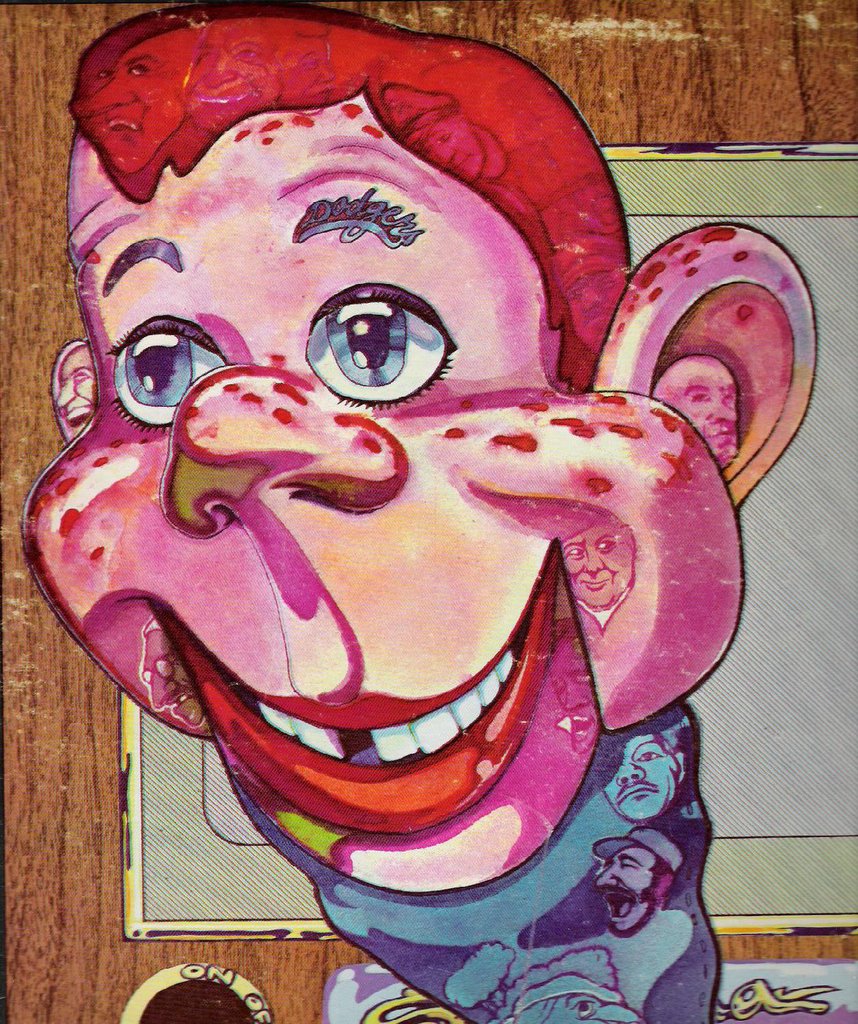
Howdy Doody Time


"The Howdy Doody Show was one of the first and easily the most popular children's television show in the 1950s and a reflection of the wonder, technical fascination, and business realities associated with early television. While Howdy and his friends entertained American children, they also sold television sets to American parents and demonstrated the potential of the new medium to advertisers.

The idea for Howdy Doody began on the NBC New York radio affiliate WEAF in 1947 with a program called The Triple B Ranch. The three Bs stood for Big Brother Bob Smith, who developed the country bumpkin voice of a ranch hand and greeted the radio audience with, "Oh, ho, ho, howdy doody." Martin Stone, Smith's agent, suggested putting Howdy on television and presented the idea to NBC televi-sion programming head Warren Wade. With Stone and Roger Muir as producers, Smith launched Puppet Playhouse on 17 December 1947. Within a week the name of the program was changed to The Howdy Doody Show."

A strange record on the the Leslee label from the 60's I would guess by the graphics. A weird mixture of newsreel from the 50's and 60's and cut between songs and segments of a puppet show for children! Not quite sure who it is aimed at. Certainly a curiosity and I uplaod side two here for your bewilderment!


Howdy Doody - Side Two

Tuesday, June 14, 2011

American Top Pops


Curious Ep on the cheapo Gala label from the 60's - versions of pop hits of the time. The Lonely One sounds like it might have been by Duanne Eddy originally. The Coasters did the original of Charlie Brown ofcourse. Not sure about the other two. Anyone have any ideas?

The main reason I bought it from the boot sale in the first place though was the great sleeve photo of a woman with her hand up the horn of an old gramophone!


Richard Deane - The Lonely One

The Promineers - Charlie Brown

Bob Mitchell - I Got A Wife

Bobby Green - I Cried A Tear

Wednesday, June 08, 2011

Ian Dury


A radio show from 1978 on BBC Radio One. I think it was called "Star Choice" - where pop celebrities of the day played DJ for two hours and raided the BBC Archives. It was Ian Dury's turn and a wonderful eclectic mix it was too -including Max Miller , Roland Kirk, Kay Starr and Albert Ayler to name but a few.

Wikipedia says -

"Dury was born in north-west London at his parents' home at 43 Weald Rise, Harrow Weald, Harrow (although he often pretended, and indeed all but one of his obituaries in the national press stated, that he was born in Upminster, Havering). His father, William George Dury (born 23 September 1905, Southborough, Kent; died 25 February 1968), was a bus driver and former boxer, while his mother Margaret (known as Peggy, born Margaret Cuthbertson Walker, 17 April 1910, Rochdale, Lancashire) was a health visitor, the daughter of a Cornish doctor, and granddaughter of an Irish landowner.

William Dury trained with Rolls-Royce to be a chauffeur, and was then absent for long periods, so Peggy Dury took Ian to stay with her parents in Cornwall. After the Second World War, the family moved to Switzerland, where his father chauffeured for a millionaire and the Western European Union. In 1946 Peggy brought Ian back to England and they stayed with her sister, Mary, a physician in Cranham, a small village bordering Upminster. Although he saw his father on visits, they never lived together again.

At the age of seven, he contracted polio; very likely, he believed, from a swimming pool at Southend on Sea during the 1949 polio epidemic. After six weeks in a full plaster cast in Truro hospital, he was moved to Black Notley Hospital, Braintree, Essex, where he spent a year and a half before going to Chailey Heritage Craft School, East Sussex, in 1951. Chailey was a school and hospital for disabled children, and believed in toughening them up, contributing to the observant and determined person Dury became. Chailey taught trades such as cobbling and printing, but Dury's mother wanted him to be more academic, so his aunt Moll arranged for him to enter the Royal Grammar School, High Wycombe which he attended until the age of 16 when he left to study painting at Walthamstow Art College, having gained GCE 'O' Levels in English Language, English Literature and Art.

From 1964 he studied art at the Royal College of Art under British artist Peter Blake, and in 1967 took part in a group exhibition, Fantasy and Figuration, alongside Pat Douthwaite, Herbert Kitchen and Stass Paraskos at the Institute of Contemporary Arts in London. When asked why he did not pursue a career in art, he said, "I got good enough [at art] to realise I wasn't going to be very good."[citation needed] From 1967 he taught art at various colleges in the south of England.

Dury married his first wife, Elizabeth 'Betty' Rathmell (born 12 August 1942, Leamington Spa, Warwickshire), on 3 June 1967 and they had two children, Jemima (born 4 January 1969, Hounslow, Middlesex) and the recording artist Baxter Dury. Dury divorced Rathmell in 1985, but remained on good terms. He also cohabited with a teenage fan, Denise Roudette, for 6 years after he moved to London."


Ian Dury's Choice - Side One

Ian Dury's Choice - Side Two

Thursday, May 26, 2011

Harry The Hipster Gibson


I thought I had featured Harry The Hipster Gibson before here but a quick search through the archives reveals that I haven't. So putting things right with one side of a cassette that Harry shares with Cecil Gant and Benny Carter on the Italian Curcio label which looks like it was part of a magazine called I Giganti Del Jazz from 1981 - but the tracks here were recorded in 1944.

Wikipedia says -

"In the 1940s, Gibson was known for writing unusual songs, which are considered ahead of their time. He was also known for his unique, wild singing style, his energetic and unorthodox piano styles, and for his intricate mixture of a hardcore, gutbucket boogie rhythms with ragtime, stride and jazz piano styles. Gibson took the boogie woogie beat of his predecessors, but he made it frantic; similar to the rock and roll music of the 1950s Examples of his wild style are found in the songs "Riot in Boogie" and "Barrelhouse Boogie". An example of his strange singing style is in the song "The Baby and the Pup." Other songs that Gibson recorded were "Handsome Harry, the Hipster", "I Stay Brown All Year 'Round", "Get Your Juices at the Deuces", and "Stop That Dancin' Up There." Gibson recorded a great deal, but there are very few visual examples of his act. However, in New York in 1944, he filmed three songs for the Soundies film jukeboxes, and he went to Hollywood in 1946 to guest star in the feature-length film musical Junior Prom. Gibson preceded the first white rock and rollers by a decade, but the Soundies he recorded show significant similarities to rock and roll.
"Harry the Hipster" headlining at the Onyx on 52nd Street, May 1948. Note in the photo the Deuces as well as Leon and Eddie's.

While working on "Swing Street" at night, Gibson was a fellow at the Juilliard Graduate School during the day. At the time, Juilliard was strictly a classical music academy, and Gibson excelled there, which partly explains the richness of the music he brought to the jazz world. The other part of the explanation is, his own inventiveness, and Gibson was almost always billed and promoted as a musical genius."

Songs on Side One are-

1. Handsome Harry, The Hipster Gibson
2. Riot In Boogie
3. Stop That Dancin' Up There
4. Get Your Deuces At The Deuces
5. The Hipster's Blues Opus 6
6. The Hipster's Blues Opus 7


Harry The Hipster Gibson - Side One

Tuesday, May 17, 2011

Phil Harris


A CD on the Living Era label thats probably still available. A good selection of his well known and not so well known tracks recorded back in the 40's and 50's.

Wikipedia says- "Although he was born in Linton, Indiana, Harris actually grew up in Nashville, Tennessee and identified himself as a Southerner (his hallmark song was "That's What I Like About the South"). His upbringing accounted for both his trace of a Southern accent and, in later years, the self-deprecating Southern jokes of his radio character. Harris began his music career as a drummer in San Francisco, forming an orchestra with Carol Lofner in the latter 1920s and starting a long engagement at the St. Francis Hotel. The partnership ended by 1932, and Harris led and sang with his own band, now based in Los Angeles. From December, 1936 through March, 1937, he recorded 16 sides for Vocalion, most were hot swing tunes that used a very interesting gimmick; they faded up and faded out with a piano solo (probably these were arranged their pianist Skippy Anderson). This was a novel approach and quite unusual for the time.
On September 2, 1927, he was married to actress Marcia Ralston in Sydney, Australia. The couple adopted a son, Phil Harris, Jr. (b. 1935). They were divorced in September, 1940.
Phil Harris played drums in Henry Halstead Big Band Orchestra in the 1920s.
In 1933, he made a short film for RKO called So This Is Harris, which won an Academy Award for best live action short subject. He followed it up with a feature-length film called Melody Cruise. Both films were created by the same team that next produced Flying Down To Rio, which started the successful careers of Fred Astaire and Ginger Rogers."

Discover more about Phil Harris HERE


Phil Harris - Some Little Bug

Phil Harris - My Kind Of Country

Phil Harris - One-Zy Two-Zy

Phil Harris - The Thing

Fred Douglas


Not really a boot sale find but an excuse to upload some novelty songs by Fred Douglas who I know nothing about except he made lots of cover versions of hits on the cheap Regal label that sold in Woolworths I believe back in the 30's and 40's. Later they had the Embassy label which did a similar service - all the pop hits of the day by obscure singers who nobody had ever heard of! Fred Douglas went by many other nome de plumes, some say as many as 60 including the comedy duo The Two Gilberts.

Chris Gavin says of The Two Gilberts -

"Almost nothing is known about this comedy duo, but it can be surmised from their recordings that the people making up the pairing varied with time. The odd thing is that the Two Gilberts appear at a time when comedy duettists had just about died out in terms of popularity. Harry Cove & Billy Thompson had dominated the recording studios (along with the likes on Will Brockton, Jack Charman, Stanley Kirkby, Lionel Rothery etc) with their duet records from before WWI. People with a good ear claim that Fred Douglas, a prolific maker of records in his own name, is always one of the pair. Recently it has been claimed that the most regular duo were Fred Douglas and Leslie Rome.

Interestingly, both Cove and Thompson were mainstays of The Two Gilberts at different times. Thompson seems to be Douglas's first partner before Cove took over in mid-1924. Recordings by Tom Gilbert exist, usually paired with recordings of the Two Gilberts, these records issued as by Tom Gilbert are also by Fred Douglas; the Regal company obviously dreamt up the name as a tie-in with the duettists as well as issuing record under Douglas's own name.

It seems that about these artists: Douglas, Thompson & Cove, very little is known as they spent pretty well the whole of their careers as recording artists, generally looked down upon by collectors and researchers as "of no historical importance or interest"."


Fred Douglas - Yes, Sir That's My Baby

Fred Douglas - Vamping Rose

Fred Douglas - Mammy

Fred Douglas - Aurora Borealis

Monday, May 09, 2011

Los Macarenos


An EP on the Regal label in Spain from 1961. Also from the same box of smoked records at the boot sale on Sunday. Some were a bit too near the fire and were badly burned or warped! This one had the wrong sleeve but will try and find one on the internet. Typical flamenco one would purchase on a package holiday in Spain.


Los Macarenos - En Er Mundo/ Los Duros Antiguos

Chris Barber


A 10 inch LP on the Pye Nixa label from 1956 I bought at a boot sale this weekend for 50p. Its slightly scratched and the sleeve shows signs of smoke damage and wear.
Line-up is Chris Barber ( trombone ), Pat Halcox ( trumpet ), Monty Sunshine ( clarinet ), Lonnie Donegan ( banjo ), Ron Bowden ( drums ) and Mick Ashman ( bass ).

Wikipedia says -

"Barber played trombone with Ken Colyer in 1949 and began leading his own bands in which he played trombone and double bass in 1950. Barber helped to create the careers of many diverse musicians, most notably the blues singer Ottilie Patterson, who was at one time Mrs Barber. Others include vocalist and banjo player Lonnie Donegan who rose to his own fame during the skiffle music craze of the mid 1950s. He had his first transatlantic hit during his time in Chris Barber's band with the release of "Rock Island Line".

In addition to Donegan, Barber also featured Pat Halcox on trumpet from 1954 onwards, once Ken Colyer had moved on after a difference of opinion as to the way the band should develop. The band formed in 1953 took Colyer's name as they thought that his recent spell in New Orleans would be an attraction, with Monty Sunshine on clarinet, Donegan, Jim Bray (bass), Ron Bowden (drums) and Barber on trombone. In April, 1953, the band made its public debut in Copenhagen where Chris Albertson recorded several sides for the then new Danish Storyville label, including some with a trio from the band, Sunshine, Donegan and Barber (on bass). Later, back in London, Sunshine and Barber recorded a version of Bechet's "Petite Fleur" that made it to #3 in the UK Singles Chart, spending a total of twenty-four weeks therein. It sold over one million copies, and was awarded a gold disc. Although the Barber band featured traditional jazz in the New Orleans style, it later also engaged in ragtime, swing, blues and R&B and worked with other artists including Louis Jordan and Dr. John. After 1959 he toured the United States many times.

In the late 1950s and early 1960s, Barber was mainly responsible for arranging the first UK tours of seminal blues artists such as Big Bill Broonzy, Sonny Terry & Brownie McGhee and Muddy Waters. This, along with encouragement from local enthusiasts such as Alexis Korner and John Mayall, sparked the interest of young local prospective musicians such as Peter Green, Eric Clapton and the members of the The Rolling Stones in the blues, and caused the British blues explosion that in turn resulted in the British invasion exported back to the US in the middle to late 1960s. In January 1963, the British music magazine, NME reported that the biggest trad jazz event to be staged in Britain had taken place at Alexandra Palace. The event included George Melly, Diz Disley, Acker Bilk, Alex Welsh, Kenny Ball, Ken Colyer, Sunshine, Bob Wallis, Bruce Turner, Mick Mulligan and Barber."


Side One -

1. Whistlin' Rufus
2. Big House Blues
3. April Showers

Side Two -

1. One Sweet Letter From You
2. Hushabye
3. We Shall Walk Throuhg The Valley


Chris Barber - Side One

Chris Barber - Side Two

Wednesday, May 04, 2011

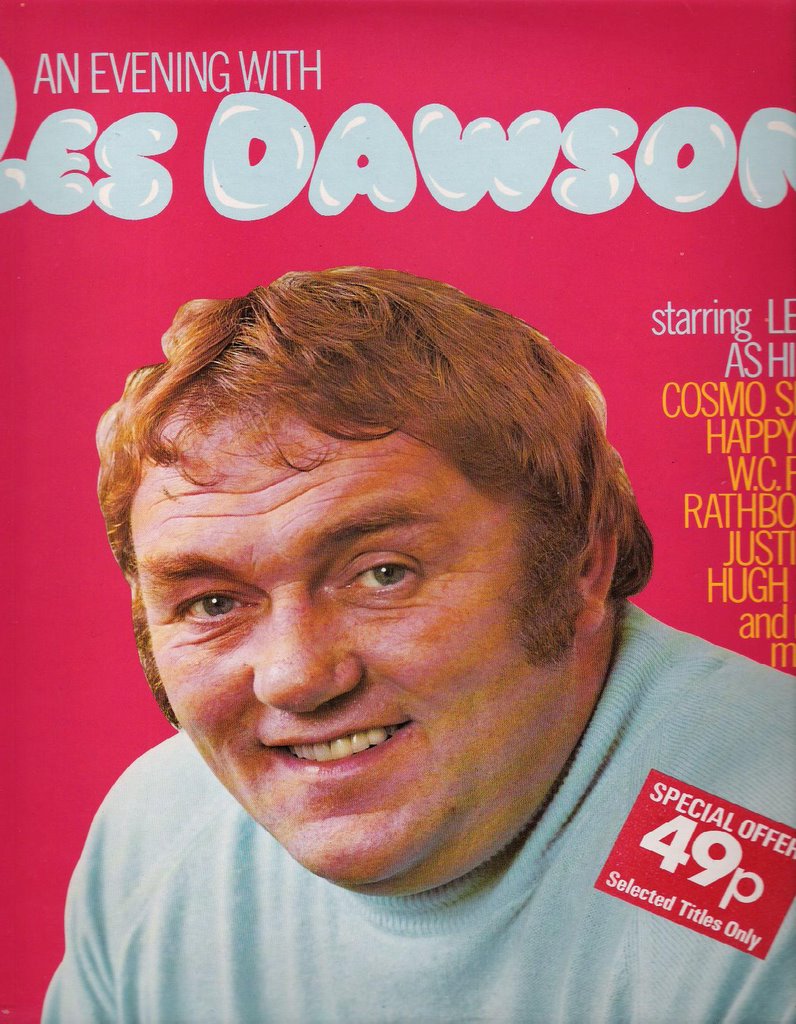
Les Dawson (Re-Up)


"Les Dawson (2 February 1931 - 10 June 1993) was a popular Lancashire comedian, known for his deadpan style. Dawson was a curmudgeon, famous for jokes about his mother-in-law and his wife.
Dawson began his entertainment career as a club pianist ("I finally heard some applause from a bald man and said 'thank you for clapping me' and he said 'I'm not clapping - I'm slapping me head to keep awake.'"), but found that he got more laughs by playing wrong notes and complaining to the audience. He made his television debut in the talent show, Opportunity Knocks, and was seldom absent from British television screens in the years that followed. His best known routines featured Roy Barraclough and Dawson as two elderly women, Cissie Braithwaite and Ada Sidebottom who, having worked in a mill in their youth, spoke some words aloud and mouthed others--particularly those pertaining to bodily functions and sex; they also repeatedly pushed up their bosoms, in pantomime dame style, an act copied faithfully from his hero, Norman Evans. Dawson's humour, though earthy, was seldom coarse, and he was as popular with female as with male audiences."

A very funny man and in reality he could play the piano really well. Most of this record is comedy routines but I have extracted two "musical" interludes for your enjoyment, or not as the case may be! A bargain at 49p!

Side Two consists of tracks -

1. I Can't Control Myself
2. Jeremiah Fisher Frog
3. Show Me The Way To Go Home
4. Goodbye (from "Whie Horse Inn" )


Les Dawson - Side Two

Les Dawson - Bye Bye Blackbird