Wednesday, September 27, 2006

Warren Smith


Part of one side of an LP on the Harvest label that came out in 1978. A concert at the Rainbow Theatre in London U.K. on April 30th 1977. Four Rock'n Roll legends including Charlie Feathers, Buddy Knox and Jack Scott. Here are the 4 tracks by Warren Smith-

1. Ubangi Stomp
2. Rock 'n' Roll Ruby
3. Blue Suede Shoes
4. I'm Movin' On

The sleevenotes by Geoff Barker say-

" Warren Smith is rightly introduced on the record as "The guy we've waited twenty years to see". Born in Mississippi in 1933, he was one of the many young rockabilly singers recorded by Sam Philips In Memphis, Tennessee for his legendary Sun record label. While the labels stars ( Elvis, Carl Perkins, Jerry Lee Lewis and Johnny Cash) were making it in a big way, there were a host of others laying down some equally innovative recordings. Warren Smith's first single issude in March 1956, was a Johnny Cash song - Rock 'N' Roll Ruby. This sold well around the Memphis area, and the follow-up Ubangi Stomp became a rockabilly standard, first coming to the attention of Britsih audiences via Jerry Lee Lewis's first album."

Monday, September 25, 2006

Lonnie Donegan


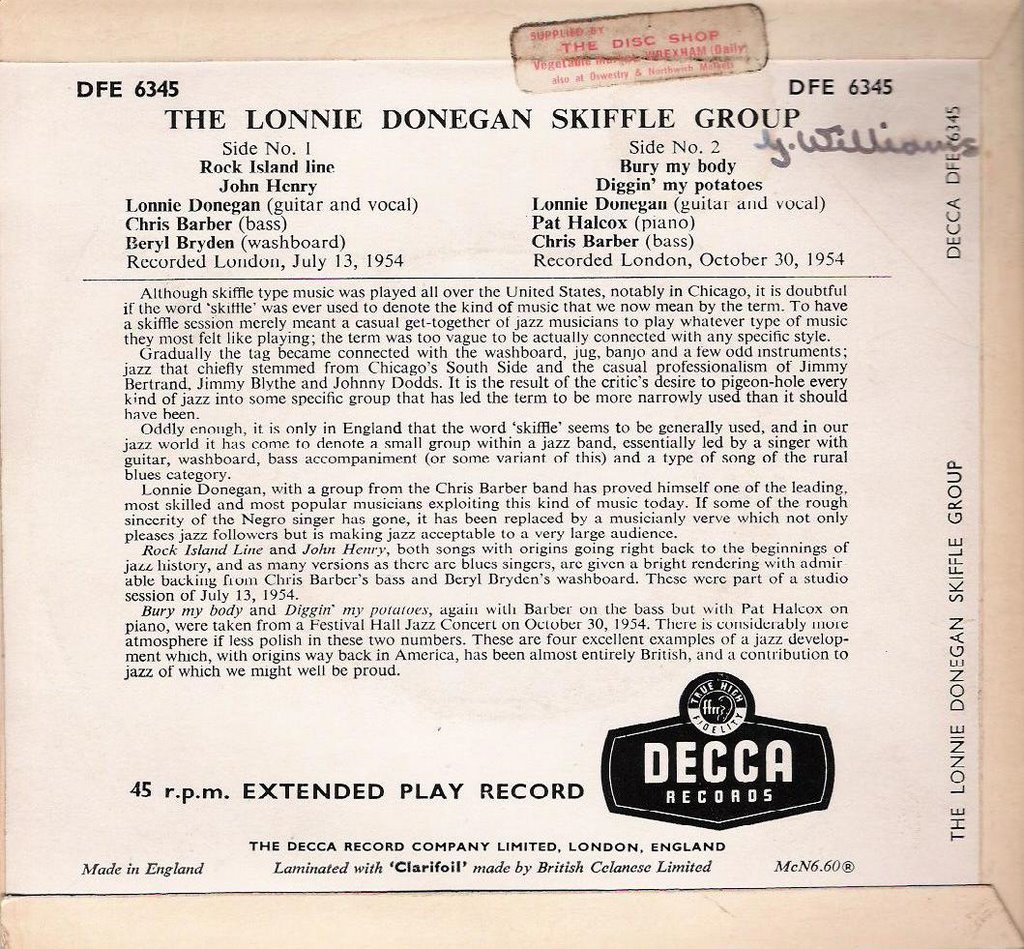
Another EP by Donegan that I found at the weekend for 25 pence. Recordings form the Festival Hall Jazz Concert of 1954 and in the studio at around the same time with Chris Barber (Bass), Beryl Bryden (Washboard) and Pat Halcox (Piano).

"He formed his own group, the Tony Donegan Jazz Band, in 1952. They were successful enough that the National Jazz Federation asked the band to play a show at Festival Hall with American ragtime pianist Ralph Sutton and blues/jazz legend Lonnie Johnson. The Federation had brought to the two over to England in defiance of a Musicians' Union ban on all foreign performers and needed a non-union band like Donegan's to play support for the two guests. The master of ceremonies at the show made a mistake in his announcement, introducing the American guitarist as "Tony Johnson" and the British banjo man as "Lonnie Donegan." The name stuck.

Donegan and his band eventually hooked back up with his old friend Chris Barber, who'd kept his band going throughout the previous two years, and eventually Barber and Donegan linked up with fellow jazzman Ken Colyer, into a kind of supergroup led by Colyer. The Ken Colyer Jazzmen, as they were called, specialized in Dixieland jazz, and built a formidible reputation, their shows popular in every club they played. It was during these shows, between sets by the full band, that Donegan would come on stage with two other players and perform his own version of American blues, country, and folk standards, punched up with his own rhythms and accents, on acoustic guitar or banjo, backed by upright bass and drums. The name "skiffle" was hung on this music as a way of referring to it on the group's posters. The word, according to Donegan, was suggested by Ken Colyer's brother Bill, who remembered an outfit called the Dan Burley Skiffle Group, based in Chicago in the 1930's. It seemed to fit, and it caught on; the Ken Colyer Jazzmen became almost as popular for Donegan's between-set skiffle songs as they were for their Dixieland music. "

Here's a previous post about Lonnie Donegan - SWAPATORIUM: Lonnie Donegan Showcase

Lonnie Donegan - Diggin' My Potatoes

Lonnie Donegan - John Henry


These SendSpace files are available for seven days or until exhausted.

Sunday, September 24, 2006

Burl Ives


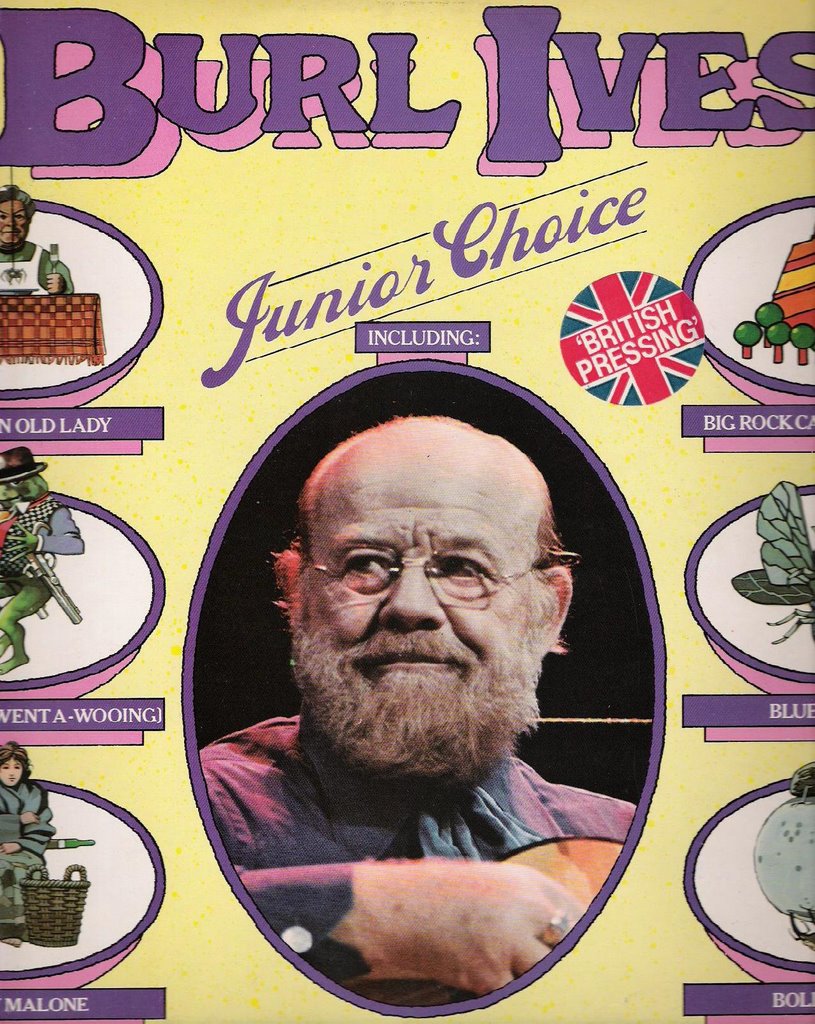
Another found today in the same box as the Zillertaler Trio. Burl Ive's childrens songs were regularly played on the BBC's "Childrens Favourites" radio show of the 50's and 60's especially songs like There was An Old Lady and Blue Tail Fly etc.
This MFP LP was released in the 70's I would imagine. No date on the sleeve.

Here's what Wikipedia has to say about him-

"Burl Icle Ivanhoe Ives (14 June 1909 – 14 April 1995) was an acclaimed American folk music singer, author and actor.
Born near Hunt City in Jasper County, Illinois, Ives is probably best remembered for his music. He dropped out of college to travel about as an itinerant singer during the early 1930s, earning his way by doing odd jobs and playing his banjo. He was jailed in Mona, Utah, for singing “Foggy Foggy Dew”, which the authorities decided was a bawdy song.
Ives from 1927 to 1929 attended Eastern Illinois State Teachers College in Charleston (now Eastern Illinois University), where he played football. During college he was a member of the Phi Sigma Kappa fraternity. He dropped out of college because of poor grades and in 1930 landed on WBOW radio in Terre Haute, Indiana.
In 1940 Ives began his own radio show, titled The Wayfaring Stranger after one of his popular ballads. The show was very popular, and in 1946 Ives was cast as a singing cowboy in the film Smoky. His first book, The Wayfaring Stranger, was published in 1948.
Other movie credits include East of Eden (1955); Cat on a Hot Tin Roof (1958); The Big Country (1958), for which he won an Academy Award for Best Supporting Actor; and Our Man in Havana (1959), based on the Graham Greene novel.
In the 1940s Ives popularized several traditional folk songs, such as “Lavender Blue” (his first hit, a folk song from the 17th century), “Foggy Foggy Dew” (an English/Irish folk song), “Blue Tail Fly” (an old Civil War tune) and “Big Rock Candy Mountain” (an old hobo ditty)."

Read more about Burl Ives HERE.


Burl Ives - Whistling Rabbit

Burl Ives - Riddle Song

Burl Ives - The Man On The Flying Trapeze


These SendSpace files are available for seven days or until exhausted.

Zillertaler Trio


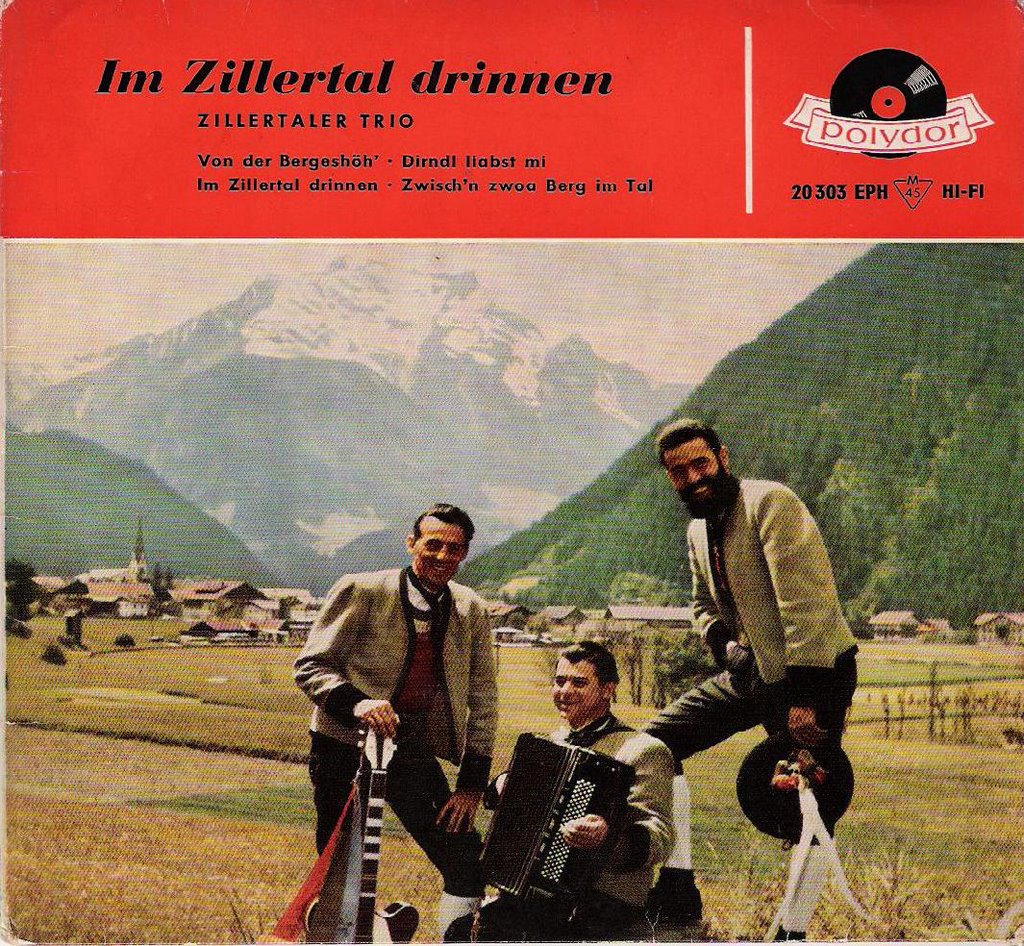
An EP of uncertain date found at car boot sale today just before the thunderstorm. I presume it's a German record as the label is printed in Germany. I was hoping for some yodelling and sure enough there is some. I have no idea what they are singing about but assume its about milk-maids and the joys of the mountains, leather shorts and the healthy outdoor life.
Perhaps a kind German person can enlighten us?


Zillertaler Trio - Im Zillertal Drinnen

Zillertaler Trio - Zwisch'n Zwoa Berg Im Tal


These SendSpace files are available for seven days or until exhausted.

Fezcast 2


Big Al Davies spins a few of his favourite tracks but keeps a low profile this time. Tunes from Sandie Shaw, Ivor Cutler, Ukelele Orchestra Of Great Britain, Loudon Wainwright III, Rolf Harris, Paul Giovanni and Magnet and Claude Vasori - not particularly in that order.

Saturday, September 23, 2006

Chicken Rock


No excuses for featuring this track again. One of my favourite "chicken songs". I saw this LP on Brick Lane market many years ago and imagined it was all songs about chickens! Sadly this was the only one but later I was able to make up my own cassette tape comp. of Chicken Songs to annoy my friends with. The title track is my Fat "Daddy" Holmes.

Here are some other rockabilly tunes from the same LP.


The Beaumarks - Rockin' Blues

The Champs - Roots

Scottie Stuart - Little Rocker

Carl Bonafede & The Gem Tones - Story That's True


These SendSpace files are available for seven days or until exhausted.

Thursday, September 21, 2006

Tom Lehrer


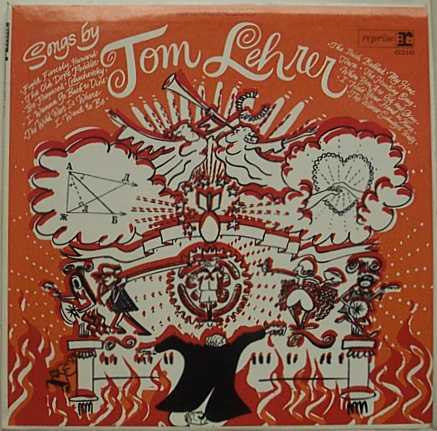
One of three Tom Lehrer I have found cheaply but this is the cheapest as it was absolutley free - sent in the post by a kind lady who didn't have a record player and so thought I might like it! It's full of great songs- all very short and very funny.

Here's what Wikipedia says about him-

"As an undergraduate student at Harvard University, he began to write comic songs to entertain his friends, including "Fight Fiercely, Harvard" (1945). Those songs later became (in a joking reference to a leading scientific journal) The Physical Revue. Influenced mainly by musical theater, his style consisted of parodying the then-current forms of popular song. For example, his appreciation of list songs led him to set the names of the chemical elements to the tune of Gilbert and Sullivan's "Major General's Song".
Inspired by the success of his performances of his songs, he paid for some studio time to record an album, Songs by Tom Lehrer, which he sold by mail order. Self-published and unpromoted, the album, which included the macabre ("I Hold Your Hand In Mine"), the mildly risqué ("Be Prepared"), and the mathematical ("Lobachevsky"), became a success via word of mouth. With a cult hit, he embarked on a series of concert tours and released a second album, which came in two versions: the songs were the same but More Songs by Tom Lehrer was studio-recorded, while An Evening Wasted with Tom Lehrer was recorded live in concert.
By the early 1960s Lehrer had retired from touring (which he intensely disliked) and was employed as the resident songwriter for the US edition of That Was The Week That Was (TW3), a satirical TV show. An increased proportion of his output became overtly political, or at least topical, on subjects such as pollution ("Pollution"), Vatican II ("The Vatican Rag"), race relations ("National Brotherhood Week"), American militarism ("Send the Marines") and nuclear proliferation ("Who's Next?" and "We Will All Go Together When We Go"). He also wrote a song which satirized the alleged amorality of Wernher von Braun. A selection of these songs was released in the album That Was The Year That Was."

Find out more about Tom Lehrer HERE.


Tom Lehrer - The Old Dope Peddler

Tom Lehrer - Be Prepared

Tom Lehrer - The Wild West

Tom Lehrer - I Wanna Go Back To Dixie

Tom Lehrer - Fight Fiercely, Harvard


These SendSpace files are available for seven days or until exhausted.

Tuesday, September 19, 2006

Will Fyffe


This LP on the World Record label is a compilation of songs by the scottish comedian Will Fyffe which I always get mixed up with Sir Harry Lauder. Mostly from the late 20's and early 30's.

"He started his career in childhood touring with his father's dramatic company and made his debut as Little Willie in East Lynne.
At 15 he played Polonius in Shakespeares Hamlet. He then moved to the Music Halls doing sketches featuring Scottish characters many of which were recorded on to 78 rpm records. He appeared at the London Pavilion in 1921 and also appeared in a number of films during the 1930's.

He was presented with the C.B.E. for entertaining the troops during World War 2. He is best known for his recording of "I Belong To Glasgow" but made many other fine recordings demonstrating that he had an excellent singing voice and in my opinion was a superior entertainer to the better known Sir Harry Lauder."


Will Fyffe - I'm 94 Today

Will Fyffe - He's Been On The Bottle Since A Baby

Will Fyffe - The Railway Man


These SEndSpace files are available for seven days or until exhausted.

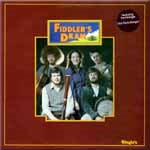
Fiddler's Dram


Another LP from the bootsale on Sunday. Their one and only hit "A Day Trip To Bangor" has surfaced on a couple of folk/novelty compilations and I was keen to see what else they had done. Mostly ordinairy folk rock from the 70's that reminds me of Steeleye Span and The Yetties etc.

Here's what Wikipedia has to say about them-

"Fiddler's Dram were a British folk band of the late 1970s. They were mainly known for their hit single Day Trip to Bangor (1979), although the sound of this record was not representative of the acoustic songs and tunes they had been performing for several years at folk clubs and festivals.
The members of Fiddler's Dram were:
Cathy Lesurf - vocals, bodhran
Alan Prosser - guitar, fiddle, bowed psaltery, bones
Chris Taylor - bouzouki, harmonica, appalachian dulcimer, mandola, tenor banjo
Ian Telfer - fiddle, bowed psaltery

They met at the University of Kent at Canterbury and were residents at Duke's Folk Club in Whitstable. With other club members including John Jones and Ian Kearey, they formed the Oyster Ceilidh Band c.1976, with Cathy Lesurf singing and later assuming the role of caller at dances.
Bassoon-player Will Ward had joined the Oyster Ceilidh Band by 1978, and became the fifth member of Fiddler's Dram on their eponymous second LP, recorded hurriedly to follow up on their unexpected success in the singles chart. The band were unable to achieve subsequent success however - in the words of Ian Telfer Day Trip To Bangor was "the kind of success you don't easily recover from. Fiddler's Dram did one more tour then gratefully took the money (and the gold discs) and ran".
Day Trip To Bangor was actually inspired after a day trip to Rhyl (a seaside resort 35 miles east of Bangor, North Wales), but because Bangor had an extra syllable and slipped off the tongue easier it was used ahead of Rhyl. This caused an outcry from Councillors and businesses in Rhyl who complained that the publicity would have boosted the resort's tourist ecomony.
The Oyster Ceilidh Band continued as both a dance and concert band however, changing their name c.1982 to Oysterband. Cathy Lesurf subsequently left the Oysters for a spell with the Albion Band."


Fiddler's Dram - Mama's Ill

Fiddler's Dram - Johnny John

Fiddler's Dram - Fedora


These SendSpace files are available for seven days or until exhausted.

Monday, September 18, 2006

Wavy Gravy

Evil Alien Diary
A short segment of a cassette some kind person sent me a few years back called "Wavy Gravy". Not sure if this was an official release or not. Can't find any record of it. probably a limited edition on obscure record label. Seems to be lots of garage bands mixed with old shlock film trailers.

Tracks are-

1. Bo Diddley - The Juveniles
2. Hambone Hunter - Ho Ho laughing Monster
3. The Motions - Bacon Fat
4. Igor & The Maniacs - Bumble Bee '65
5. Moses Longpeice - The Big Green

You can find it HERE.

Sunday, September 17, 2006

George Formby


George Formby's Crazy Record Parts 1 & 2

Delighted to find a boxed set of George Formby LP's on the World Record label yesterday at a boot sale for a pound! Four records in the set with songs from his stage shows and all his hits like "Leaning On A Lamppost", "Mr. Wu's A Window Cleaner" and many others. Also more obscure songs which I've uploaded here.

"Musical comedian George Formby was among Britain's most popular stars during the first half of the 20th century, with a legacy encompassing over 200 records and more than 20 hit films. Born George Hoy Booth on May 26, 1904 in Lancashire, England, he was the son of George Formby, Sr., himself a popular Edwardian music hall comedian. The younger Formby first worked as an apprentice jockey, but his father's sudden death in 1921 prompted him to pursue his own career as a performer; he initially worked under his given name, but later adopted his father's nom-de-stage following his marriage to dancer Beryl Ingham, who soon took over the reins of her husband's career. Initially, Formby attempted to approximate his father's act, but with little success; the chance acquisition of a banjo ukelele proved the key to establishing his own stage persona, and in light of audiences' enthusiastic reactions to his idosyncratic, self-taught playing style, the instrument was never again far from his side.

With his toothy grin and goofy personality, Formby was dubbed "the beloved imbecile" by pundits; after earning a loyal following among music hall denizens, he scored a major pop hit with 1932's "Chinese Blues," which when renamed "Chinese Laundry Blues" became his signature song for the duration of his career. Two years later Formby made his first film, Boots! Boots!; the picture was a smash, and he swiftly contracted to make 11 more films for Ealing Studios. Over the course of movies like 1935's No Limit, 1937's Feather Your Nest and 1938's It's in the Air, he became Britain's biggest star, earning an estimated £100,000 a year; his films also continued to provide him with a wealth of saucy hit records, including "The Window Cleaner," "Fanlight Fanny," "Riding in the T.T. Races" and the Noel Gay-penned "Leaning on a Lamp Post," perhaps his most popular song."

Discover more about George Formby HERE.


George Formby - I'm The Ukelele Man

George Formby - Have You Ever Heard This One?

George Formby - Wunga Bunga Boo

George Formby - I Can Tell It By My Horoscope


These SendSpace files are available for seven days or until exhausted.

Friday, September 15, 2006

Screaming Lord Sutch


Dracula's Daughter by Screaming Lord Sutch and The Savages.

"Although he was never a major pop player in the 60s - he was always more famous for being famous - Screaming Lord Sutch's band The Savages included Deep Purple's Ritchie Blackmore. Sutch plundered his act wholesale from Screaming Jay Hawkins and added a dash of Hammer horror; Blackmore often recalled the indignity of being a serious muso, standing in a West london pub dressed only in a loincloth, trying to keep his mind on playing as Sutch emerged from a coffin and advanced on him with a blood-dripping dagger drawn.

He also teamed up with Keith Moon, Jimmy Page, Blackmore and others on the 1969 album 'Screaming Lord Sutch And Heavy Friends', which was a pretty dire record, though his early 60s horrorshow rock pre-dated Alice Cooper, The Damned, Marilyn Manson and any number of goth bands by years. But it is as a 'political buffoon' that he will be best remembered."

Discover more about Screaming Lord Sutch HERE.

Fezcast from Big Al Davies


Llanbradach's finest singer/songwriter plays a few records at home. A mini-podcast full of novelty and wonder.

Wednesday, September 13, 2006

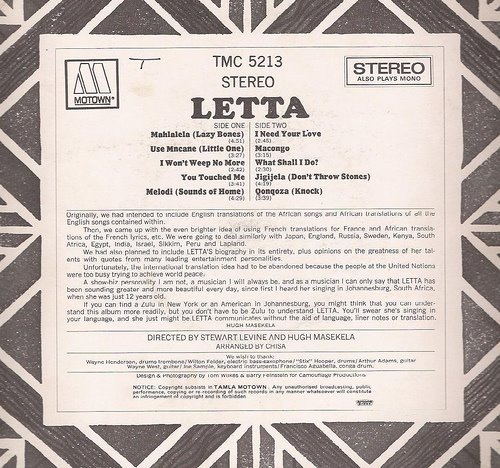
Letta Mbulu

Letta Mbulu
A unusual choice for the Tamla Motown label back in 1970 when the idea of "World Music" and WOMAD etc. would have to wait another fifteen years to become popular. I prefer the township songs here on a record produced by Hugh Masekela ( who also plays trumpet) - the soul tracks seem rather dull by comparison.

This is what Douglas Payne has to say about her-

"Letta Mbulu (pronounced "let-ah" "em-boo-loo") was born and raised in Soweto, South Africa.

Still in her teens, Letta began touring outside of Africa with the musical "King Kong," which ran for a year in England following a highly successful two-year run in South Africa. When the tour ended, she returned to South Africa but soon the policies of Apartheid were to force her to leave her native land for the U.S.A
She arrived in the United States in 1965 and quickly befriended such fellow South African exiles in New York City as Miriam Makeba, Hugh Masekela and Jonas Gwangwa - all alumni of the "King King" musical. Performances at New York's famed Village Gate club began to attract attention to her talents, particularly from jazz legend Cannonball Adderley, who invited her to tour with him (which she did throughout the remainder of the decade).

Letta Mbulu also displayed an early gift for writing joyful, memorable songs. These were showcased by no less an authority than Miriam Makeba on the singer's albums THE MAGNIFICENT MIRIAM MAKEBA ("Akana Nkomo"), ALL ABOUT MIRIAM ("U Shaka," "Jol'inkomo") and MAKEBA ("U-Mngoma," "Magwala Ndini").

Letta first made herself heard on records as part of Letta and the Safaris, a group featuring husband Caiphus Semenya and the South African husband and wife team of Jonas and Mamsie Gwangwa. A single, "Walkin' Around" was issued in 1966 by Columbia Records (home at the time to Bob Dylan and Simon & Garfunkle), but lack of publicity failed to garner much attention to the clever little R&B swinger.

Letta and Caiphus soon relocated to the West Coast, joining Hugh Masekela, who became a fixture of the California concert and recording scene. While there, producer David Axelrod fell under Letta's spell and had her signed to Capitol Records - home at the time to both the Beatles and the Beach Boys and where Axelrod himself was scoring big hits for Lou Rawls and Cannonball Adderley."


Letta Mbulu - Macongo

Letta Mbulu - Qonqoza (Knock)

Letta Mbulu - Use Mncane (Little One)


These SendSpace files are available for seven days or until exhausted.

Oh! What A Carry On


A record on the MFP label from the late 70's featuring songs not in the films but by some of the artists who took part in them over the years.

1. Be My Girl - Jim Dale
2. You Need Feet - Bernard Bresslaw
3. On Mother Kelly's Doorstep - Barbara Windsor
4. It's Alright With Me - Frankie Howard

"Possibly more than any other, the Carry On series of films typify the very essence of British comedy. They are, without doubt, the most enduring and endearing offspring of British cinema. From their debut in 1958 through to the present day, the mention of the words "Carry On" bring to mind images of saucy humour, larger than life characters and riotous slapstick. There are very few people in their home country, if not elsewhere, who haven't seen at least one of the 31 Carry On films, let alone the subsequent stage shows and television series.

The humour of the Carry Ons, while far from unique, is presented with such flair that when one thinks of the typical British comedy, the words "Carry On" immediately spring to mind. While remaining at all times highly suggestive, it never veered towards the obscene. The jokes and situations, while full of sexual innuendo and deliberately raised eyebrows, retain an innocence not found anywhere else. Great emphasis was placed on the double entendre and the dirty laugh, but overt sexuality and coarse language were always shunned."

Discover more about the Carry On films HERE.

Monday, September 11, 2006

Captain Beefheart


Not strictly a boot sale find but a very old and scratchy record I played to death back in 1970 when this first appeared on Frank Zappa's STRAIGHT label. Not quite up to the quirkiness and inspired daftness of Trout Mask Replica which was released two years previously and the Captain's finest hour ( and a bit ).

Biography by Jason Ankeny
"Born Don Vliet, Captain Beefheart was one of modern music's true innovators. The owner of a remarkable four-and-one-half octave vocal range, he employed idiosyncratic rhythms, absurdist lyrics and an unholy alliance of free jazz, Delta blues, latter-day classical music and rock & roll to create a singular body of work virtually unrivalled in its daring and fluid creativity. While he never came even remotely close to mainstream success, Beefheart's impact was incalculable, and his fingerprints were all over punk, new wave and post-rock.

Don Vliet was born January 15, 1941 in Glendale, California (he changed his name to Van Vliet in the early '60s). At the age of four, his artwork brought him to the attention of Portuguese sculptor Augustinio Rodriguez, and Vliet was declared a child prodigy. In 1954, he was offered a scholarship to study in Europe; his parents declined the proposal, however, and the family instead moved to the Mojave Desert, where the teen was befriended by a young Frank Zappa. In time Vliet taught himself saxophone and harmonica, and joined a pair of local R&B groups, the Omens and the Blackouts.

After a semester at college, he and Zappa moved to Cucamonga, California, where they planned to shoot a film, Captain Beefheart Meets the Grunt People. As the project remained in limbo, Zappa finally moved to Los Angeles, where he founded the Mothers of Invention; Van Vliet later returned to the Mojave area, adopted the Beefheart name and formed the first lineup of his backing group the Magic Band with guitarists Alex St. Clair and Doug Moon, bassist Jerry Handley and drummer Paul Blakely in 1964.

In their original incarnation, the Magic Band were a blues-rock outfit who became staples of the teen-dance circuit; they quickly signed to A&M Records, where the success of the single "Diddy Wah Diddy" earned them the opportunity to record a full-length album. Comprised of Van Vliet compositions like "Frying Pan," "Electricity" and "Zig Zag Wanderer," label president Jerry Moss rejected the completed record as "too negative," and a crushed Beefheart went into seclusion. After replacing Moon and Blakely with guitarist Antennae Jimmy Semens (born Jeff Cotton) and drummer John "Drumbo" French, the group (fleshed out by guitarist Ry Cooder) recut the songs in 1967 as Safe as Milk.

After producer Bob Krasnow radically remixed 1968's hallucinatory Strictly Personal without Beefheart's approval, he again retired. At the same time, however, Zappa formed his own , Straight Records, and he soon approached Van Vliet with the promise of complete creative control; a deal was struck and after writing 28 songs in a nine-hour frenzy, Beefheart formed the definitive lineup of the Magic Band -- made up of Semens, Drumbo, guitarist Zoot Horn Rollo (born Bill Harkleroad), bassist Rockette Morton (Mark Boston) and bass clarinetist the Mascara Snake (Victor Fleming) -- to record the seminal 1969 double album Trout Mask Replica."

Tracks are-

1. Lick My Decals Off Baby
2. Doctor dark
3. I love You, You Big Dummy
4. Peon
5. Bellerin' Plain

Discover more about Capatin Beefheart HERE.

Far East Fantasy


Or to give it's full title "Far East Fantasy In Latin Dance Rhythm" found yesterday at a boot sale for 50 pence. On the 49th State label and made in Hawaii by the All Star Ortchestra, whoever they might be. The sleeve notes don't really tell us but here is a small segment -

" These best loved melodies from Japan, China, Okinawa, Korea, the Philippines and Malaya, are set in the Latin tempo and rhythm that makes them a blend of the East and Latin America. At long last the waves of the Pacific Ocean have done their work of intermingling the music of various peoples.

Recorded in full fidelity sound, these songs will soon be haunting your memory, as snatches keep coming to mind unconsciously. Listen or dance to these beautiful melodies of the Far East."


All Star Orchestra - Shina No Yoru (rhumba) - Japan

All Star Orchestra - Holi Chin Sai Lai (cha cha cha) - China

All Star Orchestra - Ginza Kan Kan Musume (rock 'n' roll mambo) - Japan


These SendSpace files are available for seven days or until exhausted.

Saturday, September 09, 2006

The Skatalites


Actually not a second hand record atall but one I bought in a sale from a shop in Soho in London back in the 80's during the ska boom when the Specials and Madness were just getting some big hits. This is a jamaican import and a very bad pressing and probably why it was cheap but some great instrumentals on here obviously influenced greatly by New Orleans jazz and R&B.

"The Skatalites is a Jamaican music group that played a major role in popularising ska, the first truly Jamaican music created by fusing boogie-woogie blues, rhythm and blues, jazz, mento, calypso, and African rhythms. They recorded many of their best known songs, including "Guns of navarone", in the period between 1964 and 1965, as well as played on records by Prince Buster and many other Jamaican artists.
The members of the group were Tommy McCook, Roland Alphonso, Lloyd Brevett, Lloyd Knibb, Lester Sterling, Don Drummond, Jah Jerry Haynes, Jackie Mittoo, Johnny Moore, Jackie Opel, and Doreen Shaffer. Trombonist Drummond's composition, "Man In The Street", entered the Top 10 in the United Kingdom. He was not only the Skatalites' busiest composer, but was the most prolific in all of Ska, with at least 200 tunes to his name by 1965.
On January 1, 1965, Drummond was jailed for the murder of his girlfriend, Anita 'Marguerita' Mahfood, and in August that year, the Skatalites played their last show. The break-up resulted in the formation of two supergroups, "Rolando Alphonso and the Soul Vendors" and "Tommy McCook and the Supersonics". Drummond died in the Bellevue Asylum on May 6, 1969 at age 37."

Tracks are -

. Four Corners
2. Scrap Iron
3. Feeling Good
4. Royal Flush
5. Ball of Fire
6. Christine Keiler

Discover more about the Skatalites HERE

Friday, September 08, 2006

Julia Lee and Her Boyfriends


A 10" Lp on Capital found on Brick Lane flea market some years ago without it's sleeve sadly but plays very well.

"A popular entertainer who recorded frequently for Capitol during 1944-1950, Julia Lee's double-entendre songs and rocking piano made her a major attraction in Kansas City. She played piano and sang in her brother George E. Lee's Orchestra during 1920-1934, recording with him in 1927 and 1929 (including "If I Could Be With You One Hour Tonight") and cutting two titles of her own in 1929 ("He's Tall, He's Dark and He's Handsome" and "Won't You Come Over to My House"). Lee worked regularly as a single in Kansas City after her brother's band broke up."

Side one featured here with songs like "King Size Papa" and "Snatch and Grab It" to name but two.

Music Hall To Variety


This is a great LP of old Music Hall songs from the early part of the last century. I have managed to collect all three volumes from various flea markets and bootsales over the years. The first is my favourite and contains some priceless novelty songs of the period.

"Surviving recordings make it clear that few music hall stars had good voices. Like their vaudeville counterparts in the U.S., their primary qualifications were energy and personality. The best music hall performers had both in abundance. Marie Lloyd (seen at left) was one of the most beloved music hall stars. Her stage humor ranged from the wholesome to the risqué. If her trademark parasol failed to open, she would quip, "I haven't had it up for ages." One of her songs was "She Sits Among Her Cabbages and Peas" – a title that sounds less innocent than it looks. Lloyd always adapted her act to the audience at hand, winning almost universal affection. Playwright and poet T. S. Eliot explained her appeal this way –

No other comedian succeeded so well in giving expression to the life of the music hall audience, raising it to a kind of art. It was, I think, this capacity for expressing the soul of the people that made Marie Lloyd unique.
- Selected Essays by T. S. Eliot, Faber and Faber, London, 1941

After World War I, food service disappeared from the music halls, and traditional theatre seating replaced the old benches and tables. But there was still plenty of beer! Performers faced more concentrated scrutiny, which only strengthened the popularity of favorites like comic singers Florrie Forde, George Robey and Harry Champion. Most performers preferred songs with simple repetitive refrains that were easy for audiences to remember and sing along with. "

Find out more about the music hall HERE.


Billy Williams - When Father Papered The Parlour

Harry Champion - A Little Bit Of Cucumber

Ella Shields - Burlington Bertie

G.H.Elliott - Down Home In Tennessee


These SendSpace files are available for seven days or until exhausted.

Thursday, September 07, 2006

Spike Milligan & Jeremy Taylor


A record on the Music For Pleasure label released in 1974 but I think the recording at Cambridge University was probably made in the late sixties. Here's almost one side until a pice of fluff gets in the way!

SPIKE MILLIGAN

"Milligan was born in India to a father who was an Irish captain in the British army. Milligan lived in India until he was 15, an experience that later came in quite handy when he and Goons co-star Peter Sellers began the tradition of dueling Bengali accents. That Milligan more than held his own in the company of Sellers is an obvious tribute to the former man's comic gifts. The third main Goon was Sir Harry Secombe, a great musical and comic talent who is sometimes mistakenly called the group's straight man; but make no mistake about it, there was nothing straight at all about The Goon Show. When his family moved back to England, Milligan's proclivity for entertaining came to the surface, beginning with an interest in jazz that he never lost, eventually even contributing liner notes to a Stan Getz album. Milligan spent much of his youth playing trumpet in various jazz bands. He joined the British Army at the outbreak of the Second World War, serving in the Royal Artillery through the North African and Italian campaigns, where he wound up hospitalized for shell shock. Following the war, he joined the Goons at a time when the British nation was collectively wondering whether it would ever be able to laugh again. The show became a huge success, but created enormous pressures for Milligan, who was writing the lion's, or the loon's share of the scripts as well as doing the enormous weekly work of editing in sound effects."

JEREMY TAYLOR

"Jeremy set South Africa alight in the sixties with his "Ag Pleez Deddy" and was then banished from South Africa for ridiculing apartheid. After two years on the West End stage in WAIT A MINIM, a South African musical revue, he became a leading entertainer on the British folk circuit with songs like "Jobsworth", " Red Velvet Steering Wheel Cover Driver " and "Prawns in the Game".
His " Piece of Ground" was recorded in the USA by Miriam Makeba. With John Wells he wrote songs for the West End musical satire MRS WILSON'S DIARY, was for two years Spike Milligan's stage partner in FOR ONE WEEK ONLY, wrote a Latin lyric ("O Caritas") for Cat Stevens, made frequent concert appearances with Donald Swann and Sidney Carter and performed his own one-man show at Soho's Boulevard Theatre. TV series included Granada's AT LAST ITS FRIDAY with Richard Stilgoe, Diana Quick and Keith Dewhurst, PSSSST! which included Julie Covington, Jean Hart and Kenny Lynch, and SONGS FROM THE TWO BREWERS in which he hosted stars from the folk world including The Dubliners, Ralph McTell and Pentangle. In 1980 he had his own series on BBC2 with Telephone Bill and the Smooth Operators. A change of government in 1979 led to his re-admittance to South Africa and from 1980 to 1994 he chronicled his life in Broederstroom, a farming area of the Transvaal, in a series of tales which were gradually woven into his one-man stage shows."

You can find the original photo of the sleeve HERE.

Wednesday, September 06, 2006

Highlife Music


Another Highlife record on the melodisc label from the 60's. Bands from Ghana and Nigeria include West African Rhythm Brothers, Nat Atkins and His Crazy Bees and Flash Domincii and the Fabulous Supersonics.
The copious sleeve notes tell us about each of the bands involved-

"Iwa Ika Ti Beda Je starts off well with all instruments in unison. Vocal then comes in immediately and nicely too. Here Flash sings and pleads to people to ponder anew and start doing good as people all round the globe are full of wickedness....
Ki Dide was meant to be made a hit when it was issued as a single. People enjoyed listening, rather than daning to it, for the morals behind it. Funny, some people has not the voice to match their stature. A good example is 'Dele Bank-Olemoh the occasional associate singer with Flash. With so titantic a stature, he emits from his throat a voice so thin nobody will believe it is his voice...."

"Sumongole by Nat Atkins, another beautiful and fast number, with Wily on clarinet. ..."

"The sudden death of Chief J.K. Randle came as a great shock to every Nigerian when it was announced. Not less than a day after his arrival from the successful Empire Games in 1957 in which he lead the successful Nigerian athletic team as Chef-de-mission, and where the athletes did incredbly well, he was taken ill, and died not long afterwards..."


Flash Domincii - Iwa Ika Ti Beda Je

Flash Domincii - Ki Dide

Nat Atkins - Sumungole

Nigerian Union Rhythm Bnad - The Memorial of Chief J.K.Randle

West African Rhythm Brothers - Iwa D'Arekere

Nat Atkins - Togorotigiri

Flash Domincii - Iwin Nla Pade Wa


These SendSpace files are available for seven days or until exhausted.

Tuesday, September 05, 2006

Lonnie Donegan


Lonnie singing "I'm A Gamblin' Man" from his second LP on Pye.

You can find some songs from his first LP over at-

SWAPATORIUM: Lonnie Donegan Showcase

Saturday, September 02, 2006

Miniatures


An LP compiled by Morgan Fisher in 1980 which featured 51 tracks, all no more than one minute in length. Here's the first 16-

1. ollie halsall & john halsey / bum love
2. the residents / we're a happy family + bali ha'i
3. roger mcgough / the wreck of the hesperus
4. morgan fisher / green and pleasant
5. john otway / mine tonight
6. pete challis & phil diplock / my way
7. robert wyatt / rangers in the nightst
8. stinky winkles / opus
9. mary longford / body language
10. andy 'thunderclap' newman / andy the dentist
11. david bedford / wagner's ring in one minute
12. fred frith / the entire works of henry cow
13. maggie nicols / look beneath the surface
14. joseph racaille / week-end
15. the work vwith wings pressed back
16. neil innes & son / cum on feel the noize

Morgan Fisher was overwhelmed by the number of ideas he thought up for albums that he could now record and release. Realising that it was impossible to do everything he conceived, he decided to see how many of these ideas could be included on one album. Rather than recording the music himself, he invited 50 musicians who he admired to send in tracks of up to one minute in length. They responded with unanimous enthusiasm, and as well as receiving tapes through the mail from all over the world, Morgan also packed up his Revox tape recorder and went to several musicians homes to record them there. Original artwork for the sleeve was provided by Ralph Steadman.

To look at this record sleeve and others in my collection go HERE

Tabou Combo


A record found at a flea market some years ago. Tabou Combo come from Haiti and this record was recorded in 1974. The two tracks featured here are the title track "8th Sacrement" and " Pace Domine".

"Formed in the Port-Au-Prince suburb of Petion-Ville by the Chancy brothers, Albert on bass and Adolphe on guitar, this young band won the Radio Haiti mini-jazz competition in 1968. They relocated to Brooklyn in 1971, and their song "New York City," which spoke of the difficulty of life in exile, reached #1 on the Paris pop charts in August 1975. They competed with Ska-Shah for top band honors in the 70s and 80s and fought "musical duels" similar to the Weber Sicot/Jean-Baptiste Nemours battles of the 50s and 60s.

An irresistible live band, Tabou Combo takes Haitian compas to the widest of audiences. From their regular appearances in the '80s at the famous Zenith Theatre in Paris, to an audience of 20,000 in New York's Central Park, to the Jazz and Heritage Festival in New Orleans, in football stadiums throughout the Caribbean, and on the turntables of the top DJs, this band makes people dance. Influenced by funk and soul in their adopted home, Tabou took on the likeness of the Commodores on the covers of their late-'70s releases. They even made a demo tape with hopes of a Motown contract. Their desire to reach the Black US market remains unsatisfied, but they should be proud that popular musicians such as Kassav' from the Antilles/Paris and Wilfrido Vargas from the Dominican Republic have absorbed their music."

Visit the band's official website HERE.

Dark City Sisters

Dark City Sisters
A record I found some years ago in a remaindered record shop in East London.

"The Dark City Sisters were a group of session singers who came together to record an album and in the process popularized an innovative new style of singing. Rather than
singing a common four-part harmony, the Sisters used five parts, which created a richer tone. Sometimes known as "vocal jive," this technique was subsumed under the umbrella term "mbaqanga," meaning, literally, dumpling, and figuratively, a homegrown style. ~ Leon Jackson, All Music Guide"

It puzzles me though that there are only three ladies featured on the front cover of this sleeve? No other information found on the interweb sadly though see they have a couple of compilations available on CD on Sterns and World Curcuit records.

Discover more about the Dark City Sisters HERE

Friday, September 01, 2006

Theo Blaise


Originally from the Belgian Congo, Theo Blaise now lives and records in Paris, at least he did when this record " Gemile" was recorded back in 1983 on the TDK label. The track is "Radio Bala Bala".

Wednesday, August 30, 2006

Frank Sidebottom


Side one of Frank's 10" LP "Medium Play" from 1990 on the In Tape label.

Billy Cotton Band


I think I have featured Billy Cotton in a previous blog but I expect the files have long since elapsed so here are some more from a recent find - an Ace Of Clubs label release from the early 60's. A mixture of standards, sickly ballads, cockney knees-up and novelty songs that was typical of his radio and television shows of the 50's and 60's. Also appearing here are Alan Breeze, Doreen Stevens and the Bandits.

"Billy Cotton, whose theme song was "Somebody Stole My Gal", was one of the most famous British dance band leaders. As both a drummer and vocalist, he had the talents to either stand in front of a band or back it up. Cotton's group was known not only for its dance numbers but a well-mounted comedy skits as well. He began his career as a drummer in the Royal Fusiliers at a mere 15 years old and by 18 had received a commission in the Royal Flying Corps.

As might be expected, military music was only a part of the picture and by night he would be behind the drums in various camp combos. After the war his syncopation was at first limited to the activities of a bus conductor and he also worked at jobs such as a butcher's roundsman and a millwright's assistant. Meanwhile a few gigs trickled in such as a spot with Gilbert Coombes and his Fifth Avenue Orchestra in Kilburn.

In the early '20s he was hardly riding high in the music business; typical pay for a trio job of that period was a bit less than 10 bucks. Eventually Cotton set his sights on starting his own band, including his cousin Laurie Johnson whose talents included promotion as well as the violin. By 1925, Billy Cotton and his London Savannah Band was landing extended stints at venues such as the Southport Palais, with the fine players Syd Lipton and Joe Ferrie in the band on violin and trombone respectively. During the two year life of this job, Cotton evolved from presenting simply dance music to mounting more of a visual stage act."

Discover more about Billy Cotton HERE

Billy Cotton Band - Forty Fahsend Feavers On A Frush

Billy Cotton Band - Shrimp Boats

Billy Cotton Band - I Painted It


These SendSpace files are available for seven days or until exhausted.

Pangkat Kawayan


A curious record found in a charity shop some time ago. It's from the Philippines- maybe brought back from a holiday? It's an instrumental album by PangKat Kawayan "The Singing Bamboos" and consists partly of traditional Filipino music and western classical favourites like The Skater's Waltz, Carnival In Vienna and Hungarian Dance No. 5.
Here's what it says on the sleeve notes-

" This orchestral band whose solo medium of musical intrumentation come from the bamboo came to be created in late '66 at the the Aurora A. Quezon Elementary School through the initiative of the school's principal, Miss laura Gorospe, whose dream tehn was "to revive and develop an almost dying aspect of our native intrumental music - that of ' muiskong bumbong'......'

All the players are between 8 and 15 years.

Discover more about the traditional music of the Philippines HERE.


Pangkat Kawayan - Pandangguhan

Pangkat Kawayan - Modern In C Minor


These SendSpace files are available for seven days or until exhausted.

Tuesday, August 29, 2006

Frank Luther


Found a couple of years ago in a charity shop in Westcliff - on - Sea in Essex. One of Frank's records for children. I remember his classic "Three Billy Goats Gruff" that used to be played all the time on Children's Favourites on the radio throughout the 50's and 60's.

"Frank Luther (August 4, 1905 - November 16, 1980) was an American country music singer, songwriter and pianist.
Born Frank Luther Crow Lakin, Kansas, he was raised in Bakersfield, California. A trained pianist, he moved to New York City in 1928 to pursue a career in music. A country music singer, he was one of the first "Urban Cowboys", performimg country music at big city clubs as "Frank Luther and his Pards." He is remembered as the composer of "Barnacle Bill The Sailor" written with Carson Robison.
He married Zora Lyman, a fiddle player who performed and recorded with him. Eventually, Luther shifted his focus to children's songs, enjoying considerable success with his recordings on which he sang and told stories. Among the popular albums for children that Frank Luther released were "Raggedy Ann Songs & Stories" and "A Child's First Birthday Record."
For his contribution to the recording industry, Frank Luther has a star on the Hollywood Walk of Fame at 1708 Vine Street.
Frank Luther died in 1980 in New York city."


Frank Luther - Little Train

Frank Luther - When I Grow Up


These SendSpace files are available for seven days or until exhausted.

Kenneth Williams


One side of a Kenneth Williams LP "The Best Of Rambling Syd Rumpo" found at a boot sale on Sunday before the heavens opened and the deluge started.

Alan Melville


A record I found at Crewe flea market a couple of years ago. Recorded in 1961. He was a script writer for Beryl Reid and Dickie Henderson amongst others and wrote revues for the West End.

"Alan Melville was a playwright, revue author and lyricist well-known in the forties and fifties. He became a television personality and tv writer in the sixties. As far as I am aware he wrote no radio plays but some of his stage plays were adapted for radio, and Radio 4 had an Alan Melville season in 1983.

Melville was a prolific contributor to West End revues which dominated the lighter side of West End theatre. His satire was gentle, and he poked fun at the middle classes. Long-running plays of his include DEAR CHARLES, DEVIL MAY CARE, CASTLE IN THE AIR and SIMON AND LAURA. He wrote topical sketches and lyrics for revue and his SWEET AND LOW, SWEETER AND LOWER and SWEETEST AND LOWEST lasted about 2000 performances. He also wrote lyrics for Arthur Askey in the musical BET YOUR LIFE, and collaborated with Ivor Novello on his last show GAY'S THE WORD.

He moved on to television, though as a non-tv watcher I have no idea what he wrote for it. He lived in Brighton and died in 1983."

Alan Melville - Rita

Alan Melville - Is It True What They Say About Dixie?

Alan Melville - There Are No Fairies At The Bottom Of My Garden


These SendSpace files are available for seven days or until exhausted.

Monday, August 28, 2006

George Jones


A 10' album on the Ace label of some of George Jones rockabilly recordings before he moved over into the country and western side of things.I must admit I prefer George sounding like this.

"George Glenn Jones (born September 12, 1931), nicknamed The Possum, is an American country singer known for his distinctive voice and phrasing that frequently evoke the raw emotions caused by grief, unhappy love, and emotional hardship. He has had more individual songs than any other singer on the country charts, 167 as of November, 2005, but, according to a formula derived by Joel Whitburn, is second to Eddy Arnold in his overall ranking for hits and their time on the charts. He has also had the most Top 40 Hits, 143, and is second to Arnold with the most Top 10 Hits, 78. Since at least the early 1980s he has frequently been referred to as "the greatest living country singer." Almost as often he is called "the Rolls-Royce of country singers." Frank Sinatra once called him "the second best white male singer." And as the scholar Bill C. Malone writes, "For the two or three minutes consumed by a song, Jones immerses himself so completely in its lyrics, and in the mood it conveys, that the listener can scarely avoid becoming similarly involved."[1]
Jones was born with a broken arm in Saratoga, Texas and grew up in the settlements north of Beaumont around the Big Thicket. By age 24, he had been married twice, served in the Marines, and developed his skills as a country musician and singer. After Elvis Presley's success Jones half-heartedly took a stab at rock and roll in hopes of getting noticed but returned to country almost immediately (In his autobiography Jones claims that when he encountered these rock and roll records years later he would use them as frisbees). "Why Baby Why" was his first top-five hit in 1955."

Discover more about George Jones HERE.


George Jones - White Lightnin'

George Jones - Rock It

George Jones - Taggin' Along


These SendSpace files are available for seven days or until exhausted.

Sunday, August 27, 2006

The Mighty Sparrow


A record on the Melodisc label from 1968 found in a flea market a while back. Accompanied by The Ron Berridge Orchestra.

"Sparrow's roots are in Gran Roi, a rural fishing village in Grenada. He was born to a poor working class family. They migrated to his adopted homeland, Trinidad, when he was just one year old. He attended the New Town Boys School where he was selected to sing in the boys. choir of St. Patrick's Catholic Church. This was his initial involvement in music. The harmonics of the Gregorian Chants and the Plainsongs of the church that were embedded in him would later affect the depth and intensity of his compositions. His vocal abilities also reflect his childhood role as the head choirboy who sang baritone and tenor in Latin in the church.

Other influences included listening to American street quartets, pop tunes by Nat King Cole and Frankie Laine, Sarah Vaughn, Billy Eckstein, Frank Sinatra and Ella Fitzgerald with their jazz contributions, and the early calypsoes of Lord Melody, Lord Kitchener, Lord Christo, Lord Invader (of Rum and Coca Cola fame) and the Mighty Spoiler, to name a few."

Discover more about The Mighty Sparrow HERE.


The Mighty Sparrow - Crazy John

The Mighty Sparrow - Calypso Boogaloo


These SendSpace files are available for seven days or until exhausted.

Saturday, August 26, 2006

Spike Jones


A compilation Lp on the World Record Label by Spike Jones called "Go Crazy with...." found a few years back. I never get tired of listening to Spike and the band and this album is a great introduction to their brand of humour. Not to everybody's taste I know but it's not all bells, whistles and gun shots - some clever parodies of classics on here like "I Kiss Your Hand Madame", "Hut Sut Song" and "Mairzy Doats".

"His father was a Southern Pacific railroad agent. He got his nickname by being so thin that he was compared to a railroad spike. At the age of eleven he got his first set of drums. As a teenager he played in bands that he formed himself. A chef in a railroad restaurant taught him how to use adapted pots and pans, forks, knives and spoons as musical instruments. He frequently played in theater pit orchestras. In the 1930s he joined the Victor Young Band and thereby got many offers to appear to radio shows including the Al Jolson Lifebuoy Show, Burns and Allen (with George Burns) and Bing Crosby's Kraft Music Hall. In 1940, he had an uncredited part in the film Give Us Wings, and in 1942 as a hillbilly in Pass the Biscuits, Mirandy. He joined up with vocalist Del Porter and performed in Los Angeles, gaining a cult following. By 1941 the band included violinist Carl Grayson. Other band members were George Rock (voice and trumpet), Doodles Weaver (voice) and Red Ingle (voice). They became his backing band The City Slickers. Saxophonist Ed Metcalfe performed with Spike Jones for a while. Jones's wife was the singer Helen Grayco, who performed on some of his radio shows. They received a recording contract with RCA Victor and recorded extensively for the company until the mid 1950s. Jones had four children, Spike Jr., Linda, Leslie and Gina. Leslie today is the Director of Music and Film Scoring at George Lucas' Skywalker Ranch in Marin County."

To discover more about Spike Jones go HERE.


Spike Jones - Knock, Knock, Who's There

Spike Jones - River, Stay Away From My Door

Spike Jones - Pimples And Braces


These SendSpace files are available for seven days or until exhausted.

Friday, August 25, 2006

Kevin Coyne 1944-2004


A double LP I bought many years ago, probably at Brick Lane, released in 1973 on Virgin. I remember Kevin used to be played by John Peel quite a lot and he even recorded for John's Dandelion label. Here's what it says about him on his homepage-

"Kevin Coyne was born in Derby, January 1944 and was educated at Joseph Wright School of Art (1957-1961) then Derby College of Art (1961-1965) where he studied graphics and painting, obtaining the N.D.D. in 1965. Early musical influences were Little Richard, Fats Domino, Chuck Berry and later (at art school), Muddy Waters, John Lee Hooker and Jimmy Reed.

Coyne's first job was a social therapist at Whittingham Hospital, Lancashire (1965-1968). In late 1968 he moved to London, starting work for the Soho project as a counsellor for drug addicts in 1969. This work was a source for many of his early songs and remains a major influence today.


In 1973 a youthful and idealistic Coyne signed as a solo artist for Virgin (after a five album spell with Siren on Dandelion Records) proceeding to make eleven L. P. 's over the next eight years. During this period he recorded with the likes of Andy Summers, Zoot Money, Carla Bley (for her album "Silence") and Dagmar Krause. It was a productive time in his career, with tours of Australia, Europe, Canada, the U.S.A. and work in the theatre (the self-composed musicals "Babble" and "England, England"). Life was hectic. Something had to give.

A complete nervous breakdown came in 1981, the main causes being alcoholism and overwork. Virgin records departed to be replaced by Cherry Red, and succession of dark, brooding albums.

1985 was a big year of change. Coyne left London and resettled in Nuremberg, Germany. The move was a good one, resulting in formation of a German group (The Paradise Band), a fresh recording career and a drastic change in life-style. He quit drinking for good in 1987. Ten albums have been recorded in Germany."


Discover more about Kevin Coyne at his homepage HERE


Kevin Coyne - Lonesome Valley

Kevin Coyne - This Is Spain

Kevin Coyne - The Chairman's Ball


These SendSpace files are available for seven days or until exhausted.

Sunday, August 20, 2006

Asiakwa Brass Band

asiakwa brass band

I think this LP on the Drobisco label was found at Brick Lane in the 80's or 90"s. Not sure of the date. Ghanain "Highlife" played on brass instruments which is unusual I think - I certainly havent found any others. The internet isn't much help this time and no mention of Asiakwa except that it is a village in Ghana.

Discover more about the music of Ghana HERE.


Asiakwa Brass Band - Agyata Wuo (Medley)

Asiakwa Brass Band - Nsuo Amona (Medley)


These SendSpace files are available for seven days or until exhausted.

Thursday, August 17, 2006

Gay and Terry Woods


A record called "The Time Is Right" by Terry and Gay Woods from 1976 on the Polydor label I found at Brick Lane. No sleeve. I've always had a soft spot for the Fairports, Steeleye Span and that English folk rock scene of the late 60's and early 70's.

"GAY & TERRY WOODS co-founded Steeleye Span with ex-Fairport Convention bassist Ashley Hutchings. They left that band in 1970 and formed their own Woods Band with guitarist Ed Deane, drummer Pat Nash and Gay's brother Austin Corcoran.
The Woods Band released an eponymous-titled album in 1971 but soon after Gay and Terry Woods returned to live in Ireland. Their repertoire included distinctive arrangements of traditional folk songs and they attracted the attention of Polydor Records who signed the duo in 1973. Their first album for the label, 'Backwoods' , received encouraging reviews and had a strong Irish feel, the follow-up 'The Time Is Right' was more influenced by American folk and country music.

Gay and Terry's third and final album for Polydor was released in autumn 1976 and was electric folk with support from Fairport Convention's Dave Pegg and Dave Mattacks and Andrew Bodnar and Steve Goulding from Graham Parker and The Rumour.

After a couple of independent label releases in the seventies Gay relocated to Holland and formed Auto Da Fe with Trevor Knight. Auto Da Fe was far removed from the previous folk rock incarnations and the band's synthesiser-led rock featured on two albums and six singles. In the early 1990s Auto Da Fe disbanded.

Terry Woods joined The Pogues in 1985 and helped that band establish their niche as an important link between punk and Irish traditional music. This association lasted until the early-1990s. In 2000 Terry released the critically-acclaimed 'Music From The Four Corners Of Hell'."


Terry & Gay Woods - Country Girlie

Terry & Gay Woods - Song For The Gypsies


These SendSpace files are available for seven days or until exhausted.

Wednesday, August 16, 2006

Champion Jack Dupree


A rather battered Lp on the Decca label I found in a library sale many years ago. That was a good time to buy vinyl when they were changing over to CD. I remember you had to check the diagrams of previous scratches on the inner sleeve and add more if you think some were missing! Never quite understood the logic of this. The diagram for this record must have looked like a drawing by Giacometti.
Champion Jack Dupree was living in Halifax in Yorkshire when he recorded this album with Mickey Baker ( who was living in Paris) in 1967. Produced by Mike Vernon in London. Other musicians include John Baldwin, Ronnie Verrell and Albert Hall.

"William Thomas Dupree, best known as Champion Jack Dupree, was an American blues pianist. His birth date is disputed, given as July 4, July 10, and July 23, in the years 1908, 1909, or 1910. He died January 21, 1992.
Champion Jack Dupree was the embodiment of the New Orleans blues and boogie woogie pianist, a true barrelhouse "professor". His father was from the Belgian Congo and his mother was a Creole of color and part Cherokee. He was orphaned at the age of 2 and sent to the New Orleans Home for Colored Waifs (also the alma mater of Louis Armstrong).
He taught himself piano there and later apprenticed with Tuts Washington and the legendary Drive'em Down, whom he called his "father" and from whom he learned "Junker's Blues". He was also "spy boy" for the Yellow Pochahantas tribe of Mardis Gras Indians and soon began playing in barrelhouses, drinking establishments organized around barrels of booze.
As a young man he began his life of travelling, living in Chicago, where he worked with Georgia Tom and Indianapolis, Indiana, where he hooked up with Scrapper Blackwell and Leroy Carr. While he was always playing piano, he also worked as a cook, and in Detroit he met Joe Louis, who encouraged him to become a boxer. He ultimately fought in 107 bouts and winning Golden Gloves and other championships, and picking up the nickname Champion Jack, which he used the rest of his life."

Discover more about Champion Jack Dupree HERE.


Champion Jack Dupree - One Dirty Woman

Champion Jack Dupree - Tee-Nah-Nah

Champion Jack Dupree - Caldonia

Champion Jack Dupree - Garbage Man


These SendSpace files are available for seven days or until exhausted.

Thursday, August 10, 2006

Percussion - High Fidelity Demonstration Record


A boot sale find from a couple of years ago. This 10' LP on the Nixa label is from the early 60's I would guess by the artwork. This curios record of five tracks was "Conducted, Arranged and Composed by Jimmy Carroll". The sleeve notes tell us that Carroll", a top man in his profession, noted for his arrangements and versatilty" had been bitten by the "Something different" bug.Carroll was more renowned for his lush string arrangements for people like Rosemary Clooney and Marlene Dietrich. Here he tries something very different to demontstrate the new advances in high fidelity sound and comes up with something akin to the Exotica of Martin Denny and Les Baxter etc. Shame this record is so worn that these delights are rather lost under the pops and crackles! "Only nine musicians take part in this session. They each used several music stands. "operated" several instruments and displayed a light-footed sprinting ability uncommon among professional musicians."

Jimmy Carroll - Hong Kong Local

Jimmy Carroll - Drummers Parade

Jimmy Carroll - Happy Little Woodpile


These SendSpace files are available for seven days or until exhausted.

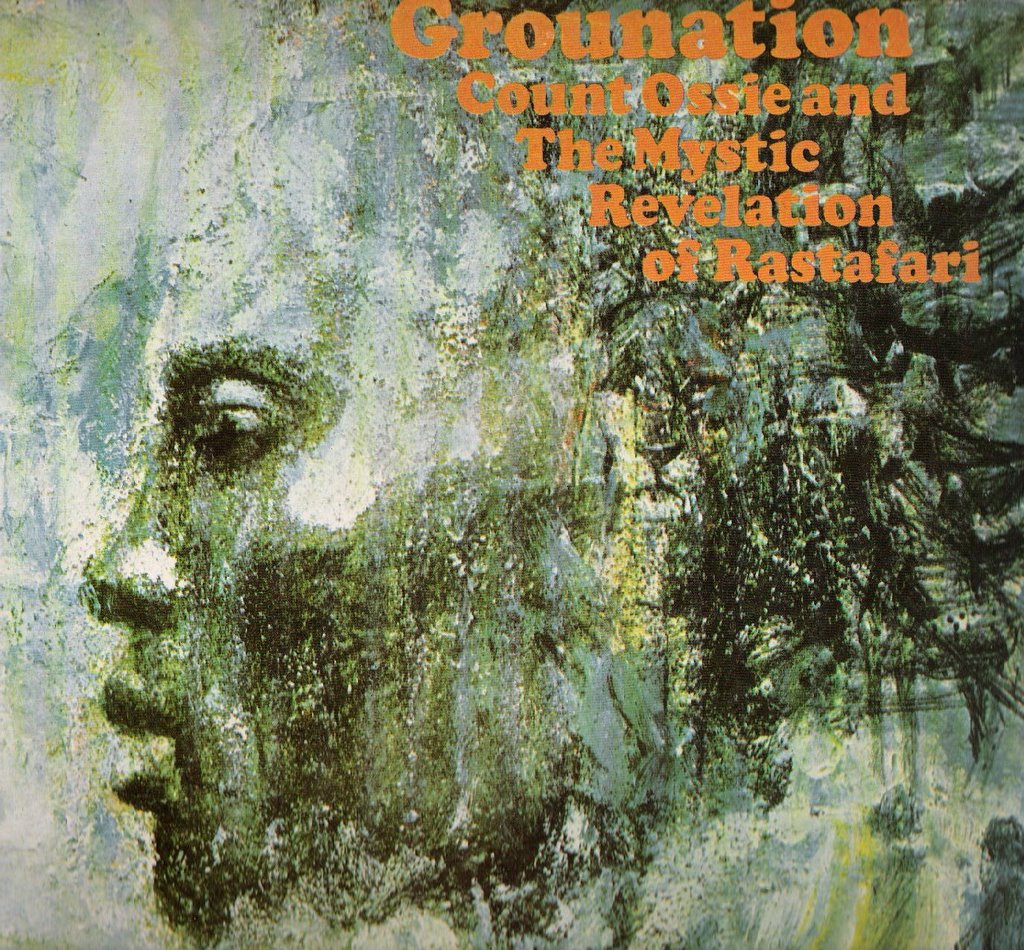
Count Ossie


I think I found this three record boxed set at a remaindered record shop in Barking in the 80's. It was released in the Vulcan label in 1974. It's called "Grounation" and by Count Ossie and The Mystic Revelation of Rastafari.

"The foundations of reggae and its association with Rastafarianism were established by drummer, percussionist and vocalist Count Ossie (born: Oswald Williams). Together with his band, the Mystic Revelation of Rastafari, Count Ossie combined African-influenced music with the European hymnal tradition to create a unique sound that inspired everyone from Ras Michael and the Sons of Negus and the Skatalites to Bob Marley & the Wailers and Toots & the Maytals.

Count Ossie's earliest inspiration came from rasta elder Brother Job, who introduced him to the philosophies of Rastafarianism. A Nyabinghi drummer from the hills of Jamaica, Count Ossie cut his first singles, including "O'Carolina" and "Chubby," for Prince Buster at the studios of RJR radio. Beginning in 1959, Count Ossie recorded for Sir Coxsone Dodd at Studio One.

Together with music director, tenor saxophone, flute and clarinet player Cedric "I-m" Brooks, Count Ossie formed the Mystic Revelation Of Rastafari. Heavily percussive, the group featured philosopher orator Samuel Clayton, double bass player, poet and vocalist Ras Jose, Ras Jose, Little Bop and Count Ossie's son, Time, on fundae drum, bass drummer and percussionist King Rayo, percussionist and vocalist Bunny, percussionist Moses, baritone saxophone and clarinet player Ras Sam II and trombonist Nambo.

There has been some debate as to the cause of Count Ossie's death in 1976. While some sources claim that he was in an auto accident, others say that he was trampled to death when a crowd panicked at the National Arena."

Read more about Count Ossie HERE.


Count Ossie - 400 Years

Count Ossie - Malorat (Passing Thru')

Count Ossie - Grounation (400 Years)


These SendSpace files are available for seven days or until exhausted.

Wednesday, August 09, 2006

Calypsos -Too Hot To Handle


This rather warped copy of "Calypsos - Too Hot To Handle" on the Monogram label was found a fewyears ago but I forget exactly where. The rather risque songs are typical of the calypso of the time which dealt also with social issues and local politics, in fact anything that was news worthy in the West Indies at that time.

"Calypso rhythms can be traced back to the arrival of the first African slaves brought to work in the sugar plantations of Trinidad. Forbidden to talk to each other, and robbed of all links to family and home, the African slaves began to sing songs. They used calypso, which can be traced back to West African kaiso, as a means of communication and to mock the slave masters.

Trinidad was colonized by the Spanish, received large numbers of French immigrants, and was later ruled by the British. This multi-colonial past has greatly impacted the development of calypso in Trinidad. Many early calypsos were sung in a French-Creole dialect called patois ("pat-was"). These songs, usually led by one individual called a griot, helped to unite the slaves.

Calypso singing competitions, held annually at Carnival time, grew in popularity after the abolition of slavery by the British in the 1830s. (It was the French who brought the tradition of Carnival to Trinidad.) The griot later became known as the chantuelle and today as the calypsonian."

Discover more about calypso HERE.


Duke Of Iron - I Left Her Behind For You

Hayden - He like It, She Like It

Marie Bryant - Don't Touch Me Tomato

Duke Of Iron - Music Lesson

Duke Of Iron - Postman


These SendSpace files are available for seven days or until exhausted.

Tuesday, August 08, 2006

Black Orpheus


A 10' LP I found a few years ago in Brick Lane and so excited by my find I sent it to Radio London DJ Charlie Gillett to play on his World Of Difference programme. Sadly it never made it in one piece - folded by some neanderthal postman! Charlie sent it back saying how sorry he was but not his fault. Maybe if he'd had a letter box that was 11 inches wide it would never have happened!?
It is the soundtrack to a film I have never seen but sounds fascinating as it is set in Rio at the time of the Carnaval. The music is by Anonio Carlos Jobin and Luis Bonfa.

"Camus was a professor of painting and sculpture before breaking into film as an assistant to Alexandre Astruc, 'Georges Rouquier' and Jacques Becker, among others. During this period he made his first film, a short documentary called Renaissance Du Havre (1950). Like many French film-makers whose first chance to direct a feature came in the postwar era, Camus chose to deal explicitly with the issue of personal sacrifice in the context of war. But unlike most of his colleagues who quite naturally dealt with WWII, Camus took as his subject the war in Indochina. Camus then embarked on three films in collaboration with writer Jacques Viot.

Marcel Camus' work is often characterised by its lyricism, which was central to his films of the 1950s and 60s - Mort en fraude (1957) (aka Fugitive in Saigon), Orfeu Negro (1959) (aka Black Orpheus) and Vivre la nuit (1967). Black Orpheus brought him international acclaim. Winner of the 1959 Palme d'Or at Cannes and an Academy Award as best foreign language film, this exotic modern adaptation of the Greek legend portrays its Orpheus (Breno Mello) as a streetcar conductor who meets his Eurydice (Marpessa Dawn) and lives out his legendary destiny during the Carnival in Rio de Janeiro."

Luiz Bonfa - Samba De Orfeu

Antonio Carlos Jobin - Scene Du Lever Du Soleil(edit)


These SendSpace files are available for seven days or until exhausted.

SWAPATORIUM: The Best Of The Two Ronnies

Sunday, August 06, 2006

Marlene Dietrich


An LP I found this morning at the boot sale at Chelford for 50p. It says it was recorded live in Rio at the Cococabana Palace but it sounds like the applause was added afterwards to me. Released in 1965 on the Realm (CBS) label. "Musical Supervision by Burt Bacharach".

"The most exotic actress of the 1930s and '40s, Marlene Dietrich performed her cabaret act around the world and recorded for Decca, Columbia and Capitol in the post-war period, after her film career had slowed. A thick German accent and her odd sung-spoken vocal style proved no barrier to international popular success and adoration. Born near Berlin in 1901, she began studying acting as a teenager, and auditioned with director Max Reinhardt several times before entering his drama school. She worked in the German theater and film world during the 1920s, gradually assuming star status until her international breakout at the end of the decade, when she appeared in The Blue Angel, directed by American Josef von Sternberg.

The film's success led directly to Hollywood, where she became one of the major female stars of the 1930s, in such films as Song of Songs, The Scarlet Empress, Knight Without Armour and Destry Rides Again. Because of her German heritage, the newly American citizen made a large mark in the war effort, performing the favorite "Lilli Marlene" on USO tours and recording anti-Nazi propaganda in German. She was awarded the Medal of Freedom and Chevalier of the French Legion of Honor after war's end. She had recorded music in Germany as early as the late '20s, but Dietrich returned again to the vocal industry in the '50s, first with Decca and then a long-standing contract with Columbia. The label released many live albums, preserving her wild cabaret act from various European capitals (several of them recorded with a young Burt Bacharach serving as musical director)."

Discover more about Marlene at her official website HERE.

Marlene Dietrich - Look Me Over Closely

Marlene Dietrich - You're The Cream In My Coffee

Marlene Dietrich - My Blue heaven

Marlene Dietrich - The Boys In The Backroom


These SendSpace files are available for seven days or until exhausted.

Arthur Lee 1945 - 2006


Sad news about Arthur Lee who died yesterday. I always admired the "Forever Changes" Lp that a friend of mine had back in the 60's but never bought myself. Many years later found this "Love Revisited" on the Elektra label (no date) but imagine it's a compilation of tracks from "Forever Changes" and some other 60's albums on Elektra.

"Lee was a genuine prodigy. Born in Memphis in 1945 and raised in the Crenshaw-Adams district of Los Angeles, he made his first recording at 18 and had formed the initial lineup of Love by the time he was 20. The group was unusual not only because it was multiracial (a real rarity in 1966) but because Lee, an African American and Love's unquestioned leader, was largely uninterested in the more traditional expressions of mid-'60s black musical culture -- namely, soul and rhythm and blues.

The first album, titled, simply, "Love," was an energetic but mostly conventional set of short songs -- one highlight was a taut, punked-out rendition of Burt Bacharach's "My Little Red Book" that would have done credit to the Ramones. Their second disc, "Da Capo," was more venturesome, but marred by one side devoted entirely to the interminable "Revelation," a not-especially-inspired jam session that grew.

And then there was "Forever Changes." As Andrew Hultkrans observes in a 130-page book (one of several published to date) about the record's history: " 'Forever Changes' is notable for its relative sonic austerity, with folk and classical influences dominant and not a Mellotron in ear shot. At its core, the record could be the product of an extremely inventive acoustic duo, with bass, drums, and tasteful orchestration providing unobtrusive but essential support. When a wailing electric guitar arrives, which happens only twice, it cuts across the pastoral-Gothic soundscape like a strafing fighter plane, making its point far more effectively than it would in a typical psych-rock context."

Discover more about Arthur Lee and Love HERE.

Love - My Little Red Book

Love - 7 And 7 Is

Love - She Comes In Colours


These SendSpace files are available for seven days or until exhausted.

Bob Buckle


Briefly a member of the Spinners Folk Group - Bob Buckle was a stalwart of the Birmingham folk scene during the 70's and maybe still is though little is found out about him on the internet. This release on the little known Ash Label from Birmingham was from 1975. Bob plays most of the instruments including the the two banjos on Home Sweet Home. Amongst a varied selection of songs- some by Woody Guthrie and Pete Seeger are ditties about sausage machines,emu's eggs and whales.

Bob Buckle - Dry Bed

Bob Buckle - Sammy Bell

Bob Buckle - Home Sweet Home


These SendSpace files are available for seven days or until exhausted.

Saturday, August 05, 2006

Gerrard Hoffnung


This charity find of Timeless Hoffnung was released in 1970, eleven years after his untimely death. These BBC archive snippets include the famous "The Bricklayer" speech from the Oxford Union and several items from radio shows of the 50's.

"Gerard Hoffnung was born in Berlin in 1925 and went to London in 1939 as a schoolboy refugee. Although he died at the early age of 34 years, he achieved in his short life enough to fill a whole series of lifetimes. Artist, teacher, cartoonist, caricaturist, musician and tuba player, broadcaster and raconteur, a much sought after speaker at the Oxford and Cambridge Unions and prison visitor, a Quaker - these were all facets of a creative personality.

In 1956 his talents combined when Hoffnung devised a concert of hilarious symphonic caricature at the Royal Festival Hall in London. Foremost composers were commissioned to write some of their wittiest and most humorous compositions, while conductors, soloists and artists submitted whole-heartedly to the unprecendented demands made upon them. Throughout the years since those performances nearly forty years ago, internationally famous orchestras have delighted in presenting gems from the Hoffnung repertoire to packed audiences. Since then, uninhibited laughter has constantly echoed as visitors file through exhibitions of the hundreds and hundreds of ingenious and absurd ideas, mostly on a musical theme, that Hoffnung illustrated with such superb artistry. His work offers no barrier to age, race or background. Success was immediate and has endured.

Find out more about Gerrrard Hoffnung at his official website HERE.


Gerrard Hoffnung - The Film Fan

Gerrard Hoffnung - Blowing Up Balloons

Gerrard Hoffnung - Tuba

These SendSpace files are available for seven days or until exhausted.

Thursday, August 03, 2006

Ska 45's


A few old scratchy Ska singles now that I found down Brick Lane in the 80's, Most are from the 60's and played to death in juke boxes I imagine.

"THE FIRST WAVE OF SKA. In 1962, a time when Jamaica was copying the musical style of America, Cecil Bustamente Campbell, later known as Prince Buster, felt that something new was needed. He had his guitarist Jah Jerry emphasize the afterbeat instead of the downbeat. To present day, the afterbeat is essential to Jamaican syncopation. Another artist, Rosco Gordon, is credited with the development of Ska. He heavily stressed the second and fourth beats of each bar. Ska was born.

The sound systems began recording their own tracks to gain an advantage over the others, not labeling the vinyl so others could not see what was playing and 'steal' it for their own sound systems. Dodd and Reid were known to scratch out labels on records they purchased during trips to places like Randy's in Tennessee in America, in order to make these releases exclusive.

The sound system war escalated to the point that roughfians were sent to competitor sound system parties to cause problems. These people were known as "Dance Hall Crashers". Despite the primitive mono recording facilities, it was the determination of the Ska enthusiasts which enabled Ska to become the first truly commercial Jamaican Music, and later named the national dance and music of Jamaica."

Read more about the history of ska HERE.


Monty & Roy with Lumbago and His Band - In & Out The Window

Tommy McCook & The Supersonics - Naked City

R.Duffus & C.Brown - No Body Know

Lee Perry - Wind Up Doll


These SendSpace files are available for seven days or until exhausted.

Make Your Own Record


I've always wanted to make my own record. Here's mine. Make yours HERE.

Wednesday, August 02, 2006

Uncle Joe's Mint Balls


I tried to find info. about this Lancashire band but they had no web presence so maybe they broke up many years ago and this tape from the charity shop is older than I thought? It's obviously a self published affair with a cheap one colour printed sleeve and a photo tucked inside the case that a friend had taken on a Box Brownie. The style is all cloth caps and clog irons and reminds me of The Houghton Weavers, The Grumbleweeds and Mike Harding - indeed Harding wrote the title song proclaiming the delights of the Wigan made mint. Maybe the group were taken to court for using the name? Who knows.
Anyway , here's a few tracks of "Folk and comedy Lancashire style".

Uncle Joe's Mint Balls - Uncle Joe's Mint Balls

Uncle Joe's Mint Balls - Dad's Medals

Uncle Joe's Mint Balls - Tek Mi On T'Fair

Uncle Joe's Mint Balls - Awterations


These SendSpace files are available for seven days or until exhausted.

aunclejoes?
Photo found inside the cassette case.

Tuesday, August 01, 2006

Amazing Thrift Vol. 4


Here's another batch of Amazing Thrift including some dodgy film stars who should stick with the day jobs. I heard that Robert Mitchum made an album of calypso songs which intrigues me - this may even be from it? Another compilation by the good folk at Ooh Ooh Music and put togther this time by Mr. Michael ( no relation!).

Here's all of side two-

Robert Mitchum - Foolish Pride

Jack Nicholson - Who Is There Among Us

Joe E. Ross - Are You Lonesome Tonight

K-Mart Food Service - Salad Bar

Sonny James - The Cat Came Back

Don "Jeepers" Bowman - The Wrong House

J.Lansing/D.Bowman/F.Husky - Jamboree Time


These SendSpace files are available for seven days or until exhausted.