Tuesday, June 28, 2011

Morecambe & Wise


The final one from this comedy set bought at the weekend. An early Lp by Morecambe & Wise from 1964 on the cheapo Music For Pleasure label.

Wikipedia says of their early days -

"Morecambe and Wise's partnership began in 1941 when they were each booked separately to appear in Jack Hylton's revue, Youth Takes a Bow at the Nottingham Empire Theatre. War service broke up the act but they reunited by chance at the Swansea Empire Theatre in 1946 when they joined forces again. They made their name in variety, appearing in a variety circus, the Windmill Theatre, the Glasgow Empire and many venues around Britain. After this they also made their name in radio, transferring to television in 1954. Their show, Running Wild, was not well received and led to a damning newspaper review: "Definition of the week: TV set – the box in which they buried Morecambe and Wise." Eric apparently carried this review around with him ever after and from then on Eric and Ernie kept a tight control over their material. In 1956 they were offered a spot in the Winifred Atwell show with material written by Johnny Speight and this was a success.

They had a series of shows that spanned over twenty years, during which time they developed and honed their act, most notably with the original move to the BBC in 1968, where they were to be teamed with their long-term writer Eddie Braben and it is this period of their careers that is widely regarded as their "glory days"."


Tracks are as follows -

1. Not Now later
2. Indians
3. Singing The Blues ( guitar - Ike Issacs )
4. Ton Up Boy (girl - Penny Morrell )
5. Why Did I Let You Go
6. Impressions
7. Grieg Piano Concerto

Orchestras directed by Ken Thorne and Harry Robinson with the Mike Sammes Singers.


Morecambe & Wise - Side One

Burl Ives


Another from the weekend haul. I have fond memories of Burl Ives on Childrens Favourites on the radio and many of the songs he sang on on this compilation on the MCA Coral label.

Wikipedia says of his early life -

"Ives was born in 1909 near Hunt City, an unincorporated town in Jasper County, Illinois, the son of Levi "Frank" Ives (1880–1947) and Cordelia "Dellie" White (1882–1954). He had six siblings: Audry, Artie, Clarence, Argola, Lillburn, and Norma. His father was at first a farmer and then a contractor for the county and others. One day Ives was singing in the garden with his mother, and his uncle overheard them. He invited his nephew to sing at the old soldiers' reunion in Hunt City. The boy performed a rendition of the folk ballad "Barbara Allen" and impressed both his uncle and the audience.

Ives had a long-standing relationship with the Boy Scouts of America. He was a Lone Scout before that group merged with the Boy Scouts of America in 1924. The collection of his papers at the New York Library for the Performing Arts includes a photograph of Ives being "inducted" into the Boy Scouts in 1966. Ives received the organization's Silver Buffalo Award, its highest honor. The certificate for the award is hanging on the wall of the Scouting Museum in Valley Forge, Pennsylvania. Ives often performed at the quadrennial Boy Scouts of America jamboree, including the 1981 jamboree at Fort A.P. Hill in Virginia, where he shared the stage with the Oak Ridge Boys. There is a 1977 sound recording of Ives being interviewed by Boy Scouts at the National Jamboree at Moraine State Park, Pennsylvania; on this tape he also sings and talks about Scouting, teaching, etc. Ives is also the narrator of a 28-minute film about the 1977 National Jamboree. In the film, which was produced by the Boy Scouts of America, Ives "shows the many ways in which Scouting provides opportunities for young people to develop character and expand their horizons."

From 1927-29, Ives attended Eastern Illinois State Teachers College (now Eastern Illinois University) in Charleston, Illinois, where he played football. During his junior year, he was sitting in English class, listening to a lecture on Beowulf, when he suddenly realized he was wasting his time. As he walked out the door, the professor made a snide remark, and Ives slammed the door behind him. Sixty years later, the school named a building after its most famous dropout. Ives was also involved in Freemasonry from 1927 onward.

On July 23, 1929 in Richmond, Indiana, Ives did a trial recording of "Behind the Clouds" for the Starr Piano Company's Gennett label, but the recording was rejected and destroyed a few weeks later."

Tracks are as follows -

1. I Know An Old Lady
2. Molly Malone
3. Horace The Horse
4. The Whistling Rabbit
5. Polly Wolly Doodle
6. Big Rock Candy Mountain/Aunt Rhody/The Fox
7. Ballad Of Davy Crockett
8. What Kind Of Animal Are You?


Burl Ives - Side One

Monday, June 27, 2011

The Singing Postman


Another great find at the boot sale this week was this LP from 1966 on the Parlophone label by Allan Smethurst - The Singing Postman. His one big hit "Hev Yew Gotta Loight Boy?" is included on this curious selection of modern day folk songs sung with a Norfolk accent.

"As the Singing Postman, Allan Smethurst benefited from the British public’s endearing sympathy for the underdog. His most popular hit, Hev Yew Gotta Loight, Boy?, momentarily outsold the Beatles — in East Anglia, at least — and for a few weeks became a national catchphrase. But like many novelty stars before and since, his 15 minutes of fame was little more than that, and after four albums he faded from the public consciousness ending his days as an alcoholic in the care of the Salvation Army.
Smethurst, a postman from Norfolk who hummed his tunes on his daily round, bought his guitar from Woolworths in 1949 and started writing and playing his own dialect songs, initially confining his activities to his bedroom. “It was ten years afore I dare let people hear them,” he once admitted. Plucking up the courage to send a tape to the BBC in Norwich, he was given a spot on a local radio show compered by a sales promotion man, Ralph Tuck, who promptly founded a record label called The Smallest Recording Organisation in the World to promote the Singing Postman. The 100 discs which Tuck had cut in the early weeks of 1966 promptly sold out and Smethurst became an overnight star, ousting the Beatles from the top of the East Anglian hit parade."

It was sadly downhill from then on. He took up drink to try and cure his crippling stage fright but obviously he was destined to be a "one hit wonder" and the music biz moved on to the next novelty act.

Tracks are -

1. January Sales
2. Suffin Cold
3. Spring Cleaning
4. Wass The Bottum Dropped Owt?
5. Hev Yew Gotta Loight, Boy?
6. The Cricket Match


The Singing Postman - Side One

Clinton Ford


An Lp on the cheapo Marble Arch label from 1968 I found at the boot sale the other day for 50p. I have a couple of other Lp's by Clinton Ford and all the songs are from the music hall or written in that comedic style. Clinton is accompanied by George Chisholm (trombone) and the Inmates.

Clinton Ford, whose real name was George Harrison strangely enough was born in 1931 in Salford near Manchester in the North West of England.
"Clinton will now be best remembered for his novelty song, "Fanlight Fanny"- a recording he made while he was with Oriole, a minor label which had association with the Woolworth's budget record brand, 'Embassy'. In fact Clinton Ford was one of Oriole's most successful artists for a while, and "Fanlight Fanny" looked like Clinton's break into the big time. Sadly, it never quite happened.

Like many other artists of the time, Clinton had first excercised his entertainment ambitions by becoming a 'redcoat' at Butlins. Although his own leanings were towards country and western material, he began singing with traditional jazz bands and skiffle groups. This appears to have influenced his style somewhat and much of his best work was done in the company of trad groups like the Merseysippi Jazz Band and George Chisholm for example. Clinton's choice of recorded material was certainly diverse- with everything from the country flavoured sentimental 'Old Shep' and his confident interpretation of 'Run To The Door' through the most outrageous novelties like 'The Old Bazaar In Cairo' and even George Formby's 'Why Don't Women Like Me'."

Tracks are -

1. My Baby's Wild About My Old Trombone
2. The Old Bazaar In Cairo
3. He Played His Ukulele As The Ship Went Down
4. The Pig Got Up And Slowly Walked Away
5. The Night I Appeared As Macbeth
6. The Biggest Balalaika In The World


Clinton Ford - Side One

Wednesday, June 22, 2011

Little Marcy


Not a great deal from the boot sales lately but did find this curiosity today for a few pence. Little Marcy is a ventriloquists doll and well known amongst collectors of strange records. It's on the Word World Wonder Series label out of Waco Texas. It has a price tag of 1:98 dollars on the sleeve depicting Marcy and her animal friends.
It was released in 1968.

"Marcy Tigner, her puppet Little Marcy, and her unusual "child-like" singing voice, found her art, her niche, in the only venue available to so many like her - Christian childrens' music. Over three decades her unusual act has been fascinating, inspiring, sometimes repelling audiences from all over, depending on one's beliefs and point of view. Even today, when her music is often categorised as 'bad' or 'disturbing,' people find confirmation of their faith in it - and in fact, it stands head and shoulders above most of the other work in the genre thanks to top-notch production values.


Her albums have been released and re-released under various labels and at various prices, as was (and probably still is) typical for the genre. What we have here is an attempt - likely foredoomed to failure - to list every "Little Marcy" album and related release ever, along with whatever other data we can glean from thrift store record purchases and random bits of research."


Little Marcy - Side Two

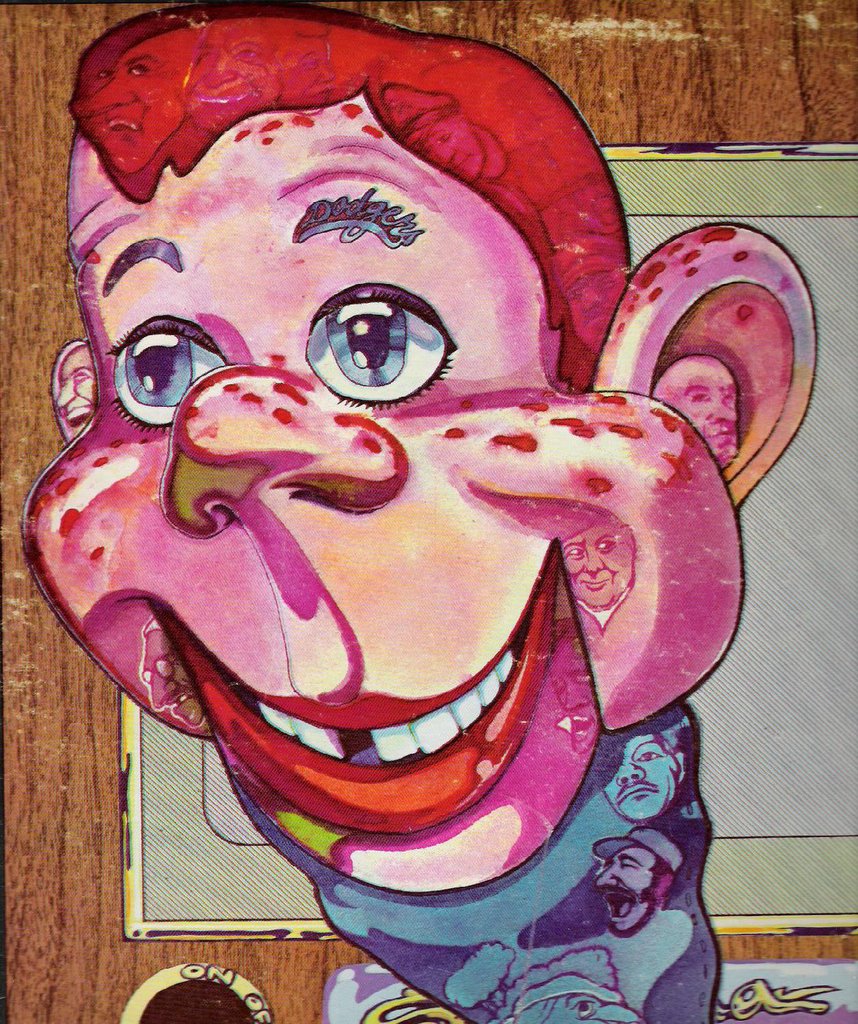
Howdy Doody Time


"The Howdy Doody Show was one of the first and easily the most popular children's television show in the 1950s and a reflection of the wonder, technical fascination, and business realities associated with early television. While Howdy and his friends entertained American children, they also sold television sets to American parents and demonstrated the potential of the new medium to advertisers.

The idea for Howdy Doody began on the NBC New York radio affiliate WEAF in 1947 with a program called The Triple B Ranch. The three Bs stood for Big Brother Bob Smith, who developed the country bumpkin voice of a ranch hand and greeted the radio audience with, "Oh, ho, ho, howdy doody." Martin Stone, Smith's agent, suggested putting Howdy on television and presented the idea to NBC televi-sion programming head Warren Wade. With Stone and Roger Muir as producers, Smith launched Puppet Playhouse on 17 December 1947. Within a week the name of the program was changed to The Howdy Doody Show."

A strange record on the the Leslee label from the 60's I would guess by the graphics. A weird mixture of newsreel from the 50's and 60's and cut between songs and segments of a puppet show for children! Not quite sure who it is aimed at. Certainly a curiosity and I uplaod side two here for your bewilderment!


Howdy Doody - Side Two

Tuesday, June 14, 2011

American Top Pops


Curious Ep on the cheapo Gala label from the 60's - versions of pop hits of the time. The Lonely One sounds like it might have been by Duanne Eddy originally. The Coasters did the original of Charlie Brown ofcourse. Not sure about the other two. Anyone have any ideas?

The main reason I bought it from the boot sale in the first place though was the great sleeve photo of a woman with her hand up the horn of an old gramophone!


Richard Deane - The Lonely One

The Promineers - Charlie Brown

Bob Mitchell - I Got A Wife

Bobby Green - I Cried A Tear

Wednesday, June 08, 2011

Ian Dury


A radio show from 1978 on BBC Radio One. I think it was called "Star Choice" - where pop celebrities of the day played DJ for two hours and raided the BBC Archives. It was Ian Dury's turn and a wonderful eclectic mix it was too -including Max Miller , Roland Kirk, Kay Starr and Albert Ayler to name but a few.

Wikipedia says -

"Dury was born in north-west London at his parents' home at 43 Weald Rise, Harrow Weald, Harrow (although he often pretended, and indeed all but one of his obituaries in the national press stated, that he was born in Upminster, Havering). His father, William George Dury (born 23 September 1905, Southborough, Kent; died 25 February 1968), was a bus driver and former boxer, while his mother Margaret (known as Peggy, born Margaret Cuthbertson Walker, 17 April 1910, Rochdale, Lancashire) was a health visitor, the daughter of a Cornish doctor, and granddaughter of an Irish landowner.

William Dury trained with Rolls-Royce to be a chauffeur, and was then absent for long periods, so Peggy Dury took Ian to stay with her parents in Cornwall. After the Second World War, the family moved to Switzerland, where his father chauffeured for a millionaire and the Western European Union. In 1946 Peggy brought Ian back to England and they stayed with her sister, Mary, a physician in Cranham, a small village bordering Upminster. Although he saw his father on visits, they never lived together again.

At the age of seven, he contracted polio; very likely, he believed, from a swimming pool at Southend on Sea during the 1949 polio epidemic. After six weeks in a full plaster cast in Truro hospital, he was moved to Black Notley Hospital, Braintree, Essex, where he spent a year and a half before going to Chailey Heritage Craft School, East Sussex, in 1951. Chailey was a school and hospital for disabled children, and believed in toughening them up, contributing to the observant and determined person Dury became. Chailey taught trades such as cobbling and printing, but Dury's mother wanted him to be more academic, so his aunt Moll arranged for him to enter the Royal Grammar School, High Wycombe which he attended until the age of 16 when he left to study painting at Walthamstow Art College, having gained GCE 'O' Levels in English Language, English Literature and Art.

From 1964 he studied art at the Royal College of Art under British artist Peter Blake, and in 1967 took part in a group exhibition, Fantasy and Figuration, alongside Pat Douthwaite, Herbert Kitchen and Stass Paraskos at the Institute of Contemporary Arts in London. When asked why he did not pursue a career in art, he said, "I got good enough [at art] to realise I wasn't going to be very good."[citation needed] From 1967 he taught art at various colleges in the south of England.

Dury married his first wife, Elizabeth 'Betty' Rathmell (born 12 August 1942, Leamington Spa, Warwickshire), on 3 June 1967 and they had two children, Jemima (born 4 January 1969, Hounslow, Middlesex) and the recording artist Baxter Dury. Dury divorced Rathmell in 1985, but remained on good terms. He also cohabited with a teenage fan, Denise Roudette, for 6 years after he moved to London."


Ian Dury's Choice - Side One

Ian Dury's Choice - Side Two

Thursday, May 26, 2011

Harry The Hipster Gibson


I thought I had featured Harry The Hipster Gibson before here but a quick search through the archives reveals that I haven't. So putting things right with one side of a cassette that Harry shares with Cecil Gant and Benny Carter on the Italian Curcio label which looks like it was part of a magazine called I Giganti Del Jazz from 1981 - but the tracks here were recorded in 1944.

Wikipedia says -

"In the 1940s, Gibson was known for writing unusual songs, which are considered ahead of their time. He was also known for his unique, wild singing style, his energetic and unorthodox piano styles, and for his intricate mixture of a hardcore, gutbucket boogie rhythms with ragtime, stride and jazz piano styles. Gibson took the boogie woogie beat of his predecessors, but he made it frantic; similar to the rock and roll music of the 1950s Examples of his wild style are found in the songs "Riot in Boogie" and "Barrelhouse Boogie". An example of his strange singing style is in the song "The Baby and the Pup." Other songs that Gibson recorded were "Handsome Harry, the Hipster", "I Stay Brown All Year 'Round", "Get Your Juices at the Deuces", and "Stop That Dancin' Up There." Gibson recorded a great deal, but there are very few visual examples of his act. However, in New York in 1944, he filmed three songs for the Soundies film jukeboxes, and he went to Hollywood in 1946 to guest star in the feature-length film musical Junior Prom. Gibson preceded the first white rock and rollers by a decade, but the Soundies he recorded show significant similarities to rock and roll.
"Harry the Hipster" headlining at the Onyx on 52nd Street, May 1948. Note in the photo the Deuces as well as Leon and Eddie's.

While working on "Swing Street" at night, Gibson was a fellow at the Juilliard Graduate School during the day. At the time, Juilliard was strictly a classical music academy, and Gibson excelled there, which partly explains the richness of the music he brought to the jazz world. The other part of the explanation is, his own inventiveness, and Gibson was almost always billed and promoted as a musical genius."

Songs on Side One are-

1. Handsome Harry, The Hipster Gibson
2. Riot In Boogie
3. Stop That Dancin' Up There
4. Get Your Deuces At The Deuces
5. The Hipster's Blues Opus 6
6. The Hipster's Blues Opus 7


Harry The Hipster Gibson - Side One

Tuesday, May 17, 2011

Phil Harris


A CD on the Living Era label thats probably still available. A good selection of his well known and not so well known tracks recorded back in the 40's and 50's.

Wikipedia says- "Although he was born in Linton, Indiana, Harris actually grew up in Nashville, Tennessee and identified himself as a Southerner (his hallmark song was "That's What I Like About the South"). His upbringing accounted for both his trace of a Southern accent and, in later years, the self-deprecating Southern jokes of his radio character. Harris began his music career as a drummer in San Francisco, forming an orchestra with Carol Lofner in the latter 1920s and starting a long engagement at the St. Francis Hotel. The partnership ended by 1932, and Harris led and sang with his own band, now based in Los Angeles. From December, 1936 through March, 1937, he recorded 16 sides for Vocalion, most were hot swing tunes that used a very interesting gimmick; they faded up and faded out with a piano solo (probably these were arranged their pianist Skippy Anderson). This was a novel approach and quite unusual for the time.
On September 2, 1927, he was married to actress Marcia Ralston in Sydney, Australia. The couple adopted a son, Phil Harris, Jr. (b. 1935). They were divorced in September, 1940.
Phil Harris played drums in Henry Halstead Big Band Orchestra in the 1920s.
In 1933, he made a short film for RKO called So This Is Harris, which won an Academy Award for best live action short subject. He followed it up with a feature-length film called Melody Cruise. Both films were created by the same team that next produced Flying Down To Rio, which started the successful careers of Fred Astaire and Ginger Rogers."

Discover more about Phil Harris HERE


Phil Harris - Some Little Bug

Phil Harris - My Kind Of Country

Phil Harris - One-Zy Two-Zy

Phil Harris - The Thing

Fred Douglas


Not really a boot sale find but an excuse to upload some novelty songs by Fred Douglas who I know nothing about except he made lots of cover versions of hits on the cheap Regal label that sold in Woolworths I believe back in the 30's and 40's. Later they had the Embassy label which did a similar service - all the pop hits of the day by obscure singers who nobody had ever heard of! Fred Douglas went by many other nome de plumes, some say as many as 60 including the comedy duo The Two Gilberts.

Chris Gavin says of The Two Gilberts -

"Almost nothing is known about this comedy duo, but it can be surmised from their recordings that the people making up the pairing varied with time. The odd thing is that the Two Gilberts appear at a time when comedy duettists had just about died out in terms of popularity. Harry Cove & Billy Thompson had dominated the recording studios (along with the likes on Will Brockton, Jack Charman, Stanley Kirkby, Lionel Rothery etc) with their duet records from before WWI. People with a good ear claim that Fred Douglas, a prolific maker of records in his own name, is always one of the pair. Recently it has been claimed that the most regular duo were Fred Douglas and Leslie Rome.

Interestingly, both Cove and Thompson were mainstays of The Two Gilberts at different times. Thompson seems to be Douglas's first partner before Cove took over in mid-1924. Recordings by Tom Gilbert exist, usually paired with recordings of the Two Gilberts, these records issued as by Tom Gilbert are also by Fred Douglas; the Regal company obviously dreamt up the name as a tie-in with the duettists as well as issuing record under Douglas's own name.

It seems that about these artists: Douglas, Thompson & Cove, very little is known as they spent pretty well the whole of their careers as recording artists, generally looked down upon by collectors and researchers as "of no historical importance or interest"."


Fred Douglas - Yes, Sir That's My Baby

Fred Douglas - Vamping Rose

Fred Douglas - Mammy

Fred Douglas - Aurora Borealis

Monday, May 09, 2011

Los Macarenos


An EP on the Regal label in Spain from 1961. Also from the same box of smoked records at the boot sale on Sunday. Some were a bit too near the fire and were badly burned or warped! This one had the wrong sleeve but will try and find one on the internet. Typical flamenco one would purchase on a package holiday in Spain.


Los Macarenos - En Er Mundo/ Los Duros Antiguos

Chris Barber


A 10 inch LP on the Pye Nixa label from 1956 I bought at a boot sale this weekend for 50p. Its slightly scratched and the sleeve shows signs of smoke damage and wear.
Line-up is Chris Barber ( trombone ), Pat Halcox ( trumpet ), Monty Sunshine ( clarinet ), Lonnie Donegan ( banjo ), Ron Bowden ( drums ) and Mick Ashman ( bass ).

Wikipedia says -

"Barber played trombone with Ken Colyer in 1949 and began leading his own bands in which he played trombone and double bass in 1950. Barber helped to create the careers of many diverse musicians, most notably the blues singer Ottilie Patterson, who was at one time Mrs Barber. Others include vocalist and banjo player Lonnie Donegan who rose to his own fame during the skiffle music craze of the mid 1950s. He had his first transatlantic hit during his time in Chris Barber's band with the release of "Rock Island Line".

In addition to Donegan, Barber also featured Pat Halcox on trumpet from 1954 onwards, once Ken Colyer had moved on after a difference of opinion as to the way the band should develop. The band formed in 1953 took Colyer's name as they thought that his recent spell in New Orleans would be an attraction, with Monty Sunshine on clarinet, Donegan, Jim Bray (bass), Ron Bowden (drums) and Barber on trombone. In April, 1953, the band made its public debut in Copenhagen where Chris Albertson recorded several sides for the then new Danish Storyville label, including some with a trio from the band, Sunshine, Donegan and Barber (on bass). Later, back in London, Sunshine and Barber recorded a version of Bechet's "Petite Fleur" that made it to #3 in the UK Singles Chart, spending a total of twenty-four weeks therein. It sold over one million copies, and was awarded a gold disc. Although the Barber band featured traditional jazz in the New Orleans style, it later also engaged in ragtime, swing, blues and R&B and worked with other artists including Louis Jordan and Dr. John. After 1959 he toured the United States many times.

In the late 1950s and early 1960s, Barber was mainly responsible for arranging the first UK tours of seminal blues artists such as Big Bill Broonzy, Sonny Terry & Brownie McGhee and Muddy Waters. This, along with encouragement from local enthusiasts such as Alexis Korner and John Mayall, sparked the interest of young local prospective musicians such as Peter Green, Eric Clapton and the members of the The Rolling Stones in the blues, and caused the British blues explosion that in turn resulted in the British invasion exported back to the US in the middle to late 1960s. In January 1963, the British music magazine, NME reported that the biggest trad jazz event to be staged in Britain had taken place at Alexandra Palace. The event included George Melly, Diz Disley, Acker Bilk, Alex Welsh, Kenny Ball, Ken Colyer, Sunshine, Bob Wallis, Bruce Turner, Mick Mulligan and Barber."


Side One -

1. Whistlin' Rufus
2. Big House Blues
3. April Showers

Side Two -

1. One Sweet Letter From You
2. Hushabye
3. We Shall Walk Throuhg The Valley


Chris Barber - Side One

Chris Barber - Side Two

Wednesday, May 04, 2011

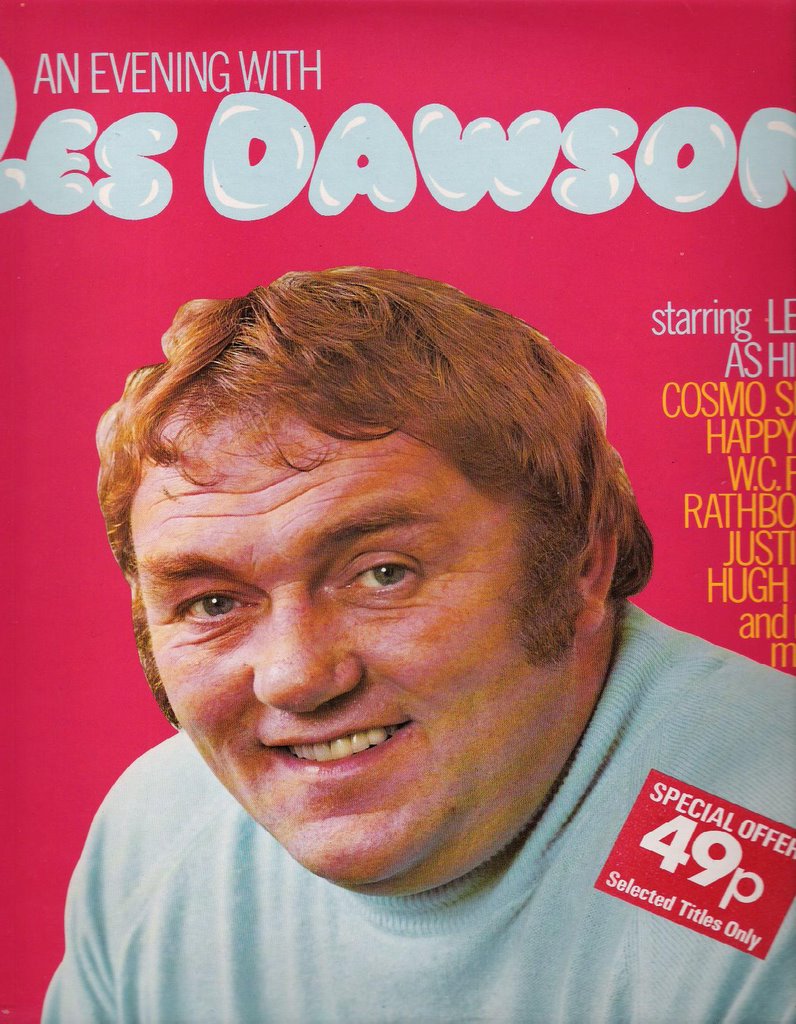
Les Dawson (Re-Up)


"Les Dawson (2 February 1931 - 10 June 1993) was a popular Lancashire comedian, known for his deadpan style. Dawson was a curmudgeon, famous for jokes about his mother-in-law and his wife.
Dawson began his entertainment career as a club pianist ("I finally heard some applause from a bald man and said 'thank you for clapping me' and he said 'I'm not clapping - I'm slapping me head to keep awake.'"), but found that he got more laughs by playing wrong notes and complaining to the audience. He made his television debut in the talent show, Opportunity Knocks, and was seldom absent from British television screens in the years that followed. His best known routines featured Roy Barraclough and Dawson as two elderly women, Cissie Braithwaite and Ada Sidebottom who, having worked in a mill in their youth, spoke some words aloud and mouthed others--particularly those pertaining to bodily functions and sex; they also repeatedly pushed up their bosoms, in pantomime dame style, an act copied faithfully from his hero, Norman Evans. Dawson's humour, though earthy, was seldom coarse, and he was as popular with female as with male audiences."

A very funny man and in reality he could play the piano really well. Most of this record is comedy routines but I have extracted two "musical" interludes for your enjoyment, or not as the case may be! A bargain at 49p!

Side Two consists of tracks -

1. I Can't Control Myself
2. Jeremiah Fisher Frog
3. Show Me The Way To Go Home
4. Goodbye (from "Whie Horse Inn" )


Les Dawson - Side Two

Les Dawson - Bye Bye Blackbird

Wednesday, April 27, 2011

Billy Cotton Band


LP on the Columbia label from 1961 when the The Billy Cotton Band Show was at it's height on BBC radio and TV. I have fond memories of his show being aired at Sunday lunchtime as the family all sat round the dinner table to eat. I bought this purely for the nostalgia of a bygone time that will never be again.

Wikipedia says -

"William Edward Cotton (6 May 1899 – 25 March 1969), better known as Billy Cotton, was a British band leader and entertainer, one of the few whose orchestras survived the dance band era. Today, he is mainly remembered as a 1950s and 1960s radio and television personality, although his musical talent emerged as early as the 1920s. In his younger years Billy Cotton was also an amateur footballer for Brentford F.C.(and later, for the then Athenian league club Wimbledon, now AFC Wimbledon), an accomplished racing driver and the owner of a Gipsy Moth which he piloted himself.
Born in Smith Square, London, to Joseph (born in 1858 in Coventry, Warwickshire) and Susan Cotton, Cotton was a choirboy and then started his musical career as a drummer, an occupation he also pursued in the army during the First World War. He enlisted in the Royal Fusiliers by falsifying his age and saw service in Malta and Egypt, before landing at Gallipoli in the middle of an artillery barrage. Later in the war he was recommended for a commission and learned to fly Bristol Fighter aircraft. He flew solo for the first time on 1918-04-01, the day the Royal Flying Corps became the Royal Air Force. He was then not yet 19 years old.
He married Mabel E. Gregory in 1921 and had two sons, Ted and Bill Jnr. In the inter-war years. he had several jobs such as bus driver before setting up his own orchestra, the London Savannah Band, in 1924. At first a straight dance band, over the years the London Savannah Band more and more tended towards music hall/vaudeville entertainment, introducing all sorts of visual and verbal humour in between songs. Famous musicians that played in Billy Cotton's band during the 1920s and 1930s included Arthur Rosebery, Syd Lipton and Nat Gonella. The band was also noted for their African American trombonist and tap dancer, Ellis Jackson. Their signature tune was "Somebody Stole My Gal", and they made numerous records – 78s, that is – for Decca.
During the Second World War Cotton and his band toured France with the Entertainments National Service Association (ENSA). After the war, he started his successful Sunday lunchtime radio show on BBC, the Billy Cotton Band Show, which ran from 1949 to 1968. In the 1950s composer Lionel Bart contributed comedy songs to the show. It regularly opened with the band's signature tune and Cotton's call of "Wakey Wakey". From 1957, it was also broadcast on BBC television.
In 1962 Billy Cotton suffered a stroke. He died in 1969 while watching a boxing match at Wembley. His son, Bill Cotton, later became BBC's head of variety."

Tracks are as follows -

1. Somebody Stole My Girl
2. Sing Sing Sing / Sugartime / Let's gather Round The parlour Piano / Bill Bailey Won't You Please Come Home ( with Alma Cogan, Russ Conway and the Silouettes.)
3. Exodus Song ( with Grisha Farfel )
4. And The Great Big Saw Came Nearer and Nearer ( with Alan Breeze & The Highlights )
5. Let's Face The Music & Dance ( with Alma Cogan )
6. She's Funny That Way / The Man I Love / You Were meant For Me ( with Alma Cogan )
7. Ta Ra Ra Boom De Ay / Ragtime Cowboy Joe / Row, Row, Row ( company and audience )


Billy Cotton Band - Side One

Cliff Carlisle


Another from the recent boot sale batch. On the Old Timey label from 60's I imagine, though songs recorded back in the 30's. Similar to Tommy Collins but more yodelling and exceptional steel guitar.

Wikipedia says -

"Carlisle was born in Taylorsville, Kentucky and began performing locally with cousin Lillian Truax at age 16. Truax's marriage put an end to the group, and Carlisle began playing with Wilber Ball, a guitarist and tenor harmonizer. The two toured frequently around the U.S. playing vaudeville and circus venues in the 1920s.
Carlisle and Ball first played at Louisville, Kentucky radio station WHAS-AM in 1930, which made them local stars, and later that year they recorded for Gennett Records and Champion Records. In 1931, they recorded with Jimmie Rodgers. Toward the end of 1931, Carlisle signed with ARC and was offered performance slots on several radio stations, including WBT-AM in Charlotte, North Carolina, WLS-AM in Chicago and WLW-AM in Cincinnati, Ohio. Cliff's brother Bill became his guitarist after Ball left in 1934. During the 1930s Carlisle, who recorded a large amount of material despite a hiatus from 1934 to 1936, frequently released songs with sexual connotations including barnyard metaphors (which became something of a hallmark).
Carlisle toured with his son, "Sonny Boy Tommy," to occasional consternation from authorities in areas where this contravened local child labor laws. He continued to perform on WMPS-AM in Memphis, Tennessee for several years in the 1940s, but by the 1950s had retired from music.
In the 1960s, The Rooftop Singers covered his tune "Tom Cat Blues"; in its wake, Carlisle and Ball did a few reunion shows together and recorded for Rem Records. On April 2, 1983, Carlisle died at the age of 79 in Lexington, Kentucky."

Tracks are as follows -

1. Hobo Blues
2. Shot The Innocent man
3. Two Little Sweethearts
4. Trouble Minded Blues
5. The Hobo's Fate
6. Payday Fight
7. Waiting For A Ride


Cliff Carlisle - Side One

London Barrel Organ


This was 10p in a charity shop so could hardly pass it up. Turns out to be pretty much what I expected and a nostalgic reminder of what the buskers of Victorian London must have sounded like - monkey with tin cup and all!

Wikipedia says -

"A barrel organ (or roller organ) is a mechanical musical instrument consisting of bellows and one or more ranks of pipes housed in a case, usually of wood, and often highly decorated. The basic principle is the same as a traditional pipe organ, but rather than being played by an organist, the barrel organ is activated either by a person turning a crank, or by clockwork driven by weights or springs. The pieces of music are encoded onto wooden barrels (or cylinders), which are analogous to the keyboard of the traditional pipe organ.

The pieces of music (or tunes) are encoded onto the barrel using metal pins and staples. Pins are used for short notes, and staples of varying lengths for longer notes. Each barrel usually carried several different tunes. Pinning such barrels was something of an art form, and the quality of the music produced by a barrel organ is largely a function of the quality of its pinning. This complex encoding of music was an early form of programming.
The organ barrels must be sturdy to maintain precise alignment over time, since they play the same programming role as music rolls and have to endure significant mechanical strain. Damage to the barrel, such as warpage, would have a direct (and usually detrimental) effect on the music produced.
The size of the barrel will depend on the number of notes in the organ and the length of the tune to be played. The more notes, the longer the barrel. The longer the tune, the greater the diameter.
Since the music is hard-coded onto the barrel, the only way for a barrel organ to play a different set of tunes is to replace the barrel with another one. While not a difficult operation, barrels are unwieldy and expensive, so many organ grinders only have one barrel for their instrument."

Tracks on side one are -

1. I Do Like To Be Beside The Seaside
2. Don't Dilly Dally
3. The Honeysuckle & The Bee
4. Wouldn't It Be Loverly
5. Run Rabbit Run
6. That Old Fashioned Mother Of Mine
7. God Bless The Prince Of Wales

London Barrel Organ - Side One

Tommy Collins


An LP on the Capitol label from 1984 but original recordings from 1959. Found at car boot the other day in Frodsham. I'd not heard of Tommy Collins before I must admit but pleasantly surprised by the overall sound which reminds me of Hank Williams and several other artistes of that era when country music had that hillbilly swing.

Wikipedia says -

"Leonard Raymond Sipes (September 28, 1930 – March 14, 2000), better known as Tommy Collins, was an American country music singer and songwriter.
Active primarily during the 1950s through 1970s, Collins was instrumental in helping create the Bakersfield sound of the country music genre. He enjoyed a string of hits during the mid-1950s including "It Tickles" and "Watcha Gonna Do Now". He also wrote several songs for other artists, including "If You Ain't Lovin' (You Ain't Livin')", which was a top 10 hit for Faron Young in 1954 and a No. 1 hit by George Strait in 1988.
After several years in the ministry, Collins returned to recording. In 1965, he had a comeback hit with "If You Can't Bite, Don't Growl". In the 1970s, he wrote several hits for Merle Haggard, including the No. 1 hits "Carolyn" and "The Roots of My Raising". In 1981, Haggard recorded a biographical tribute to Collins called "Leonard".
Collins was the inspiration and character talked about in Craig Morgan's song, "I Wish I Could See Bakersfield"
Collins remained active in the songwriting business. He died March 14, 2000, in Ashland City, Tennessee."

Tracks on side one are -

1. You Better Not Do That
2. I Always Get A Souvenir
3. Untied
4. How Do I Say Goodbye
5. I'll Be Gone
6. It Tickles


Tommy Collins - Side One

Friday, April 22, 2011

Pedro & His Amigos


My son actually bought this record in Buxton yesterday in a charity shop as a joke gift for a friend. I managed to borrow it to have a listen before he wrapped it up. Despite the amuisng sleeve the record offers little for the world music afficianado! It is quite charming in its simplicity and so uploading three tracks so you can hear a sample of what you might find if ever you see it in your local charity shop or boot sale.


Eddie & His Amigos - Granada

Eddie & His Amigos - El Gallo

Eddie & His Amigos - Tico Tico

Kantata


Not sure where I got this LP on the Asona label from. Made in 1986 in London England.

The sleeve notes by Anthony Roberts-Frampong say -

" Katana are Lee Duobo, Sylvester Kwame, Eddie Sey, Ogene Kologbo, Emmanuel Roberts and Fouad Amoo. Now based in West Berlin their music features strong funky harmonies but retains the subtle influence of their West-African roots - Highlife.
This is the second album, the first namely AKWANKWAA (DUKE) released on the Oval label in 1984. It is interesting to note that this is the finest example to date of Katana's work, and when you listen to it you will undoubtedly agree with me. It is an excellent blend of smooth and funky highlife sounds exemplified by IT'S HIGH TIME NOW, ODO BEBA (ATEAA), and with their more defined treatment of the Ghanaian traditional song MONSOM."

Side two features the tracks -

1. Monsom
2. saturday Night
3. Feeling So Nice


Katana - Side Two