Friday, December 16, 2005

The Spotnicks


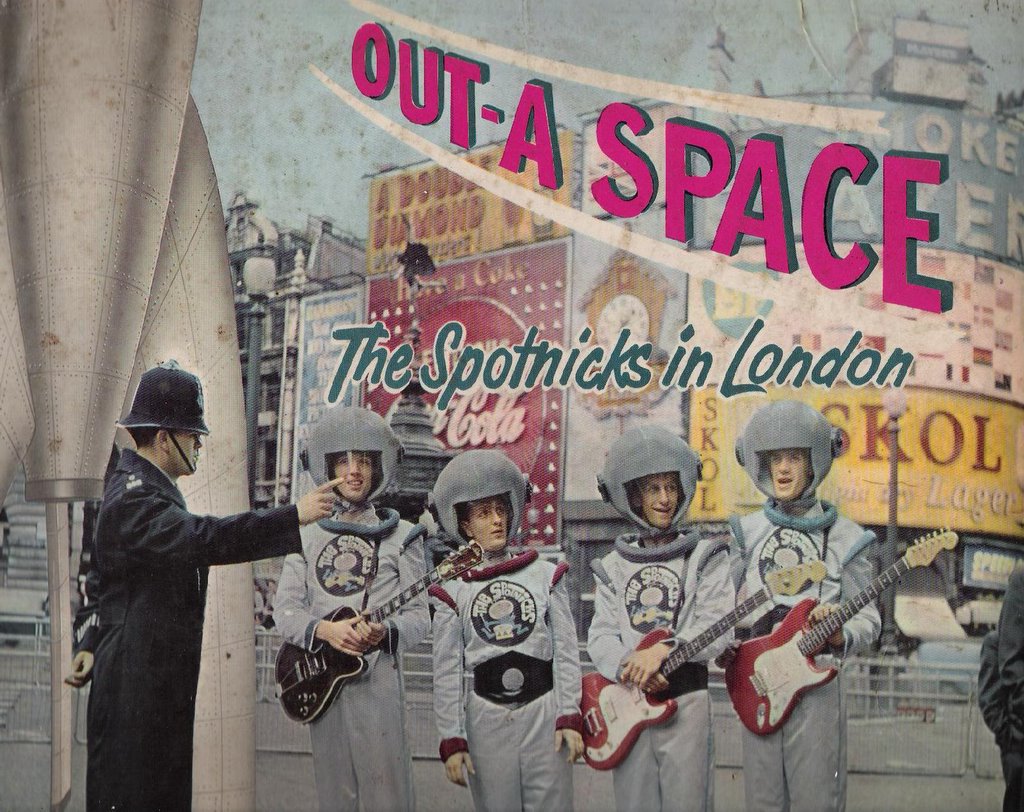
"The Spotnicks was formed in Göteborg, Sweden, in 1957, by guitarist and undisputed bandleader Bo Winberg. The other members were guitarist and singer Bob Lander, drummer Ove Johansson, and bassist Björn Thein, several of whom had already played together in local rock & roll bands like the Blue Caps, Rock Teddy, and the Rebels. The first year, they performed under the name the Frazers, but soon changed it to the Spotnicks. In 1961, they were signed by Karusell and released their first singles containing mostly instrumental covers of famous songs. The selection of songs was as varied as the performance was homogenous, including titles like "Hava Nagila" and "Johnny Guitar." Later the same year, the Spotnicks toured Germany, France, and Spain and in 1962, they released the debut album The Spotnicks in London, recorded on their first trip to England. Featured on this tour were the space suits that the band would wear on-stage until 1969. "Hava Nagila" became a hit in England in 1963 and the same year, Johansson left and was replaced by Derek Skinner. The rest of the '60s meant increasing success in Europe, the U.S., and Japan, and the band even managed to compete with themselves on the Japanese charts when the Spotnicks' song "Karelia" took the first position from the Feenades' "Ajomies." The song was the same, just recorded under different titles. The Feendes were a Finland-based side project to the Spotnicks, built on Winberg and Peter Winsnes, who had joined the Spotnicks in 1965. Winberg also released less successful recordings under the name the Shy Ones. Compared to the following decades, the '60s were a relative stable period for the group when it came to the lineup. Some new members were recruited though, like drummer Jimmie Nicol, bassist Magnus Hellsberg, and drummer Tommy Tausis, who had earlier played with Tages

In 1969, the Spotnicks disbanded, but Winberg continued to record using the name until the group reunited in 1972 on request by a Japanese record company. The same year, "If You Could Read My Mind" from the album Something Like Country became a big hit in Germany. The Spotnicks would keep their popularity there for a long time, even as it faded elsewhere. Only the Japanese audience proved more faithful and accordingly, the Spotnicks located most of their tours during the '70s to these countries. After the release of Something Like Country in 1972, by many fans seen as the Spotnicks' best album, they had practically ended being a band, consisting mainly of Winberg and various session musicians."

I must apologize for the terrible condition of this record. Found at Brick Lane flea market many years ago. The sleeve photo is a classic and the music is pretty good too despite the crackles and jumps!

The Spotnicks - Old Kentucky Home

The Spotnicks - I'm Going Home

Download these Rapid Share files as described before in previous posts.

Thursday, December 15, 2005

Billy Cotton Band


"William Edward Cotton (May 6, 1899 – March 25, 1969), better known as Billy Cotton, was a British band leader and entertainer, one of the few whose orchestra survived the dance band era. Today, he is mainly remembered as a 1950s and 60s radio and television personality, although his musical talent emerged as early as the 1920s. In his younger years Billy Cotton was also an amateur footballer, an accomplished racing driver and the owner of a Gipsy Moth which he piloted himself.
Born in Lambeth, London, Cotton was a choirboy and then started his musical career as a drummer, an occupation he also pursued in the army during the First World War. In the interwar years he had several jobs such as bus driver before setting up his own orchestra, the London Savannah Band, in 1924. At first a straight dance band, over the years the London Savannah Band more and more tended towards Music Hall/vaudeville entertainment, introducing all sorts of visual and verbal humour in between songs. Famous musicians that played in Billy Cotton's band during the 1920s and 30s included Arthur Rosebery, Syd Lipton and Nat Gonella. The band was also noted for their African American trombonist and tap dancer, Ellis Jackson. Their signature tune was "Somebody Stole My Gal", and they made numerous records – 78s, that is – for Decca.

During the Second World War Cotton and his band toured France with the Entertainments National Service Association (ENSA). After the war, he started his successful Sunday lunchtime radio show on BBC, the Billy Cotton Band Show, which ran for more than 20 years from 1949. It regularly opened with the band's signature tune and Cotton's call of "Wakey Wakey". From 1957, it was also broadcast on BBC television.
In 1962 Billy Cotton suffered a stroke. He died in 1969 while watching a boxing match at Wembley."

Billy Cotton Band - I've Got A Lovely Bunch Of Cocoanuts

BIlly Cotton Band - The Marrow Song

See previous blogs to find out how to access the Rapid Share files.

Wally Whyton


"Born in London, Whyton studied piano and trombone as a youngster. Inspired by the music of American folk musicians, including Pete Seeger, Josh White, and Woody Guthrie, he switched to guitar. Equally versed in blues and jazz, Whyton was a perfect choice to replace Lohn John Baldry in the early skiffle group the Thameside Four. Although he only played with the group for a few months, the experience proved invaluable when he met guitarist, vocalist, and the manager of London's Gyre and Gimbal Coffee Bar, Johnny Booker. Agreeing to work together, they formed the Vipers Skiffle Band with guitarist/vocalist Jean Van Der Bosch, bassist Tony Tolhurst, and washboard player John Pilgrim. Three months later, the group became the house band at London's Two I's Coffee Bar. Auditioned by George Martin, the Vipers signed with Parlophone in September 1956. Although their second single, "Don't You Rock Me Daddy-O" (which reached the British Top Ten), was followed by half a dozen other charting tunes, the Vipers recorded only one album, The Original Soho Skiffle Band, distributed in the United States. Whyton and the Vipers enjoyed a close relationship with skiffle singer Lonnie Donegan, who recorded "Don't You Rock Me Daddy-O." Whyton subsequently composed a spoof of Donegan's interpretation, "Putting on the Smile," that Peter Sellers recorded for his album, Songs for Swinging Sellers. Although they dropped skiffle from their name in May 1958 and had begun veering toward pop, the Vipers continued to influence British rock into the mid-'60s. Their constantly changing personnel included three musicians -- Hank Marvin, Bruce Welch, and Jet Harris -- who went on to form the Shadows."

Wally went on to join Children's Television in the 60's and I remember him with puppets Pussy Cat Willum, Ollie Beak and Fred Barker. He also did a long running radio show called "Country Meets Folk". I guess this old scratchy record ( sorry!) was made about that time he was on Childrens TV.

Wally Whyton - Clap Hands

Wally Whyton - Christmas Is Coming

These Rapid Share files are accessible by scrolling down the page and clicking on the FREE button. Wait at the bottom of the page for your file to appear ( about 20 seconds ).

Monday, December 12, 2005

Johnny Cash


"Born February 26, 1932, in Kingsland, Arkansas, J.R. Cash was one of six children belonging to Ray and Carrie Rivers Cash. When John was three years old, his father took advantage of a new Roosevelt farm program and moved his young family to Dyess Colony in northeast Arkansas. There the Cash family farmed 20 acres of cotton and other seasonal crops, and young John worked alongside his parents and siblings in the fields.


Music was an integral part of everyday life in the Cash household. John soaked up a variety of musical influences ranging from his mother's folk songs and hymns to the work songs from the fields and nearby railroad yards. He absorbed these sounds like sponge absorbs water. In later years Cash would draw from his life in Arkansas for inspiration: "Pickin' Time," "Five Feet High and Rising," and "Look at Them Beans" are all reflections on Cash's early life.

Cash remained in Dyess Colony until his graduation from high school in 1950. As a young man he set off for Detroit in search of work. He ended up in Pontiac, Michigan, and took work in an automotive plant. His tenure in the North Country was short-lived and Cash soon enlisted in the Air Force. After basic training in Texas (where he met first wife Vivian Liberto), he was shipped to Landsberg, Germany. While in the service Cash organized his first band, the Landsberg Barbarians.

After his discharge in 1954 Cash returned stateside and married Liberto. He and his new bride soon settled in Memphis where Cash worked a variety of jobs -- including that of appliance salesman -- while trying to break into the music business."

Here's a couple of tracks from one of my favourite Johnny Cash LP's which has quite a few "Novelty" songs on it.

Find out more about Johnny Cash HERE at his officila website.

Johnny Cash - Everybody Loves A Nut

Johnny Cash - Dirty Old Egg Sucking Dog

These Rapid Share files are accessible by scrolling down the page and clicking on the FREE button. Wait at the bottom of the page for your file to appear ( about 20 seconds ).

Sunday, December 11, 2005

Freddie "Parrot Face" Davies


"Brixton London born on the 21 July 1937, but long time Salford resident, Freddy Davies was a well known comedian in the 1960s and 1970s, both in live variety shows and television. A former Butlin's redcoat whose family were already veteran entertainers, Freddy was notable for blowing raspberries and his comic voice with its distinctive lisp and his trilby pulled hard down over his ears.
Later he went on to a successful career as a comedian along with fellow comedian and personal friend Jim Bowen on ocean cruise liners.
More recently he has made several notable television guest appearances in more serious roles, including BBC1's "Casualty" and in the 1995 mini TV Series "Band of Gold"."

Getting in to the spirit of Christmas with this obscurity from 1968 on the Major Minor label. It can only get better from now on. 49p! - well it was for charity!

Freddie "Parrot Face" Davies - All I Want For Christmas....

Freddie "Parrot Face" Davies - I'm A Little Christmas Cracker

These Rapid Share files are accessible by scrolling down the page and clicking on the FREE button. Wait at the bottom of the page for your file to appear ( about 20 seconds ).

Friday, December 09, 2005

Prag VEC


Not Much info on this post punk band so here's an edited interview from the NME in 1978.

"A NEW extended play record to enthuse about. A new band to sell to you. Their name' is prag VEC; the four tracks they've recorded are "Existential", "Bits", "Wolf" and "Cigarettes". A record self-financed with help from a close friend in the Honest John's empire.


The members of prag VEC are: Sue Gogan (vocals), John Studholme (guitar), David Boyd (bass), Nick Cash (not the 999 Nick Cash) (drums).

Firstly, why the 'curious' name? prag VEC?

Sue: "It's just just two words shortened. I read it somewhere and just liked the Sound of it."

Nick: "There's no instant connotations. . . people can come in with an open mind."


"A&R at Virgin didn't like us, said we were 'too progressive'... they'd just signed
Penetration, and said, 'Sorry - you're too like Pauline'."

The management agencies of Albion, Asgard, Cowbell, DJM, and A&M were approached, but all agreed: "You're not commercial enough. Come back in a year (when you are)."

"We don't have a manager. A friend is helping us organise, trying to get gigs around the country, but that's very tentative because he doesn't have any money either..."

And finally prag VEC's origins...

Sue and John started in the debatedly Trotskyite R&B band The Derelicts... "Which folded in 1976. Coming out of that gave us the impetus to form another band. In The Derelicts we weren't doing our own material, so we ended up trying to write songs together and spent about a year doing that. We went to see a lot of bands in that time, and kept very much in touch with the punk thing all the way through it.

"We've been together since February... me and John started the band, met Nick last May and finally persuaded him to join in February."

The problem is... "Our rehearsal space was a squat in North Kensington, but we've been evicted from there and rehoused for a flat 15 floors... so we can play in the lift."


Prag VEC - Wolf

Prag VEC - Cigarettes

These Rapid Share files are accessible by scrolling down the page and clicking on the FREE button. Wait at the bottom of the page for your file to appear ( about 20 seconds ).

Wednesday, December 07, 2005

Doctor Swan


Another oddity. A childrens "Edutainment" record Made by Peter Pan in the 70's I would guess. Other records in the series are The Alphabet, Numbers, Manners, Words, Animal Sounds etc. This one is all about "Safety" and here's what it says on the back of the sleeve-

"By using a marvelous combination of information, comedy and songs, the marvelous Dr. Swan leads children into the world of education in a way that is often unique and always entertaining. "Learn About" deals with the everyday life experiences that the pre-school child can relate to. This series, through the use of stories and memorable songs, subtly teaches perceptual , auditory and motoric skills."

Doctor Swan - Safety

This Rapid Share file is accessible by scrolling down the page and clicking on the FREE button. Wait at the bottom of the page for your file to appear ( about 20 seconds ).

Sunday, December 04, 2005

Scanner's International Band


Not found on the internet either. Type in Scanner's International Band and all you get is tons of websites about scanners!
Here is a small introduction to the pop music of that troubled country Zimbabwe that may shed some light -

"In many cases, political unrest and social upheaval create a musical atmosphere that is ripe for change. Zimbabwe's Second Chimurenga, better known to foreigners as the Rhodesian War, was this catalyst. Chimurenga guitar was the first incarnation of electric Zim music.

The Chimurenga sound developed during the liberation struggle of the 1970s. As most Zimbabwean bands continued to play European covers, a few unique artists looked towards their own culture for inspiration. Thomas Mapfumo, arguably Zimbabwe's top artist, was the nation's Chirmurenga pioneer.

Looking inward, Mapfumo worked to base his music on his own Shona culture. The music, which finds its roots in traditional spiritual tradition, relies heavily on the mbira for inspiration. Rhythms and melodies from the mbira are transcribed for guitar and feature prominently in the songs. The lyrics usually contain a traditional moral message, or a more current, political tone. The mbira is present in many songs as well. Danceable yet relaxing, chimurenga sometimes has a trance-inducing quality to it. Mapfumo's band-mate, Jonah Sithole, is another Chimurenga pioneer. His work in transcribing mbira onto the guitar, as well as Mapfumo's elements of European rock and Caribbean reaggae made Chimurenga an infectious success. At the height of the voilence, the people of Zimbabwe relied of this music as the war for independence raged on. Robson Banda, backed by his band the Black Eagles, was another chimurenga icon who produced a number of hits during the 1970s and 1980s.

The South African Influence

Other artists, however, looked south for inspiration. Artists such as Oliver Mtukudzi found South African music as an appealing base for his emerging musical style. Another Zimbabwean icon, "Tuku" incoporated elements of Township Jive, Mbaqanga, and Jazz into his musical melange. Vocalist James Chimombe melded South African music with Country & Western influences to create some of the 1980s most memorable songs. Meanwhile, vocalist Zexie Manatsa, backed by the Green Arrows incorporated Mbaqanga, Chimurenga, and local cultural variations into his unique traditional-contemporary mix."

More about the music of Zimbabwe HERE.

Scanner's International Band - Makorokoto

Scanner's International Band - Baba Na Amai

These Rapid Share files are accessible by scrolling down the page and clicking on the FREE button. Wait at the bottom of the page for your file to appear ( about 20 seconds ).

Georges Korafas


Again not much could be gleaned from the interent about this record or the artiste. Found in a charity shop or jumble sale by Celia and improved greatly by the addition of some amusing collage. The sleeve notes , translated by Babelfish , merely state -
"The marvellous sound of the whole of George Korafas is the result of many years of repetitions, development and research in the modern sonorites. Not only this orchestra makes you dancer, thanks to his science of the tempi and with the choice of topics, but still, you can the ecouter during hours without you weary bus Korafas it is music!"

Who can argue with that?

Georges Korafas - Kissin' Twist

Georges Korafas - Stai Accanto A Me

These Rapid Share files are accessible by scrolling down the page and clicking on the FREE button. Wait at the bottom of the page for your file to appear ( about 20 seconds ).

Friday, December 02, 2005

Frank Crumit


"b. 26 September 1889, Jackson, Ohio, USA, d. 7 September 1943, Longmeadow, Massachusetts, USA. Crumit's early career took a somewhat unusual route from the Culver Military Academy, Indiana, via the University of Ohio, into vaudeville as the One Man Glee Club. First recording in 1919 for the Columbia label, he later signed for Victor Records in 1924 and shortly after for Decca. Crumit played the ukulele, sang in a soft, warm voice, and was especially noted for his performance of novelty numbers, such as A Gay Caballero, Abdul Abulbul Amir (and the follow-ups, The Return Of… and The Grandson Of . . .), The Prune Song, There's No One With Endurance Like The Man Who Sells Insurance, Connie's Got Connections In Connecticut, Nettie Is The Nit-Wit Of The Networks and What Kind Of A Noise Annoys An Oyster?. He is supposed to have written thousands of songs and adapted many others such as Frankie And Johnny and Little Brown Jug to suit his individual style. Crumit enjoyed great popularity throughout the '20s and '30s, appearing in several Broadway shows, including GREENWICH VILLAGE FOLLIES. He also appeared in TANGERINE with his future wife, Julia Sanderson. They married in 1927 and retired from show business for two years. Following their comeback in 1929, they were extremely successful together on radio in the '30s as the Singing Sweethearts, and in 1939 began THE BATTLE OF THE SEXES game show which continued until Crumit's death in 1943."

Frank Crumit - The Gay Caballero

Frank Crumit - Frankie & Johnny

These Rapid Share files are accessible by scrolling down the page and clicking on the FREE button. Wait at the bottom of the page for your file to appear ( about 20 seconds ).

Wednesday, November 30, 2005

The Olympics


"The Olympics were one of the great L.A.-based acts who managed to score regional hits on the West Coast by balancing upbeat and often humorous novelty R&B tunes with those about popular dances of the day (some of the other West Coast groups who fit this description were the Jay Hawks, the Cadets/Jacks, the Marathons, and the DooTones). They are perhaps best remembered for their Coasters-derived "Western Movies," but their other L.A.-area hits include the popular dance number "Baby Hully Gully," "Big Boy Pete" (which stalled out at number 50 pop, but went to number ten R&B), and "Mine Exclusively."

The Olympics' original lineup -- raspy baritone Walter Ward (who sang lead), Eddie Lewis (tenor), Charles Fizer (baritone), and Walter Hammond (baritone) -- started out as Walter Ward & the Challengers, waxing "I Can Tell" in 1958. All three baritone leads rarely exploited their low range, preferring to sing in shrill high tones. They changed their name to the Olympics shortly thereafter, hooking up with the songwriting team of Fred Smith and Cliff Goldsmith, who wrote and produced the act's first hit in 1958 for Si Aronson's Hollywood-based Demon Records. "Western Movies," a Coasters-type novelty number, caught on quickly, right around the same time that all of America was preoccupied with Western-themed movies and TV shows. The single climbed to number eight pop and number seven R&B in 1958."

Not sure how this copy on a Brazilian label "Arvec" got to Brick Lane flea market but I'm glad it did. Some great songs on here but not quite in the same league as the Coasters who had Leiber and Stoller writing for them.

The Olympics - Private Eye

The Olympics - Dodge City

These Rapid Share files are accessible by scrolling down the page and clicking on the FREE button. Wait at the bottom of the page for your file to appear ( about 20 seconds ).

Tuesday, November 29, 2005

Granpa Jones


"Grandpa Jones (October 20, 1913 - February 19, 1998) .
Born Louis Marshall Jones in Niagra, Kentucky, he spent his teenage years in Akron, Ohio where he began singing old time country music tunes on a local radio show. By 1935 his pursuit of a musical career took him to WBZ (AM) radio in Boston, Massachusetts where he met musician/songwriter, Bradley Kincaid who gave him the nickname "Grandpa" due to his off-stage grumpiness at early-morning radio shows. Jones liked the name and decided to create a stage persona based around it.
Performing as "Granpa Jones," he played the banjo, yodeled, and sang mostly old-time ballads. Some of his more famous songs include, "T is for Texas" and "Mountain Dew." Moving to Nashville, Tennessee, he became part of the Grand Ole Opry and was a regular cast member on the popular TV show, Hee Haw."

You can find out more about Granpa Jones by going HERE.

Granma Jones - New Vitamin

Granpa Jones - Baldheaded End Of The Broom

These Rapid Share files are accessible by scrolling down the page and clicking on the FREE button. Wait at the bottom of the page for your file to appear ( about 20 seconds ).

Sunday, November 27, 2005

Fat "Daddy" Holmes


Not a great deal found on the web regarding (William) Fat "Daddy" Holmes. This rockabilly and surf instrumental compilation was released in 1974 and contains songs by a variety of obscure artistes including The Chancellors, Scottie Stuart, Carl Bonafede and Jesse Lee Turner. The stand out tracks though are by Holmes with quirky chicken sound effects on "Chicken Rock" ( 1954 ) and dopey hep-cat jive talk on "Where Yo Is" from around the same time.

Fat "Daddy" Holmes - Chicken Rock

Fat "Daddy" Holmes - Where Yo Is

These Rapid Share files are accessible by scrolling down the page and clicking on the FREE button. Wait at the bottom of the page for your file to appear ( about 20 seconds ).

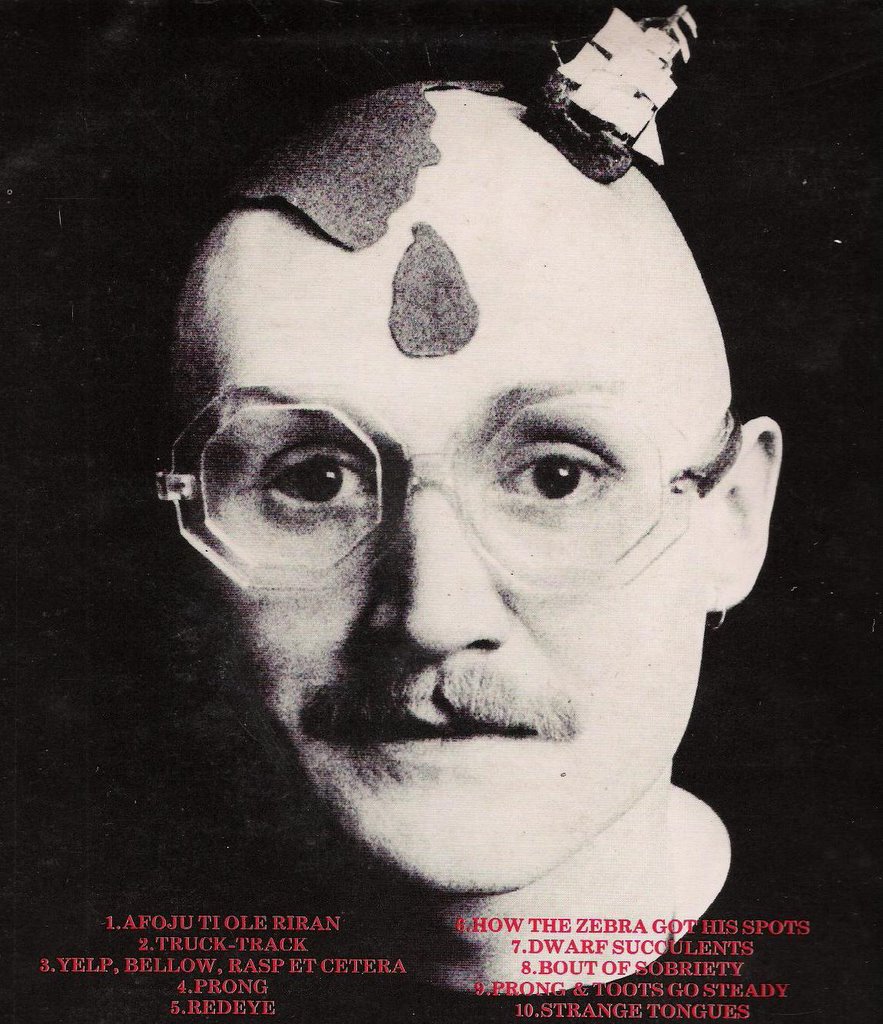
Vivian Stanshall


by Jason Ankeny
"Dubbed the "court jester of the underground rock scene in the 1960s" by influential DJ John Peel, Vivian Stanshall earned his greatest notoriety as the original tenor in the absurdist Bonzo Dog Band, although he was also a noted artist and comedian. Stanshall was born on March 21, 1943 in East London, England before World War II forced him and his mother to evacuate to Oxfordshire. While attending art school under the well-known pop artist Peter Blake (the designer of the Beatles' famed Sgt. Pepper album cover), Stanshall formed the Bonzo Dog Dada Band with flatmate Rodney Slater and fellow student Larry Smith in 1962.

Later shortened to simply the Bonzo Dog Band, the satirical group became highly successful before creative differences triggered their break-up in 1970. Stanshall quickly resurfaced with a series of short-lived and diverse projects: the first, the Sean Head Showband, issued the single "Labio Dental Fricative," while his second solo release, under the guise of Vivian Stanshall and His Gargantuan Chums, was a parody cover of Terry Stafford's "Suspicion." "Blind Date" was recorded as biG Grunt, a group also comprised of Bonzo Dog Band auxilliary members Roger Ruskin Spear, Dennis Cowan and "Borneo" Fred Munt; while the group did play a handful of live gigs, they met their premature demise when Stanshall, a heavy drinker and drug user, suffered a nervous breakdown and was hospitalized.

In 1974, Stanshall emerged with his debut solo LP Men Opening Umbrellas, recorded with Steve Winwood; Stanshall later returned the favor, collaborating with Winwood on his own self-titled debut and contributing significant lyrical ideas to 1980's Arc of a Diver. After narrating Mike Oldfield's Tubular Bells, Stanshall was tapped to guest host the BBC Radio 4 program Start the Week, where he developed his monologue Rawlinson End, which later inspired his own 1978 release Sir Henry at Rawlinson End as well as a film of the same title which starred Trevor Howard.

In 1981, Stanshall issued the autobiographical Teddy Boys Don't Knit, followed three years later by the spoken word project Henry at Ndidis Kraal. The Rawlinson saga continued with Rawlinson Dogends, a 1991 play staged at London's Bloomsbury Theatre complete with musical backing from Rodney Slater and Roger Ruskin Spear. Another autobiographical radio play, Essex Teenager to Renaissance Man, followed in 1994, along with film and voiceover work. Vivian Stanshall died in a house fire on the morning of March 5, 1995."

More about Vivian Stanshall HERE.

Vivian Stanshall - Dwarf Succulents

Vivian Stanshall - Bout Of Sobriety

These Rapid Share files are accessible by scrolling down the page and clicking on the FREE button. Wait at the bottom of the page for your file to appear ( about 20 seconds).

Friday, November 25, 2005

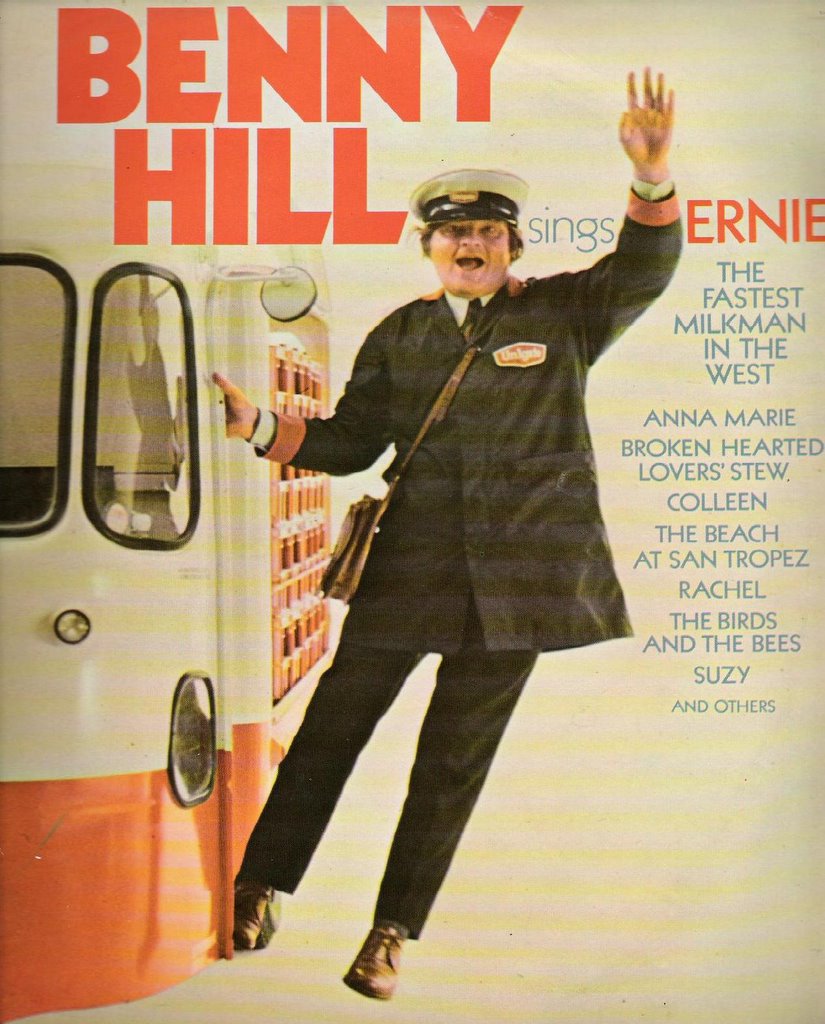
Benny Hill


"Born Alfred Hawthorn Hill (January 21, 1924/1925 - April 20, 1992), in Southampton, Benny Hill was a prolific comic British actor. In fact, he was one of the most universally recognized British comedians. He worked compulsively and had only a few friends, although colleagues who knew him closely insist that he was never lonely, but was content with his own company. He never married, although he did propose to two women, one the daughter of a British writer, and was rejected by both. He never owned his own home, nor even a car, instead preferring to rent a small flat in Teddington, a convenient walking distance to the Teddington Studios where he taped the one-off one-hour episodes of his television programme, The Benny Hill Show."

Found at a boot sale last year this budget "Music For Pleasure" 1971 release contains Hill's big U.K. hit "Ernie" and other comic songs as featured on his TV show. Words and music by Benny Hill. Arranged and conducted by Harry Robinson.

Find out more about Benny Hill HERE

Benny Hill - Broken-Hearted Lovers Stew

Benny Hill - Ting-A-Ling-A-Loo

These Rapid Share files are accessible by scrolling down the page and clicking on the FREE button. Wait at the bottom of the page for your file to appear ( about 20 seconds ).

Flanders and Swann


"In 1936, Michael Flanders and Donald Swann met at school in Westminster. Little did they know at that point the partnership they were going to make in later years, to become famous and release several recordings of their highly successful revues, and remembered for many years after their deaths.

At the Westminster school, they worked together for the first time in 1939, when Donald, born in 1923 in Llanelli to Russian parents, provided piano music for a revue called 'Go for it' that Michael, born in 1922 in London, was performing in. After school, both men went to Christ Church, Oxford, but they had little to do with each other. The war then came into the frame, Michael serving on a destroyer, and Donald in the Ambulance service in Greece and Palestine. It was during this time that Michael contracted Polio after his ship was torpedoed, and was made wheelchair-bound for the rest of his life. Following the war, the two got back together, and set about writing songs; Donald providing the music, while Michael, who originally wanted to be an actor, writing the words.

The first revue they contributed to, Oranges and Lemons, featured the song In The D'Oyly Cart, a send-up of Gilbert and Sullivan. The show started in 1948, and ran for a couple of years. Following the first revue were Penny Plain, Airs on a Shoestring and Pay the Piper, all of which, like the first, directed by Laurier Lister, and starring other performers such as Joyce Grenfell and Ian Wallace. After these, in 1950, the pair made their first step towards independence, performing songs in the Whistler Ballroom in 1950.
The pair, renown for their revue-writing talents, were invited to give a lecture on this topic at the Dartington School of Music in 1956. It was here Michael started to introduce each song with a short narrative. This, he found, went down as well with the audience as the songs themselves, and so this was integrated into the performance, and in 1959 the duo performed their first fully-fledged revue of their own, At the Drop of a Hat, at the New Lindsay theatre in Notting Hill gate.

After three weeks, the show was moved to the Fortune theatre in the West end, where it ran for over 750 performances. It was during this run the performance was recorded by George Martin (of Beatles fame). 1959 also saw the first US tour, and one to Switzerland, and the recording of their first studio album, The Bestiary of Flanders and Swann. The pair toured England after this, and then, in 1963, their second revue opened at the Haymarket theatre. At the Drop of Another Hat ran for almost a year, and was recorded, like the first show. The pair toured Australia at this time also.
After Another Hat, the F&S found the format of revues rather restricting, and branched out into other areas. Michael Flanders Narrated many radio shows, stories and documentaries, and presented radio quiz shows. Donald wrote more music, including for the Hoffnung concerts. They did have a final tour, and very successful it was too, and then they decided to stop 'while they were ahead'. "

This album "The Bestiary" released in 1961 in the U.K. and later in the U.S. but without "The Wompom" which is a shame as it's by far the best track and funniest as Flanders and Swann add an array of vocal gymnastics not heard on any of their other records.

Flanders & Swann - The Ostrich

Flanders & Swann - The Wompom

These Rapid Share files are accessible by scrolling down the page and clicking on the FREE button. Wait at the bottom of the page for your file to appear ( about 20 seconds ).

Wednesday, November 23, 2005

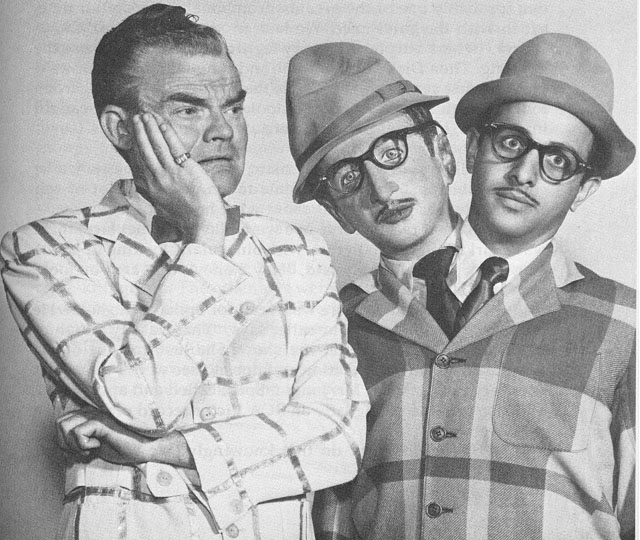
Spike Jones


"Lindley Armstrong "Spike" Jones (December 14, 1911 - May 1, 1965) was a popular musician and comedian. He was born in Long Beach, California.
His father was a Southern Pacific railroad agent. He got his nickname by being so thin that he was compared to a railroad spike. At the age of eleven he got his first set of drums. As a teenager he played in bands that he formed himself. A chef in a railroad restaurant taught him how to use adapted pots and pans, forks, knives and spoons as musical instruments. He frequently played in theater pit orchestras. In the 1930's he joined the Victor Young Band and thereby got many offers to appear to radio shows including the Al Jolson Lifebuoy Show, Burns and Allen (with George Burns) and Bing Crosby's Kraft Music Hall. In 1940, he had an uncredited part in the film Give Us Wings, and in 1942 as a hillbilly in Pass the Biscuits, Mirandy. He joined up with vocalist Del Porter and performed in Los Angeles, gaining a cult following. By 1941 the band included violinist Carl Grayson. Other band members were George Rock (voice and trumpet), Doodles Weaver (voice) and Red Ingle (voice). They became his backing band The City Slickers.Jones's wife was the singer Helen Grayco, who performed on some of his radio shows. They recorded five records for Victor's label "Bluebird" before receiving their big break."

This EP was on the tape sent today with the Johnny Standley and it seems churlish not to include it all as its very funny despite the bad quality of some of the surface noise. Sorry! I have quite a few Spike Jones albums, records and tapes but never heard this one before with Spike introducing each track.

Find out more about Spike Jones HERE.

Spike Jones - Fun In Hi-Fi Pt.1

Spike Jones - Fun In Hi-Fi Pt.2

These Rapid Share files are available by scrolling down the page and clicking on the FREE button. Wait at the bottom of the page for your file to appear ( about 20 seconds ).

Johnny Standley


I'm afraid I know very little about Johnny Standley. All I could glean from the internet is that he travelled with his father's "tent shows" in the Mid West and this single, "It's In The Book", was his one "hit" in 1952. The second part of the song is taken from an advert for Granma's Lye Soap. No other recordings seem to be available. This EP was found by a friend of mine who had been looking for it for a while. He sent me a copy on a tape today along with this very pale photo-copy of the sleeve. I had to darken it a bit on photoshop, hence the rather strange tones. Johnny reminds me of a few other American comedy acts of the 50's like Jonathan Winters and Milton Berle etc. and his preaching style like that of the english eccentric Gerrard Hoffnung.

Johnny Standley - It's In The Book

Johnny Standley - Clap Your Hands

These Rapid Share files are accessible by scrolling down the page and clicking on the FREE button. Wait at the bottom of the page for your file to appear ( about 20 seconds ).

Sunday, November 20, 2005

Sophie Tucker


"Sophie Tucker was born in Russia while her mother was emigrating to America to join her husband, also a Russian Jew. Her birth name was Sophia Kalish, but the family soon took the last name Abuza and moved to Connecticut, where Sophie grew up working in her family's restaurant.

Playing piano to accompany her sister at amateur shows, Sophie quickly became an audience favorite; they called for "the fat girl." At age 13, she already weighed 145 pounds.

She married Louis Tuck in 1903, and they had a son, Bert, but she divorced Tuck fairly quickly. Leaving Bert with her parents in 1906, she went to New York, changed her name to Tucker, and began singing at amateur shows to support herself.

She was required to wear blackface by managers who felt that she would not otherwise be accepted, since she was "so big and ugly" as one manager put it. She joined a burlesque show in 1908, and, when she found herself without her makeup or any of her luggage one night, she went on without her blackface, was a hit with the audience, and never wore the blackface again.

She briefly appeared with the Ziegfield Follies, but her popularity with audiences made her unpopular with the female stars, who refused to go on stage with her.

Tucker's stage image emphasized her "fat girl" image but also a humorous suggestiveness. She sang songs like "I Don't Want to Be Thin," "Nobody Loves a Fat Girl, But Oh How a Fat Girl Can Love." She introduced in 1911 the song which would become her trademark: "Some of These Days."

She added jazz and sentimental ballads to her ragtime repertoire, and, in the 1930s, when American vaudeville was dying, she took to playing England. She made eight movies and appeared on radio and, as it became popular, television."

Sophie Tucker - I've Got A Cross-Eyed Papa

Sophie Tucker - Hula Lou

These Rapid Share files are accessible by scrolling down the page and clicking on the FREE button. Wait at the bottom of the page for your file to appear ( about 20 seconds ).

Stanley Holloway


Stanley Holloway (born Stanley Augustus Holloway) was born on the 1st October 1890 in London, England, UK and died on the 30th January 1982 in Littlehampton, England, UK.

"He tried to make a go of his first job as a clerk in a Billingsgate fish market, but the call of the theatre was loud and strong. Originally planning an operatic career, Holloway studied singing in Milan, but this came to an end when World War One began. Finishing up his service with the infantry, Holloway headed for the stage again, making his London premiere in 1919's Kissing Time. His first film was The Rotters (1921), and the first time the public outside the theatres heard his robust voice was on radio in 1923. Holloway toured the music hall-revue circuit with his comic monologues, usually centered around his self-invented characters "Sam Small" and "The Ramsbottoms."

Holloway's entree into talking pictures was with a 1930 film version of his stage success, The Co-Optimist. The British film industry of the '30s was more concerned in turning out "quota quickies" so that Hollywood would send over an equal number of American films, but Holloway was able to survive in these cheap pictures, occasionally rising to the heights of such productions as Squibs (1935) and The Vicar of Bray (1937). In 1941, Holloway was cast in one of the prestige films of the season, George Bernard Shaw's Major Barbara; this led to top-drawer film appearances throughout the war years, notably This Happy Breed (1944), The Way to the Stars (1945) and Brief Encounter (1947). Though he'd had minimal Shakespearian experience, Holloway was selected by Laurence Olivier to play the Gravedigger in Olivier's filmization of Hamlet (1947), a role he'd forever be associated with and one he'd gently parody in 1969's Private Life of Sherlock Holmes.

Gaining an American audience through repeated showings of his films on early-'50s TV, Holloway took New York by storm as Alfred P. Doolittle in the stage smash My Fair Lady - a role he'd repeat in the 1964 film version (after James Cagney had turned it down), and win an Oscar in the bargain.

Continuing his activities in all aspects of British show business -- including a 1960 one-man show, Laughs and Other Events -- Holloway decided he'd take a whack at American TV as the butler protagonist of the 1962 sitcom Our Man Higgins. It's difficult to ascertain the quality of this series, since it had the miserable luck of being scheduled opposite the ratings-grabbing Beverly Hillbillies.

Stanley Holloway perservered with stage, movie, and TV appearances into the '70s; in honor of one of his two My Fair Lady songs, he titled his 1981 autobiography Wiv a Little Bit of Luck."

Stanley Holloway - Any Old Iron?

Stanley Holloway - Wot Cher!

These Rapid Share files are accessible by scrolling down the page and clicking on the FREE button. Wait at the bottom of the page for your file to appear ( about 20 seconds ).