Sunday, May 27, 2012

Celestine Ukwu

Celestine Ukwu - Side One.
A Nigerian LP on the Philips label I've had for a number of years, originally bought at Cheshire Street in the East End of London I think. Delightful ju ju music with xylophone and jazzy brass section. "Born in 1940, Celestine was educated musically by his uncle who taught him how to read music and play harmonium. His grandmother was a folk musician and dancer and his father, who worked as a coal miner, was a popular local performer of igede, ikpa and ode music. His mother was lead singer for a women's dance troupe. After Catholic primary school, where he excelled in drama and music, Celestine went to teacher training school for two years, dropping out in 1960 to join Mike Ejeagha's group as vocalist and maraca player. But he soon left to join a group led by Mr Picolo who were going to tour the Congo. Thus an early exposure to Congolese music had a huge impact on his own musical formation. On his return to Nigeria he briefly joined a group called African Baby Party. Three months later he moved to Maiduguri and formed Freedom Jazz Band, but then he moved to Zaria and formed The Republic Knights with Charles Jebba. But he moved again, to Onitsha, where he fronted the Niger City Starlighters. With this formation he made his debut recordings, and scored hits with "No Condition is Permanent," "Artificial Beauty," "Appolonia," and "Ije Enu." This latter song sold 200,000 copies in 3 months. After nine months he decided to start anew and with the help of Matthias Okafor who owned the Frontline Hotel, Onitsha, and who rented instruments for him, Ukwu was able to start Celestine Ukwu & His Music Royals of Nigeria in April 1962. The band was a huge success for five years. In 1967 the Biafran War broke out and the non-Biafran members of the band fled, while Ukwu recorded "Hail Biafra!" and did his bit to boost morale during the strife. In addition to singing he also played drums and vibraphone on his recordings. The band toured neighbouring countries and even went to West Germany. In 1972 students at the University of Nigeria renamed his band the Philosophers National. In 1977 at the age of 37, Ukwu died in a car wreck." Biography courtesy of www.musikifan.com Tracks are - 1. Ejim Nke Onye 2. Ima Echi

Saturday, May 26, 2012

Anarkali

LP I bought in a library sale many years ago. Film soundtrack on the EMI label from 1953.
Features the beautiful voice of Lata Mangeshkar. Wikipedia says - " Anarkali (Hindi: अनारकली, Urdu: اناركلی) is a 1953 film based on the historical legend of the Mughal emperor Jahangir. As per the legend Jahangir revolted against his father Akbar over his love for a common girl called Anarkali. It was the top grossing Hindi film in the year of its release, and one of the biggest Hindi film hits in its decade. Another film on the same theme was Mughal-e-Azam, made in 1960, which was again a major commercial and critical hit." Anarkali - Side One.

Thursday, May 24, 2012

Sunny Ade & His African Beats

This Nigerian LP on the African Songs label from 1974 is shared with Sunny Ade's African beats and Apola Sounds by Idowu Animasahun. The sleeve notes say -"The story of Sunny Ade and African Beats dates back a number of years. within this short period of time, however, the African beats has made tremendous impact and completely revolutionised the trend of ju ju music in the country.... The music is called African Beats and the dance style is more recently christened Synchro System Movement." No mention the songs on here so one must assume they are well known hits of the time and need no explaination among the faithful fans of Sunny Ade. Discover more about King Sunny Ade HERE. King Sunny Ade - Nigeria's Sounds Of The Moment

Tuesday, May 22, 2012

Saturday Night At Flannagans

This LP from the boot sale was inside the wrong sleeve so picked this one from Ebay - not sure it's right but will have to do. It's no great shakes as a sing-along record with boozy pub crown led by Bernard Bedford - whoever he might be? Not much gleaned from the internet. A short extract here to give you some idea of how it sounds. I have fond memories of the TV show from Leeds Varieties in the 60's and 70's which sounded similar to this but somehow better. I suppose it was the injection of humour by the likes of Ken Dodd and Billy Dainty etc. that lifted above the normal mire of pub sing-along and into the realms of the affectionate re-creation of the Victorian Music Hall. Flannagans - Side Two.

Monday, May 21, 2012

The Midnight Minstrels

The last of the 78's from the suitcase you'll be pleased to know! One side is too scratched to play really. This one is another little known outfit but a detective on DailyMotion says - "This appears to be a Stan Greening pseudonym. Like many of the bandleaders who directed music purely for recording, Stan Greening (✩Kensington, UK 1888 - ✛Clapham, UK 1971) is hardly known today. He studied piano and composition at the Royal Academy of Music, and worked as a classical musician before WWI. In 1924 he started recording for the Crystalate Company for their Imperial and Mimosa labels, a position he maintained until the early 30s. Around the same time, he worked for Parlophone and is likely to have organised the sessions issued as by The Marlborough Dance Orchestra. At the start of 1925, he began working for Columbia, providing studio dance bands and accompaniments for the Columbia and Regal labels. Greening's recordings were issued on Regal as Corona Dance Orchestra. Other record companies which made use of his services were HMV, Brunswick and Duophone." Midnight Minstrels - Tip Toe Through The Tulips.

Jack Payne

One more 78 from the pile. This time a 10" on the Columbia label. Wikipedia says - Jack Payne (22 August 1899 – 4 December 1969) was a British dance music bandleader who established his reputation during the British dance band era of the 1930s. John Wesley Vivian Payne was born in Leamington Spa, Warwickshire, the only son of a music publisher's warehouse manager. While serving in the Royal Flying Corps he played the piano in amateur dance bands. Payne served in the Royal Air Force during World War I, and led dance bands for the troops. Prior to joining the Royal Air Force, he was part of "The Allies" concert party. This voluntary group performed to wounded soldiers convalescing around Birmingham. In the 1920s he played in a ten-piece band which became the house band at the London's Hotel Cecil in 1925. This ensemble regularly performed on the BBC in the latter half of the decade. In 1928, Payne became the BBC Director of Dance Music and the leader of the BBC's first official dance band. In 1929 the band was featured in the first ever BBC television broadcast. His signature tune was Say it With Music written by Irving Berlin. [edit]The 1930s and 1940s In July 1930 a reviewer from The Gramaphone magazine wrote that "Jack Payne's Band is public property. It is paid out of the wireless licence fees which you and I supply...As such its one duty is to please the masses. It has to be good musically, it has to entertain, it needn't worry about anything advanced in the way of style, and the last thing it need be is rhythmically hot. I think we must all agree that it does its job well, and that anything it may at times lack in modern rhythmic stylishness is amply compensated by other qualities more important from the public's viewpoint, such as musical ability and versatility". After leaving the BBC in 1932, when he was succeeded by Henry Hall, he returned to playing hotel venues and took his band on nationwide tours and made a film Say it with Music (1932), followed four years later by Sunshine Ahead. Payne had three successful waltzes - Blue Pacific Moonlight, Underneath the Spanish Stars and Pagan Serenade, which he composed and later published in the 1930s. Payne did some jazz recording, including working with Garland Wilson. He toured South Africa and France in the 1930s, but also concentrated his efforts on running a theatrical agency." Jack Payne - You're Gonna Be Young. Jack Payne - You're Gonna Be Young. Jack Payne - Sitting On A Five Bar Gate.

Saturday, May 19, 2012

Trying To Make A Living

Some urban blues on the Red Lightnin' label from the 70's. Compilation of 50's recordings by Little Mac, L.C. McKinley, Eddie Boyd etc. "Malcolm Simmons ( Little Mac )was born on January 25, 1933, in the small cotton-farming community of Twist, Arkansas. He was a childhood friend of James Cotton, who was serving as an apprentice of Sonny Boy Williamson II (Rice Miller) at the time. The two boys persisted in skipping school together for the more enticing lure of jamming on their harmonicas, and Cotton taught Simmons the harp techniques he was learning from the master. Soon school was dropped completely, and Mack picked cotton and drove a tractor full time. Then at 18, he left for St. Louis, where he lived for two years while working on the railroad. It was here that Simmons met the renowned Robert Nighthawk and made his club debut on Nighthawk's stage. In 1954 Little Mack moved on to Chicago, where he formed his own band and held down a five-year stand at Cadillac Baby's, as well as performing regularly at Pepper's Lounge and at Sylvio's." Here's a bit about Eddie Boyd - "EDDIE BOYD (By Dominic Turner) Born Edward Riley Boyd, 25 November 1914 (some sources say 13 November), Stovall (Mississippi) Died 13 July 1994, Helsinki, Finland Starting out as a guitarist but ultimately making his name as a pianist, Eddie Boyd is universally known in blues circles for his powerful "Five Long Years." But this oft covered Chess blues classic was by no means the only highlight of an excellent career. Born on Frank Moore's Stovall plantation near Clarksdale in the heart of the fertile Mississippi delta (his cousin, Muddy Waters, was born there just a few months later), Boyd taught himself to play the guitar at a young age. After a hard day's work in the fields, he would take to the legendary Mississippi juke joints in the evening, playing and singing the blues to rowdy audiences of black workers. But it was a tough upbringing, and Boyd, frustrated by the unfair segregationist policies, ran into trouble after a fight with a white youth (some accounts suggest that Boyd threw a hayfork!). As a result of that incident, he joined the hordes of Southern blacks who moved further north to seek their fortune, and settled in Memphis around 1931. The move to an even more stimulating musical environment soon rubbed off, and he learned to play the piano, developing a style that owed much to Roosevelt Sykes and Leroy Carr. He continued to play regularly in the city's bars and juke joints, often appearing on Beale Street as a pianist and singer with his band the Dixie Rhythm Boys." Various - Trying To Make A Living Side Two

Thursday, May 17, 2012

Bidgood's Broadcasters

More Bidgoodness with Harry and the boys."Harry BIDGOOD (born in London, 1898) recorded both under his own name, and a variety of other names such as Harry Bidgood's Broadcasters, The Riverside Dance Orchestra, Don Porto and His Novelty Accordions, Rossini's Accordions, Primo Scala and His Banjo Band (or: Primo Scala and His Accordion Band) Among his famous vocalists are Vera Lynn, Cavan O'Malley, Sam Costa. Bidgood's career began when he became the pianist with the De Groot Orchestra then resident at London's Piccadilly Hotel. In time, he became the Musical Director for Vocalion Records, and in 1932, for Crystalate Records. Curiously, he is probably better remembered by his pseudonym of "Primo Scala" than by his own English birthname. (He contrived the name from Italy's boxing champion 'Primo Carnera' and a then famous Irish Sweepstakes winner, Signor Emilio Scala.). He died in London in 1957." Bidgood's Broadcasters - Sing A Little Love Song. Bidgood's Broadcasters - Hitting The Ceiling.

Harry Hudson/ Walter Miller

Could not find anything about Walter Miller - another nom de plume perhaps? Delightful double novelty disc with Sarah Jane sounding very much like On Ilkley Moor Bah't At?! "Harry Hudson was a music hall personality who recorded solo comic records for Edison Bell Records..In 1928,the newly formed Edison Bell Radio label was born, and Hudson was approached to become the musical director. So Hudson began recording several hundred records before the depression, finally sank the label, in 1932/33 However from 1934 enterprising Hudson,went on to concentrate on the Variety Club circuit. in Great Britain. Someone informed me that in old age he played piano intros on a TV quiz show in the 1950's..It seemed he had a very upbeat personality. The Radio records have a loud,dynamic sound that showed Hudson's classy studios bands to their best advantage." Harry Hudson - When I Met Connie In A Cornfield. Harry Hudson - Sarah Jane.

The Biltmore Players

"It's an 8 inch record. The smaller ones were I think budget releases and sold in shops like Woolworths in the 20's/30's." Another from the suitcase of scratchy 78's. Not much on the net about the Biltmore players. Another pseudonym for a house band perhaps. These cheapo labels used to have lots of them. Anybody knows different please let us know. Biltmore Players - Betty Co-ed. Biltmore Players - When It's Moonlight By Killarney.

The Clevelanders/ Lou Gold

More from the 78 pile this time two artistes on one record. Not much known about the Clevelanders but found this on a YouTube intro. to this record - "The Clevelanders apparently was a pseudonym for Jack Albin. Although very popular in his day, almost nothing is known of him today. It was a steady outfit that played in New York's best hotels and restaurants, the best known being the Pennsylvania Hotel. With the orchestra based at this hotel, he recorded extensively in 1929 and 1930, and also a few excellent discs for Crown in 1931. Shortly after those sessions, Albin left the music business, and what happened in the rest of his life is totally unknown. As for this lovely record, it was made in 1930. Outstanding vocal by Scrappy Lambert." Same goes for Lou Gold. Here's another snippet of info. I found on YouTube - "Although largely forgotten today, Lou Gold was a very popular orchestra leader during the 1920s. He was born Lewis Milton Goldwasser in 1894, and mainly active in the New York area during the 1920s and 1930s as a composer, pianist and orchestra leader. His orchestra made several recordings both with his own name and with different pseudonyms, depending on what label the recordings were made for. During his life he worked with artists like Benny Goodman, Tommy Dorsey, Abe Lyman and many others. He died in 1950." Lou Gold - Love Ain't Nothing But The Blues. Clevelanders - Lucky Me, Lovable You.

Wednesday, May 16, 2012

Roy Fox

Somebody I recognise from the British Dance Band era. A very warped record sadly so only one side will play. Wikipedia says - Roy Fox (b. October 25, 1901, Denver, Colorado, United States - d. March 20, 1982, London, England, UK) was an American dance bandleader whose period of greatest popularity came during his years performing in England during the British dance band era. Roy Fox was raised in Hollywood, California. He began playing cornet when he was eleven years old, and by age 13 was performing in the Los Angeles Examiner's newsboys' band. Soon after he played bugle for a studio owned by Cecil B. DeMille. His first major association came at the age of 16, when he joined Abe Lyman's orchestra at the Sunset Inn in Santa Monica, where he played alongside Miff Mole, Gussie Miller, Henry Halstead, and Gus Arnheim. He developed a soft style of playing there which earned him the nickname "The Whispering Cornetist". [edit]The 1920s and 1930s In 1920 he put together his own band, with whom he recorded in 1925. That same year he also scored a gig on radio broadcasting with Art Hickman's orchestra; this ensemble toured the U.S., then did an extended residency in Florida. After some time in New York City, Fox and Arnheim reconvened in Hollywood, working at the Ambassador Hotel, and Fox continued to broadcast with his own bands. During this time he also did a number of film soundtracks. In 1930 Fox was invited to perform in London, which he first did on September 29, 1930. He recorded on the BBC that year, and when his band returned to the U.S. the following spring, Fox remained behind, recording with a new group for Decca Records and accepting an engagement at the Monseigneur restaurant in Piccadilly. He lost this contract in November 1931 when he fell ill with pleurisy and traveled to Switzerland for a stay at a sanatorium. Upon his return he put together yet another group composed entirely of new members aside from trumpeter/vocalist Sid Buckman, and performed in Belgium as well as the UK. Art Christmas played a variety of instruments in this band. He made the films On the Air and Big Ben Calling in 1933-34, recorded for HMV in 1936, and toured Europe until 1938, when he fell ill again." Roy Fox - Lonely Lane

Tuesday, May 15, 2012

Harry Hudon's Melody Men

Not much found on the internet about Harry Hudson but David Glow on YouTube seems to know things - "Harry Hudson was a music hall personality who recorded solo comic records for Edison Bell Records..In 1928,the newly formed Edison Bell Radio label was born, and Hudson was approached to become the musical director. So Hudson began recording several hundred records before the depression, finally sank the label, in 1932/33 However from 1934 enterprising Hudson,went on to concentrate on the Variety Club circuit. in Great Britain. Someone informed me that in old age he played piano intros on a TV quiz show in the 1950's..It seemed he had a very upbeat personality. The Radio records have a loud,dynamic sound that showed Hudson's classy studios bands to their best advantage. Here Sylvester Ahola is present on trumpet lead in a hot,tight rendition of this evergreen song. Hudson was not shy man, and took vocals himself,on a number of records,in spite of being a poor singer.Joe Leigh is the vocalist on this record. Hudson seems to have got on well with Al Bowlly as they teamed up again at Decca which he played piano on some of Al's solo records in 1934. He has never had the proper acknowledgement of his massive contribution to British musical history and is not well known today." Harry Hudson - Marie. Harry Hudson - Building A Nest For Mary.

Phil Allen & His Merrymakers

Scarce info. on Phil Allen on the net. He's not even in the British Dance Band Encyclopedia., so maybe he's not British? Anyway a fun song that reminds me of "Always Look On The Bright Side Of Life". Maybe Monty Python were influenced by this record? Phil Allen - Looking On The Bright Side. Phil Allen - Your More Than The World To Me.

Harry Bidgood & His Broadcasters

More Harry Bidgood for all his fans out there! Wikipedia says - "Henry Bidgood (1898 – November 15, 1957) known as "Harry" was an English composer, dance band leader and musical director for films.[1] Born in London the son of composer Thomas Bidgood. He studied at The Royal College of Music. Bidgood released dance band music under various names, mostly notably Primo Scala and his Accordion Band.[2] Over the course of 20 years he would frequently broadcast on the BBC. Bidgood was also the musical director for numerous films including several George Formby films." Harry Bidgood - Where Oh Where Do I Live?. Harry Bidgood - Little Brown Baby.

Randolph Sutton

More vintage novelty songs from the 78 pile. Not much known about Randolph Sutton but Wikipedia says - "Randolph Sutton (born Bristol July 1888 and died Brixton 28 February 1969) was an English singer. He was a popular stage entertainer in music hall and variety. He appeared at the "Royal Variety Performance". Sutton made a famous recording of "On Mother Kelly's Doorstep" during the 1930s and 1940s, and made a further recording of this song as late as January 1969, shortly before his death. He made his final stage appearance at the City Hall Theatre in St Albans, Hertfordshire on 26 February 1969." Randolph Sutton - There's A Good Time Coming. Randolph Sutton - Over The Garden Wall

Monday, May 14, 2012

Harry Bidgood

More from the ubiquitous Harry Bidgood who also went under several pseudonyms including Ciro's Club Band and Primo Scala's Accordion Band. "Harry Bidgood was born in London in 1898, receiving early musical education from his father prior to attending the Royal College of Music. He commenced his professional career just after the First World War as pianist with De Groot at the Piccadilly Hotel, London. In 1926 he started directing recording sessions for Vocalion, which, in 1928, began to issue the famous 8-inch Broadcast records. Harry directed a 'house band' for these records, known as Harry Bidgood and his Broadcasters. Other studio bands under his direction included: The New York Nightbirds, Ciro's Club Band, The Manhattan Melody Makers, Al Benny's Broadway Boys, The Riverside Dance Band and Nat Lewis and his Dance Band. When accordion bands started to become popular in the early thirties, Harry Bidgood saw the potential and formed a band for Eclipse called Don Porto's Novelty Accordion Band. He also recorded (in 1935) as Rossini's Accordion Band for the Crown label, which sold in Woolworth's stores. It was under the alias of Primo Scala and his Accordion Band, however, that he was destined to become most famous." Bidgood's Broadcasters - All By Yourself In The Moonlight. Bidgood's Broadcasters - I Think Of What You Used To Think Of Me

Sunday, May 13, 2012

Kempion/ The Farriers

Two bands on this LP on the Broadside label ( 1976) I found today at a boot sale. Singing songs about the Birmingham canals. Nice English folk tradition which reminds me of The Incredible String Band, Martin Carthy etc. Couldnt find much about the Farriers but this was the line up of Kempion back then- "DAVID OXLEY was born in the West Midlands. He plays fiddle, bouzouki and mandolin. David is classically trained MARK WALLIS is from Somerset. He plays guitar, bouzouki, mandolin and tenor banjo. Mark does session work, often in conjunction with David, for L.P. records and BBC radio. DUNCAN HUDSON is a Scotsman from Kirkintilloch, near Glasgow. He plays the tin whistle and the flute, on both of which he is self taught. A true folk musician. MORRIS McPHIILLIPS is the group's vocalist. His raw, powerful voice is one of the few that can cut through the lively sound of an instrumental group in full flight. Morris also plays the bodhran, or celtic drum, and the Appalachian dulcimer. " Tracks are as follows - I Can't Find Brummagem, The New navigation, Tom King, A New Song For The Opening Of The Birmingham and Liverpool Railway, Norton New Bell Wake, Birmingham On Sea, Birmingham Jack Of All Trades. Farriers/Kempion - Side One

Cosmotheka

I've been looking for this LP by Cosmotheka for ages and luckily found it today at the local boot sale for a quid. A lovely selection of songs inspired by the music hall and featuring songs made famous by Gus Elan, Eugene Stratton, Billy Williams etc. "The two Sealey brothers, Alan and Dave, were born in Melen Street and attended Bridge Street and Bridley Moor Schools. They became famous as a 'music hall' type duo known as Cosmotheka, a name taken from an old time music hall which was once in the back streets of Paddington. They have shared the stage with such fellow celebrities as Roy Hudd, June Whitfield, Don McClean, Isla St Clare, Charlie Chester, Dame Vera Lynn and many others. Dave moved to London in the mid 1960s, hoping to become a pop star: 'I was always involved in some way or other as a singer and when I was in my twenties I was in a rock and roll band . We had a bit of success and got to make a recording for EMI at Abbey Road Studios, where the Beatles made Sergeant Pepper. A bit later on I got a solo career with Dick James' Music in London. Neither of these two recording contracts came to much, so I returned to Redditch and got married. 'My brother, Alan, had been singing in a folk group and in about 1974, shortly after I got married, we said suddenly, 'Why don't we sing as a duet?'. We hadn't really got anything in mind, except that Alan had an old music hall item he used to sing with his folk group. It was called, 'A little bit of cucumber'. Between us we then decided that's what we would have a look at, old music hall songs, and we would sing them in two-part harmony with me accompanying on my guitar. We went down to the local library, looked through the old scores and learned two or three of them. Alan and I were both sales reps, and I was working in Digbeth in what had been the old Bird's Custard factory which was then being used for manufacturing polythene bags. I used to wander off at lunch time going round the local junk shops looking for songs to start Cosmotheka off. I was searching through some sheet music for songs by Gus Elen, who was a music hall singer, when the proprietor came over and said, 'What are you looking for?'. I told him and he said, 'I have got some of his records at home'. It turned out that he was a member of the Birmingham Gramophone Society. I asked him if I could take a tape recorder to his house and record some of the old songs, and he was very obliging. When I went to see him he took me into his front room, it was cluttered with old gramophones and phonographs. These were his main interest but he had collected a lot of cylinders and 78 records on the way. The first thing he played to me was a song called 'Little Billy's Wild Woodbines' by Billy Williams, who called himself 'The Man in a Velvet Suit'. His most famous song was 'When father papered the parlour'. The old fellow put the record on; there was a great big horn attached to the gramophone and a tiny metallic voice started coming out of the blackness of the horn. It felt like a time machine, almost as if I could see this little fellow at the end of this horn. I was completely hooked, I had never heard anybody sing quite like that and he affected a funny little laugh at the end. That was the first time I heard a music hall artist singing and I heard three that day. I walked away with about six numbers that formed the initial batch of songs for what was to become the Cosmotheka act." Tracks are as follows = Good Little Girl, The 'ouses In Between, The Baby's Name, Little Dolly Daydream, Down The Road, Up Went My Little Umbrella, The Golden Dustman, Cosmotheka - Side One

Harry Bidgood

Another Harry Bidgood 78 of which there are several in this old suitcase, all on the 8" Broadcast label. "Harry Bidgood was born in London in 1898, receiving early musical education from his father prior to attending the Royal College of Music. He commenced his professional career just after the First World War as pianist with De Groot at the Piccadilly Hotel, London. In 1926 he started directing recording sessions for Vocalion, which, in 1928, began to issue the famous 8-inch Broadcast records. Harry directed a 'house band' for these records, known as Harry Bidgood and his Broadcasters. Other studio bands under his direction included: The New York Nightbirds, Ciro's Club Band, The Manhattan Melody Makers, Al Benny's Broadway Boys, The Riverside Dance Band and Nat Lewis and his Dance Band. When accordion bands started to become popular in the early thirties, Harry Bidgood saw the potential and formed a band for Eclipse called Don Porto's Novelty Accordion Band. He also recorded (in 1935) as Rossini's Accordion Band for the Crown label, which sold in Woolworth's stores. It was under the alias of Primo Scala and his Accordion Band, however, that he was destined to become most famous. There are various theories as to the origin of the name Primo Scala. It has often been suggested that 'Primo' came from a heavyweight boxer named Primo Carnera and that 'Scala' came from Emilio Scala, winner of the Irish Sweepstake, although it is more likely to have to have derived from Scala Records, once part of Vocalion, for which Bidgood recorded. Primo Scala's success on record was such that he assumed this identity for the rest of his career; furthermore, the band began to take on public engagements and by the late thirties was regularly heard on the radio. By January 1941, Primo Scala and his Accordion Band was appearing on 'Music While You Work', soon becoming one of the most frequent and popular contributors, partly because accordions came over well in the factories." Harry Bidgood - Side By Side. Harry Bidgood - Dreamy Devon.

Saturday, May 12, 2012

Layton & Johnstone

American duetists Layton & Johnstone were popular in the UK during the 20's and 30's. It's hard to imagine why now. A piano/vocals duet with heavy classical influence, Layton & Johnstone were staid but solid interpreters of American popular song during the '20s and early '30s. They sold over 10 million records during their time together, much of which was spent in England (they were one of the most successful acts on Britain's vaudeville scene). Pianist Turner Layton, born in Washington, D.C. in 1894, was the son of a music teacher, a vaudeville performer as of 1920 (occasionally with Henry Creamer), and a recording artist (for the prestigious Black Swan label) just one year later. He also appeared in musicals (often all-black) including +Strut, +Three Showers, and +Miss Liza, then met up with Clarence "Tandy" Johnstone in the early '20s. The pair made their London debut in 1923, very early on, and performed in the West End, appeared on radio, and recorded dozens of records. A few titles became popular, including "Bye-Bye, Blackbird," "River Stay 'Way From My Door," and "It Ain't a Going to Rain No More." The partnership ended in 1935, when Johnstone was implicated in a divorce suit that caused a scandal. He returned to America (and obscurity), dying in 1953, while Layton continued as a popular soloist. He was also an accomplished songwriter, the tunesmith behind "Dear Old Southland," "If I Could Be With You One Hour Tonight," and "After You've Gone." ~ John Bush, All Music Guide Layton & Johnstone - Bye Bye Blackbird

Friday, May 11, 2012

Harry Hudson's Melody Men

Harry Hudson was a popular dance band leader from the 20's through to the 50's. His big hit "Hunting Tigers Out In In-diah" was covered by the Bonzo Dog Band in the 60's. Not much can be gleaned about him on the net sadly. Harry Hudson - March Of The Chocolate Soldiers Harry Hudson - Mother Goose Parade

Harry Hemsley

Slightly creepy record of Harry Hemsley who specialised in imitating young children. He directed and took part in the Ovaltineys Concert Party on Radio Luxembourg. Harry Hemsley - Children At Play Harry Hemsley - A Child's Wish

Oscar Rabin Band

More from the 78 pile. Pleasant enough MOR dance band versions of hits of the day recorded at Hammersmith Palais it says but seems unlikely. Wikipedia says - "The Oscar Rabin Band was one of the most successful Jazz and British dance bands of the 1950s. Band leader Oscar Rabin played bass saxophone, an unusual instrument then as now. His friend Harry Davis, tall, elegant and good-looking, acted as compère and conductor. Oscar Rabin formed his first band with Harry Davis, The Romany Five, in 1922. They could be seen in those days at the Palais de Dance in Derby, England. Oscar played violin but over the next decade he formed a full size dance band in which he took up playing the bass saxophone They gradually expanded the band all the way through the tough times of the 1930s. During this period character actor Sam Kydd made his show-business start as M.C. for the band. By the time of World War II, they had become one of the most widely known of British dance bands, touring throughout the country. Oscar, short and fat, never did front his own band, nor was he regarded as anything more than a workaday musician. His role was to run the business side of the band. His partner Harry, who occasionally played guitar, was very good with audiences. (Harry's daughter Beryl became a professional singer, and moved to the USA.) However, the combination of the two men was a successful one and audiences took to them. Ex-band member Roy Bull has recalled: "My memories of the Oscar Rabin days are all very pleasant ones, as Oscar himself was one of the most kind people I have ever met, and certainly the best band leader for whom I ever worked." Oscar Rabin Band - I'll never Smile Again Oscar Rabin Band - Halfway Down The Street

Bob and Alf Pearson

This 78 on the Rex label is another from the suitcase I bought recently. Bob and Alf do a version of the Gracie Fields hit song from the film Sing As We Go. This is the slightly posher version. "Bob & Alf Pearson were one of the few singing duos to span all the decades from the 1930's to well into the 1980's. Their gentle humour and immaculate harmonies made them enormously popular on stage, on record and most memorably, on radio. Their signature tune, We Bring You Melody From Out Of The Sky, My Brother And I, evokes sweet memories for any fans of Ted Ray's outstanding BBC radio series `Ray's A Laugh'. They were born in Sunderland. Their mother, professionally known as Emily Smiles, had a big reputation as a well known local singer Her talents were obviously passed on to her boys. Bob was born in 1907 and AIf in 1910. In 1924, aged 14, Alf started his solo career, singing on the stage of the local King's Theatre which was owned by George Black. In 1927 Bob and Alf started singing duets at amateur concert parties in the North East, occasionally in Pierrot ensembles where no doubt Bob's talent on the piano was very welcome. So began their illustrious and successful career By 1928 the whole family had moved to Tolworth, in Surrey. They were plasterers and their father's firm had won the contract to plaster the houses that were being built on the Kingston by pass at Tolworth. They entered a nationwide talent contest sponsored by Columbia Records: the prize for winning was a recording contract and 50 copies of the record. They won of course and received their 50 records. This enormous publicity resulted in them being booked by John Sharman of the BBC, For the hit show,`Saturday Music Hall'. They made their first broadcast in 1929 and at the same time they began recording for the Piccadilly Recording Co. They had started to do some weekly transmissions for the television pioneer John Logie Baird, from his studio in Long Acre; all this now a part of early television history. Bob and Alf were probably the first couple to have their faces on the small screen. Alf remembers, "There were only about 400 TV sets in the country and the picture was about the size of a cigarette card". They were at this time still plastering and would leave the job at about l0a.m. charge up to John Logie Baird's studio by train and sing two sets of three songs twice a week, for the princely sum of two guineas (£2.10) As finance was very tight for the development of this new fangled TV, they were asked to take a cut and perform for one guinea (£1.05) Eventually they decided to end this charging around, give up plastering and try their luck as full time professionals." Bob & Alf Pearson - Love Wonderful Love Bob & Alf Pearson - Sing As We Go

Wednesday, May 09, 2012

Piccadilly Dance Band

Another 78 from the suitcase. Not much found out about the Piccadilly Dance Band but this info. is about the Piccadilly label - "One of the most attractive British labels, Piccadilly was introduced in October 1928 as the budget line for Metropole Records, though the labels all state "Piccadilly Records Ltd" with no mention of Metropole. They sold in huge numbers for 1/6 (initially), reducing to 1/1 in 1931, before disappearing in April 1932. The catalogue numbers started at 100 and ran to 934, and the English matrix numbers, initaially in an M-series (from Metropole) then switched to a 1000-series. American recordings were initially from Emerson, and subsequently from Grey Gull and finally there were a few from ARC/Banner. There was also a red-labelled classical series using a 5000-series catalogue. The recording quality varied, but the pressing were usually very smooth, though rather brittle." Piccadilly Dance Band - Chloe (Blues). Piccadilly dance band - Get Out And Get Under The Moon.

Harry Chrysler

More 78 fun from the old battered suitcase. Harry plays a spooky sounding pipe organ which reminds me of Fats Waller's in Eraserhead. No info about him on the net as far as I could see. Harry Chrysler - The Kiss Waltz Harry Chrysler - When It's Springtime In The Rockies

Fats Waller

A great little 10" LP on the HMV label from the late 50's I would guess. Lovely comic songs, terrific piano, hot jazz combo and eccentric vocals - who could want for more! Wikipedia says - "Thomas Wright Waller was the youngest of four children born to Adaline Locket Waller and the Reverend Edward Martin Waller. He started playing the piano when he was six and graduated to the organ of his father's church four years later. At the age of fourteen he was playing the organ at Harlem's Lincoln Theater and within twelve months he had composed his first rag. Waller's first piano solos ("Muscle Shoals Blues" and "Birmingham Blues") were recorded in October 1922 when he was 18 years old. He was the prize pupil, and later friend and colleague, of stride pianist James P. Johnson. Fats Waller was the son of a preacher and learned to play the organ in church with his mother. Overcoming opposition from his clergyman father, Waller became a professional pianist at 15, working in cabarets and theaters. In 1918 he won a talent contest playing Johnson's "Carolina Shout", a song he learned from watching a player piano play it. Waller was one of the most popular performers of his era, finding critical and commercial success in his homeland and in Europe. He was also a prolific songwriter and many songs he wrote or co-wrote are still popular, such as "Honeysuckle Rose", "Ain't Misbehavin'" and "Squeeze Me". Fellow pianist and composer Oscar Levant dubbed Waller "the black Horowitz".[1] Waller composed many novelty swing tunes in the 1920s and 1930s and sold them for relatively small sums. When the compositions became hits, other songwriters claimed them as their own. Many standards are alternatively and sometimes controversially attributed to Waller. The anonymous sleeve notes on the 1960 RCA (UK) album Handful of Keys state that Waller copyrighted over 400 new songs, many of which co-written with his closest collaborator Andy Razaf. Razaf described his partner as "the soul of melody... a man who made the piano sing... both big in body and in mind... known for his generosity... a bubbling bundle of joy".[citation needed] Gene Sedric, a clarinetist who played with Waller on some of his 1930s recordings, is quoted in these same sleeve notes recalling Waller's recording technique with considerable admiration. "Fats was the most relaxed man I ever saw in a studio, and so he made everybody else relaxed. After a balance had been taken, we'd just need one take to make a side, unless it was a kind of difficult number. Tracks are as follows - 1. There'll Be Some Changes Made 2. Spring Cleaning 3. I Can't Break The Habit Of You 4. Sugar Blues 5. I'd Rather Call You Baby Fats Waller - Side One

Tuesday, May 08, 2012

Maurice Elwin

I love this Zonophone label with its Celtic decoration. Another from the boot sale pile. Not much gleaned about Maurice except that he used to sing with Percival Mackey's Orchestra. Just a piano and guitar on this rather maudlin song about Cobblestones though it does have a kind of period charm. Maurice Elwin - Ramona Maurice Elwin - Cobblestones

Savoy Havana Band

10" 78 on the Columbia label from the 30's I would guess. (wrong) Typical British dance band instrumentals that are redolent of a bygone age. Wikipedia says - "The Savoy Havana Band was a British dance band of the 1920s. It was resident at the Savoy Hotel, London, between 1921 and 1927. The band was formed by the American saxophonist Bert Ralton in 1921. Originally there were six players including Ralton. It was later increased to ten players. From 1924 it was led by the English violinist Reginald Batten. Both the Savoy Havana Band and their colleagues the Savoy Orpheans were under the management of Wilfred de Mornys. Among the players was a young American saxophonist, Rudy Vallee, whose attempts to become a vocalist were discouraged by his fellow-players. Another member of the ensemble was the pianist Billy Mayerl. The owner of the Savoy Hotel, Rupert D'Oyly Carte, called the original Savoy Havana Band and the Savoy Orpheans "probably the best-known bands in Europe." When de Morny's contractual arrangement with the Savoy Hotel company ended on 31 December 1927, the band went on tour, and disbanded in 1930." Savoy Havana Band - Take A Step Savoy Havana band - Tell Me In The Moonlight

Monday, May 07, 2012

Harry Bidgood

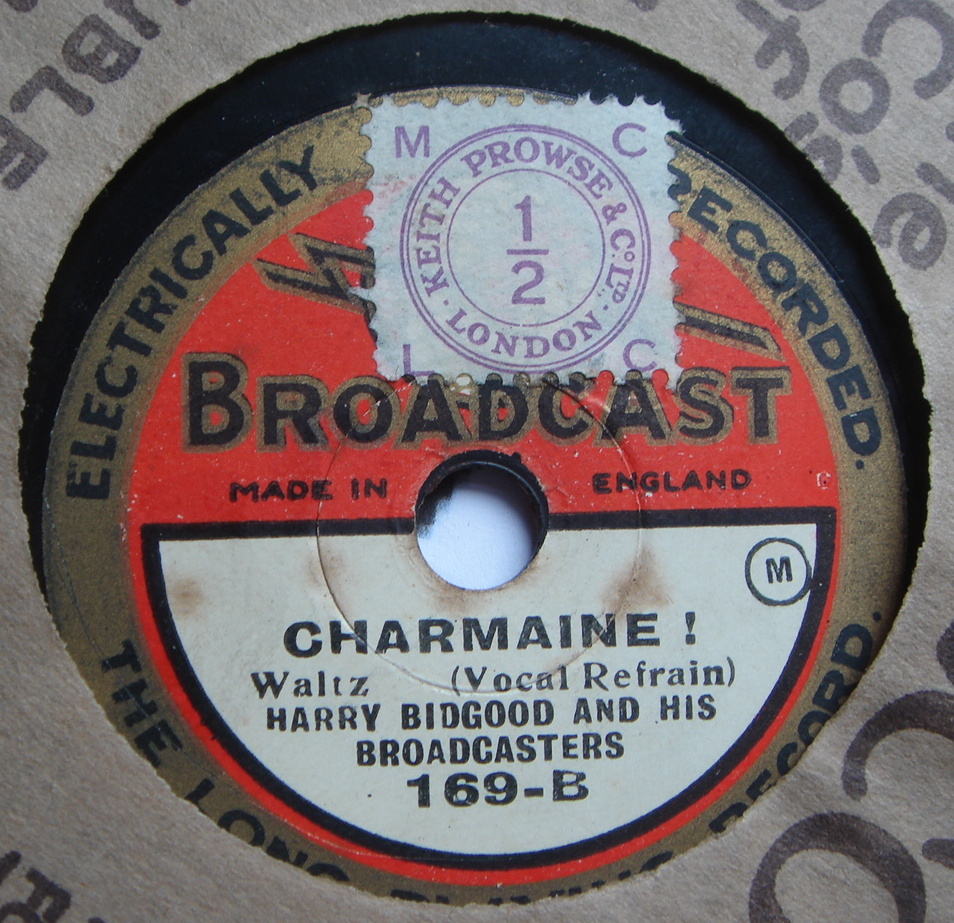
Another 78 from the boot sale pile. A 8" disc on the Broadcast label. "Me And Jane On A Plane" is a novelty number that was ideal for The Bonzo Dog Band and their ilk to play in their sets accompanies with daft props like a goggles, huge moustaches and scarves stiffened with wire so they looked like they were caught in the wind. Wikipedia says - "Henry Bidgood (1898 – November 15, 1957) known as "Harry" was an English composer, dance band leader and musical director for films.[1] Born in London the son of composer Thomas Bidgood. He studied at The Royal College of Music. Bidgood released dance band music under various names, mostly notably Primo Scala and his Accordion Band.[2] Over the course of 20 years he would frequently broadcast on the BBC. Bidgood was also the musical director for numerous films including several George Formby films." BTW I must apologise for all the text running together. Blogger has changed for the worse and I don't know how to fix it! Harry Bidgood - Charmaine Harry Bidgood - Me And Jane In A Plane

Ciro's Club Dance BandS

Sadly not much information about Ciro's Club on the net - only this - "The Sunset Strip has long been known as the playground of the stars. The brightest stars, the biggest moguls and most Oscar-winning artists dined, danced and romanced in clubs along the Strip. The most popular rendezvous, Ciro’s , opened in 1940." Now it's the Comedy Store apparently. Ciro's Club Dance Band - Ol' Man River Ciro's Club Dance Band - A Room With A View

Leslie Sarony

I found a suitcase full of old 78's today at a boot sale so will be uploading a few in the next couple of weeks. Delighted to find this novelty song amongst them by Leslie Sarony who churned out dozens of hits during the 30's and 40's. Wikipedia says - "Leslie Sarony (born Leslie Legge Frye 22 January 1897 - 12 February 1985) was a British entertainer, singer and songwriter. Sarony was born in Surbiton, Surrey and died in London. He began his stage career aged 14 with the group Park Eton's Boys. In 1913 he appeared in the revue Hello Tango. In the Great War, Sarony served in the London Scottish regiment in France and Salonika. His stage credits after the war include revues, pantomimes and musicals, including the London productions of Show Boat and Rio Rita. Sarony became well known in the 1920s and 1930s as a variety artist and radio performer. In 1928 he made a short film made in the Phonofilm sound-on-film system, Hot Water and Vegetabuel. In this film, he sang, interspersed with his comic patter, the two eponymous songs – the first as a typical Cockney geezer outside a pub, the second (still outside the pub) as a less typical vegetable rights campaigner ("Don't be cruel to a vegetabuel"). He went on to make a number of recordings of novelty songs, such as He Played his Ukulele as the Ship Went Down, including several with Jack Hylton and his Orchestra. He teamed up with Leslie Holmes in 1935 under the name The Two Leslies. The partnership lasted until 1946. Their recorded output included such gems as "I'm a Little Prairie Flower". His song "Jollity Farm" was covered by Bonzo Dog Doo-Dah Band." Leslie Sarony - Ain't It Grand To Be Blooming Well Dead Pt. 1 Leslie Sarony - Ain't It Grand To Be Blooming Well Dead Pt. 2

Thursday, May 03, 2012

Jon Pertwee

Another curio from Crewe flea market in the shape of a give-away ( I presume ) bit of Heinz promotional material as a floppy disc from 1976. This was obviously a commercial of some sort but I don't remember this catchy fun song. The other side is almost as good ( or as bad depending on your point of view!) Wikipedia says - "Born in Chelsea, London, to a family descended from Huguenots (the name was an Anglicisation of "Perthuis"; his full surname being "de Perthuis de Laillevault"), he was the son of noted screenwriter and actor Roland Pertwee and distant cousin of actor Bill Pertwee, who played Chief Warden Hodges in the comedy Dad's Army (coincidentally, Jon Pertwee was the writers' first choice for the role of Captain George Mainwaring in Dad's Army). The actor Henry Ainley, a close friend of his father, was his godfather and Ainley's son Anthony appeared alongside Pertwee in the 1983 Doctor Who anniversary story The Five Doctors. [edit]Education Pertwee was educated at Frensham Heights School, an independent school in Rowledge, near Farnham in Surrey, at Sherborne School in Sherborne in Dorset, and at some other schools from which he was expelled. After school, he went to the Royal Academy of Dramatic Art (RADA), from which he was also expelled after he refused to play a Greek "wind" during one of the lessons, feeling it was a waste of both his time and his father's money. He was also accused of writing graffiti about the tutors on the toilet walls. Pertwee was an officer in the Royal Navy, spending some time working in naval intelligence during the Second World War. He was a crew member of HMS Hood and was transferred off the ship shortly before she was sunk, losing all but three men. During his time in the Navy Pertwee woke up one morning after a drunken night out while in port to find a tattoo on his right arm, which was occasionally seen during his time in Doctor Who. After the war he made a name for himself as a comedy actor, notably on radio in Waterlogged Spa, alongside Eric Barker and Puffney Post Office in which he played a hapless old postman with the catch-phrase "It doesn't matter what you do, as long as you tears them up". From 1959 to 1977, he had a long-running role as the conniving Chief Petty Officer Pertwee in The Navy Lark on BBC Radio. He was known as a Danny Kaye look-alike, and his impersonation of Kaye can be seen in the 1949 film Murder at the Windmill. On stage, he played the part of Lycus in the 1963 London production of A Funny Thing Happened on the Way to the Forum with Frankie Howerd and appeared in the smaller role of Crassus in the 1966 film version. He appeared as Sidney Tait in the 1963 comedy Ladies Who Do and later in four Carry On films: Carry On Cleo (1964, as the soothsayer), Carry On Screaming (1966, as Dr. Fettle), Carry On Cowboy (1965, as Sheriff Earp) and Carry On Columbus (1992, as the Duke of Costa Brava). On television, he started off with small parts in children's shows like Mr Pastry. Later he made an appearance in The Avengers episode "From Venus with Love" as Brigadier Whitehead, and in the 1970s, he guest-starred as a vicar in The Goodies' episode "Wacky Wales". He had one of his most memorable film roles in the 1971 Amicus horror compendium The House That Dripped Blood. Filmed in the summer of 1970, between his first and second Doctor Who seasons, Pertwee played the lead in the last segment of the film as Paul Henderson, a deliciously arrogant horror film star who meets his quasi-comedic doom thanks to a genuine vampire cloak." Jon Pertwee - The Noodle Doodle Man Jon Pertwee - The Noodle Doodle Man On The Moon

Wednesday, May 02, 2012

4 MA

Another curiosity from Yugolsavia now Croatia and Serbia. Found in the same Oxfam shop as the previous record. 60's again I would guess by the dated graphics which first drew my attention. Sounds a bit like Mitch Miller or similar chirpy pop group of the late 50's early 60's. The sleeve notes in Croatian say "Volkalni kvarket "4 M" in addition to his numerous appearances in nozemsivu stekoo especially very popular with local audiences and the day is undoubtedly one among the most wanted. Vokaine up our pop music." Translation courtesy of Google. 4 M - Nima Splita Do Splita/ Marela 4 M - Jenka Song/ Klin

Aleksandar Stepic

A curious Ep I found today in Crewe Oxfam shop for 29p. Attracted by the exotic sleeve from Yugoslavia or perhaps now Serbia. On the Diskos label from the 60's I would guess? " STEPIĆ ALEXANDER (the Great Field, 1932) Aca was born in 1932. in Veliko Polje, near. He is one of the creators of art in the field of folk music, which, as a composer and leader affirmed estradnog Ensemble, a period of 40 years, has achieved results that will be recorded in our contemporary ethnomusicology. Aca Stepić belongs constellation of musical artists who create in the spirit of the original folk music such as: Miodrag Todorovic-Krnjevac, Radojka Zivkovic, Dragan Toković, and Dr. Peter Tanasijević. Creativity Alexander Stepić is inseparably connected with our original folk music. His compositions are enriched with subtle feelings for the beauty of sound, because it originated in an area where every ton of new songs, or the car is subject to a detailed analysis of the people, which is the best critic of folk music. After high school, do not go to college, but stays with his accordion, that it introduces into the world of folk music 1950th year. At first guest in the famous restaurants and hotels, a very respectable music scene in Belgrade. noted that his visit to Sarajevo, where he meets and his associates usnešnu, singer Silvana Armenulić. After accepting the engagement of Sarajevo in Belgrade at the "Grand", which leads to Sylvan Armenulić with gift Ruzic performances every night with his orchestra. After "Grand", the Aca and Silvana accept involvement in the famous "Skadarlija", which remain around the two years, and then accept the engagement in the restaurant "Stari Grad", where they end up working in restaurants, and 1964. year signed a contract with the concert agency "Belgrade Estrada," which at that time very professionally organized concerts. in 1962. It was hired to play the accordion as the best of our National Orchestra of Radio Belgrade, under the direction of Vlastimir Pavlovic - Carevce. For this work he remained for about a year. After this engagement successfully engaged in creative work and playing in folk music, which lasts continuously since 1965. to 1995 . year. As a regular contributor to participate in numerous programs and actions of Radio-Television Serbia, such as the village cheerfully, Saturday evening, merry evening, spinning spindle, etc. Weekly afternoon. He participated in many cultural and artistic events and festivals as: - September Ivanjica 1967th later called Nušićijada in Ivanjica - Belgrade spring of 1970." Kola - Nadino Kolo/Veliko Poljsko Kolo

Monday, April 30, 2012

Larry Williams

An LP on the Sue label from the 60's with Screaming Lord Sutch introducing a "live" concert by Larry Williams who owed a lot to Little Richard and James Brown. Wikipedia says - "Larry Williams (May 10, 1935 – January 7, 1980 was an American rhythm and blues and rock and roll singer, songwriter, producer, and pianist from New Orleans, Louisiana. Williams is best known for writing and recording some rock and roll classics from 1957 to 1959 for Specialty Records, including "Bony Moronie", "Short Fat Fannie", "High School Dance" (1957), "Slow Down", "Dizzy Miss Lizzy" (1958), "Bad Boy" and "She Said Yeah" (1959), which were later covered by British Invasion groups and other artists. John Lennon, in particular, was a fan of Williams, recording several of his songs over the course of his career. "Bony Moronie" is listed as one of the Top 500 songs that shaped Rock and Roll. Williams lived a life mixed with tremendous success and violence-fueled drug addiction. He was a long-time friend of Little Richard. As a child in New Orleans, Williams learned how to play piano. When he was a teenager, he and his family moved to Oakland, California, where he joined a local R&B group called the Lemon Drops. In 1954, Williams went back to New Orleans for a visit. He began work as Lloyd Price's valet and played in the bands of Price, Roy Brown and Percy Mayfield. In 1955, Williams met and developed a friendship with Little Richard Penniman, who was recording at the time in New Orleans. Price and Penniman were both recording for Specialty Records. Williams was introduced to Specialty's house producer, Robert Blackwell, and was signed to record. In 1957, Little Richard was Specialty's biggest star, but bolted from rock and roll to pursue the ministry. Williams was quickly groomed by Blackwell to try to replicate his success. Using the same raw, shouting vocals and piano-driven intensity, Williams scored with a number of hit singles. Williams' three biggest successes were "Short Fat Fannie", which was his first hit, reaching #5 in Billboard's pop chart, "Bony Moronie", which peaked at #14, and its flip "You Bug Me Baby" which made it to #45. "Dizzy Miss Lizzy" charted at #69 on Billboard the following year. Both "Short Fat Fannie" and "Bony Moronie" sold over one million copies, gaining gold discs." Larry Williams - Side One

Wednesday, April 25, 2012

Gerard Hoffnung

An curious Lp I found the other day which features interviews or short talks with Gerard Hoffnung the English humourist in the 50's from various radio programmes on the BBC. A cross between Count Arthur Strong and Boris Johnson. Probably hilarious at the time but now seems rather dated and quaint. Wikipedia says - "Gerard Hoffnung (22 March 1925 – 25 September 1959) was an artist and musician, best known for his humorous works. Born in Berlin, and named Gerhard, he was the only child of a well-to-do Jewish couple, Hildegard and Ludwig Hoffnung. He was sent to England, where he attended Bunce Court School in 1938. In 1939, his parents left Germany, initially for Florence and then for London, and Hoffnung then attended Highgate School, while his father went to what was then the British Mandate of Palestine to enter the family's banking business. This temporary separation became permanent as a consequence of World War II. Hoffnung died of a cerebral haemorrhage only 20 years after arriving in England, but filled those two decades with considerable achievements as - amongst other things - a cartoonist, tuba player, impresario, broadcaster and public speaker, much sought after by the Oxford and Cambridge Unions. Hoffnung published a series of books of cartoons poking gentle fun at conductors and orchestral instrumentalists. After his death, some of these were turned into a short animated film by Halas and Batchelor under the title The Hoffnung Symphony Orchestra, which won a number of awards in 1965-66. He created three Hoffnung Music Festivals held at the Royal Festival Hall in London. These featured contributions from distinguished "serious" musicians. Compositions specially commissioned for the Festivals included Malcolm Arnold's A Grand, Grand Overture, Op. 57 which was dedicated to U.S. President Herbert Hoover and was scored for several vacuum cleaners and other domestic appliances. Franz Reizenstein's Concerto Popolare was described as "The Piano Concerto to end all Piano Concertos". William Walton conducted a one-note excerpt from his oratorio Belshazzar's Feast: the word, "Slain!" shouted by the chorus. Much of Hoffnung's own humour relies on timing. A notable example is the 'Bricklayer's Lament' which was part of his 1958 Oxford Union Speech. Hoffnung's life was in the tradition of the Great British Eccentric, despite his continental origins. He affected, consciously or otherwise, the persona of an elderly music master, a role honed while teaching at Stamford School, where his eccentricities are remembered to this day. His voice had the hoarseness one associates with age, its cadences slow and faltering after the fashion of the old, or perhaps in homage to Colonel Blimp. His eccentricities were legendary, to the point where stories about him are fantastic enough to be believable, as nobody would think of making them up. For instance, he is said to have been fanatical about learning to whistle entire symphonies, even calling friends who were conductors and whistling down the phone line at them to check his memory." Gerard Hoffnung - Side One

Monday, April 23, 2012

Don & Dewey

Some frantic R&B now with a Latin twist from an LP on the Specialty label from the 70's but most of the songs on this compilation are from the 50's and early 60's. Wikipedia says - "Don and Dewey were an American rock and roll duo, comprising Don "Sugarcane" Harris (June 18, 1938[1] - 1999) and Dewey Terry (July 17, 1937[2] - May 11, 2003). Both were born and grew up in Pasadena, California. In 1954, Dewey Terry was a founding member of a group called The Squires while still in high school. He was later joined by a friend, Don Bowman (who would later change his name to Harris). In 1955 the Squires released a record on the minor Los Angeles-based label Dig This Record. In 1957 the group broke up, but Don and Dewey remained together. Later that year they were signed by Art Rupe's Specialty Records label and for the next two years produced rock and roll, Both Don and Dewey played guitar, with Dewey often doubling on keyboards. When not playing guitar or bass, Don occasionally played the electric violin, a skill for which he subsequently became well known under the name of "Sugarcane" Harris. Legendary drummer Earl Palmer played frequently on their sessions. Although Don and Dewey did not have any hits of their own, several of the songs that they wrote and/or recorded would appear on the charts later, performed by other artists. "I'm Leaving It Up to You" became a #1 hit for Dale & Grace in 1963. "Farmer John" was a hit by The Premiers, reaching #19 in 1964 after having been covered The Searchers a year earlier. "Koko Joe" (written by the then Specialty Records producer Sonny Bono), "Justine" and "Big Boy Pete" were a staple for The Righteous Brothers for many years. (Indeed, it has frequently been noted that the early Righteous Brothers act was quite closely based on Don and Dewey's.) Finally, "Big Boy Pete" became a minor hit in 1960 for The Olympics, reaching #50 and a #4 hit for The Kingsmen when recorded with new lyrics as "The Jolly Green Giant" in 1965. In 1959 Don and Dewey and producer Bono left Specialty Records for Rush Records, where they recorded a few songs but split up shortly afterward. In 1964 Art Rupe recorded both Don and Dewey and Little Richard (another Specialty Records act) and, although some energetic music was generated, there were to be no further hits for either act. The pair played briefly in Little Richard's band and then went their separate ways once again." Don & Dewey - Side Two

Little Eva

A record without it's sleeve I bought many years ago at Cheshire Street in East London I think. Some lovely examples of soul ballads in the style of The Ronettes and Carol King. Indeed Carol King wrote many of the songs on this compilation LP of her hits with Gerry Goffin. Wikipedia says - "Born in Belhaven, North Carolina, she moved to the Brighton Beach section of Brooklyn, New York at a young age. As a teenager, she worked as a maid and earned extra money as a babysitter for songwriters Carole King and Gerry Goffin. It is often claimed that Goffin and King were amused by Boyd's individual dancing style, so they wrote "The Loco-Motion" for her and had her record it as a demo (the record was intended for Dee Dee Sharp). However, as King said in an interview with NPR and in her "One to One" concert video, they knew she could sing when they met her, and it would be just a matter of time before they would have her record songs they wrote, the most successful being "The Loco-Motion". Music producer Don Kirshner of Dimension Records was impressed by the song and Boyd's voice and had it released. The song reached #1 in the United States in 1962. It sold over one million copies, and was awarded a gold disc. After the success of "The Loco-Motion", Boyd was stereotyped as a dance-craze singer and was given limited material. The same year, Goffin and King wrote "He Hit Me (It Felt Like A Kiss)" (performed by The Crystals) after discovering that Boyd was being regularly beaten by her boyfriend.[2] When they inquired why she tolerated such treatment, Eva replied, with apparent sincerity, that her boyfriend's actions were motivated by his love for her." Little Eva - Side Two

Monday, April 16, 2012

Blues For Your Pocket


A nice blues compilation I seem to have had in my collection for ever which came out in 1972 on the Transatlantic label. I think I must have bought it new for the princely sum of 19 shillings and 11 pence! Has some great artistes on it including Son House, Furry Lewis, Jazz Gillum and Big Bill Broonzy.

Wikipedia says of Memphis Slim -

"Memphis Slim's birth name was John Len Chatman, and he was born in Memphis, Tennessee, United States. His father Peter Chatman sang, played piano and guitar, and operated juke joints, and it is now commonly believed that he took the name to honor his father when he first recorded for Okeh Records in 1940. Although he started performing under the name Memphis Slim later that same year, he continued to publish songs under the name Peter Chatman.
He spent most of the 1930s performing in honky-tonks, dance halls, and gambling joints in West Memphis, Arkansas, and southeast Missouri. He settled in Chicago in 1939, and began teaming with Big Bill Broonzy in clubs soon afterward. In 1940 and 1941 he recorded two songs for Bluebird Records that became part of his repertoire for decades, "Beer Drinking Woman," and "Grinder Man Blues." These were released under the name "Memphis Slim," given to him by Bluebird's producer, Lester Melrose. Slim became a regular session musician for Bluebird, and his piano talents supported established stars such as John Lee "Sonny Boy" Williamson, Washboard Sam, and Jazz Gillum. Many of Slim's recordings and performances until the mid-1940s were with guitarist and singer Broonzy, who had recruited Slim to be his piano player after Joshua Altheimer's death in 1940."

Wikipedia says of Fred McDowell -

"McDowell was born in Rossville, Tn. His parents, who were farmers, died when McDowell was a youth. He started playing guitar at the age of 14 and played at dances around Rossville. Wanting a change from plowing fields, he moved to Memphis in 1926 where he started to work in the Buck-Eye feed mill where they processed cotton into oil and other products. He also had a number of other jobs and played music for tips. Later in 1928 he moved south into Mississippi to pick cotton. He settled in Como, Mississippi, about 40 miles south of Memphis, in 1940 or 1941, and worked steadily as a farmer, continuing to perform music at dances and picnics. Initially he played slide guitar using a pocket knife and then a slide made from a beef rib bone, later switching to a glass slide for its clearer sound. He played with the slide on his ring finger.
While commonly lumped together with Delta Blues singers, McDowell actually may be considered the first of the bluesmen from the 'North Mississippi' region - parallel to, but somewhat east of the Delta region - to achieve widespread recognition for his work. A version of the state's signature musical form somewhat closer in structure to its African roots (often eschewing the chord change for the hypnotic effect of the droning, single chord vamp), the north hill country blues style (or at least its aesthetic) may be heard to have been carried on in the music of such figures as Junior Kimbrough and R. L. Burnside, while serving as the original impetus behind creation of the Fat Possum record label out of Oxford, Mississippi."

Tracks are as follows -

1. Memphis Slim - Boogie Woogie Piano Styles
2. Little Brother Montgomery - Lonesome Mama
3. Sticks McGhee - Drink Of Wine Mop Mop
4. J. D. Short - So Much Wine
5. James "Son" Thomas - Beefsteak Blues
6. Fred McDowell - Mojo Hand

Blues For Your Pocket - Side Two

Joey Lewis


An Lp I've had for a while. Not sure where it came from. Released in the 70's I imagine on the Straker's record label this is instrumental soca at it's best.

Wikipedia says -

"Soca is said to have been created in 1963 (see 1963 in music) by Ras Shorty I's "Clock and Dagger" from calypso music. Shorty added Indian instruments, including the dholak, tabla and dhantal. A prolific musician, composer and innovator, Shorty experimented with fusing calypso and the other Indian inspired music including chutney music for nearly a decade before unleashing "the soul of calypso,"...soca music. Shorty had been in Dominica during an Exile One performance of cadence-lypso, and collaborated with Dominica's 1969 Calypso King, Lord Tokyo and two calypso lyricists, Chris Seraphine and Pat Aaron in the early 1970s, who wrote him some creole lyrics. Soon after Shorty released a song, "Ou Petit", with words like "Ou dee moin ou petit Shorty" (meaning "you told me you are small Shorty"), a combination of calypso, cadence and kwéyòl. Shorty's 1974 Endless Vibrations and Soul of Calypso brought soca to its peak of international fame.
Many people think that soca music was created by the blending of calypso and soul music. Many people believe this misconception because it is stated that Lord Shorty called soca "soul calypso". What Lord Shorty meant to say[citation needed] was that soca was the "soul of calypso", but to make it short he called it "soca", which blends the first two letters of "SOul" and "CAlypso". Soca music evolved from a fusion of calypso, cadence, and Indian instruments."


Joey Lewis - Soul Chick/Walk 00 Miles/Steel & Brass

Saturday, April 14, 2012

Billie Anthony


A 78 found today at Age UK. I have never heard this version of This Ole House before but apparently it was a big hit in the 50's long before Shakin' Stevens.
I love the deep baritone voice that keeps chiming in every so often!

Wikipedia says -

"Billie Anthony (11 October 1932 — 5 January 1991) was a Scottish female singer. She is best known for her Top 10 hit version of "This Ole House", which despite chart competition from other versions of the same song, reached #4 in the UK chart.

She was born Philomena McGeachie Levy in Glasgow, Scotland. Her mother, Lily, was a talented dancer and her father, a song and dance man, and stage manager at the Glasgow Empire. Her godmother was Gracie Fields. Although her parents divorced when she was eighteen days old, she spent her entire childhood in and around the theatre, and wanted a career on the stage as a dancer. At first her mother was against her going into show business, so on leaving school she reluctantly agreed to train as a dressmaker, but her obsession with the theatre proved too powerful.
In 1946, when still only fourteen, she ran away from home and joined the chorus of a touring show as one of "May Moxon’s Young Ladies". Five years later she met Peter Elliott, who was part of a famous show business family called The Musical Elliotts. They developed an instant friendship and, due to their mutual love of dancing, decided on the formation of their own double act. As Phil and Peter Elliott, they successfully toured variety theatres as "The Debonair Dancers — Four Educated Feet". They toured continuously throughout 1952 but, in 1953, were compelled to abandon their act when Peter was called up to do his national service with the Royal Air Force."


Billie Anthony - This Ole House

Billie Anthony - (Oh) What A Dream

Swinley Sings & Plays


A curio from the pile of records and books I bought this morning from the Age UK shop that were selling off everything for " A bag for a £1" - today only. This EP caught my eye. It has no sleeve but I love the simple graphics/lettering on the label. Swinley seems to be a school in Brackell Berkshire. This was recorded in 1935 so puzzled why it's on a vinyl 45 and not on a 78? A bit of detective work found the County Recording Service but they only seemed to have made things for Julian Cope and more recent stuff so doubt if it's the same place. Curiouser and curiouser!
The record itself is rather dull and sounds like something Uncle Mac used to play on his radio show in the 50's.

Swinley Sings & Plays - Side One

Swinley Sings & Plays - Side two