Showing posts with label instrumental/ pop. Show all posts

Sunday, April 06, 2014

Duane Eddy

Another single from today's boot sale in a wet field. From 1962 on the Decca label. Duane's guitar style is very memorable. This was a minor hit I think in the UK- not as big as Peter Gunn , Rebel Rouser and some of the others who's names escape me for the moment. Wikipedia says - "Born in Corning, New York, he began playing the guitar at the age of five. In 1951 his family moved to Tucson, and then toCoolidge, Arizona. At the age of 16 he obtained a Chet Atkins model Gretsch guitar, and formed a duo, Jimmy and Duane, with his friend Jimmy Delbridge (who later recorded as Jimmy Dell). While performing at local radio station KCKY they met disc jockey Lee Hazlewood, who produced the duo's single, "Soda Fountain Girl", recorded and released in 1955 in Phoenix. Hazlewood then produced Sanford Clark's 1956 hit, "The Fool", featuring guitarist Al Casey, while Eddy and Delbridge performed and appeared on radio stations in Phoenix before joining Buddy Long's Western Melody Boys, playing country music in and around the city. Eddy devised a technique of playing lead on his guitar's bass strings to produce a low, reverberant "twangy" sound. In November 1957, Eddy recorded an instrumental, "Movin' n' Groovin'", co-written by Eddy and Hazlewood. As the Phoenix studio had no echo chamber, Hazlewood bought a 2,000 gallon water storage tank which he used as an echo chamber to accentuate the "twangy" guitar sound. In 1958, Eddy signed a recording contract with Lester Sill and Lee Hazlewood to record in Phoenix at the Audio Recorders studio. Sill and Hazlewood leased the tapes of all the singles and albums to the Philadelphia-based Jamie Records. "Movin' n' Groovin'" reached number 72 on the Billboard Hot 100 in early 1958; the opening riff, borrowed from Chuck Berry's "Brown Eyed Handsome Man," was itself copied a few years later by The Beach Boys on "Surfin' U.S.A.". For the follow-up, "Rebel 'Rouser", the record featured overdubbed saxophone by Los Angeles session musician Gil Bernal, and yells and handclaps by doo-wop group The Rivingtons. The tune became Eddy's breakthrough hit, reaching number 6 on the Billboard Hot 100 chart. It sold over one million copies, earning Eddy his first gold disc. Eddy had a succession of hit records over the next few years, and his band members, including Steve Douglas, saxophonist Jim Horn and keyboard player Larry Knechtelwould go on to work as part of Phil Spector's Wrecking Crew. According to writer Richie Unterberger, "The singles - 'Peter Gunn,' 'Cannonball,' 'Shazam,' and 'Forty Miles of Bad Road' were probably the best - also did their part to help keep the raunchy spirit of rock & roll alive, during a time in which it was in danger of being watered down." On January 9, 1959, Eddy’s debut album, Have 'Twangy' Guitar Will Travel, was released, reaching number 5, and remaining on the album charts for 82 weeks. Eddy's biggest hit came with the theme to the movie Because They're Young in 1960, which featured a string arrangement, and reached a chart peak of number 4 in America and number 2 in the UK in September 1960. It became his second million selling disc.[1] Eddy's records were equally successful in the UK, and in 1960, readers of the UK's NME voted himWorld's Number One Musical Personality, ousting Elvis Presley. In 1960 Eddy signed a contract directly with Jamie Records, bypassing Sill and Hazlewood. This caused a temporary rift between Eddy and Hazlewood. The result was that for the duration of his contract with Jamie, Eddy produced his own singles and albums. "Duane Eddy and the Rebels" became a frequent act on The Dick Clark Show." Duane Eddy - Ballad Of Paladin Duane Eddy - The Wild Westerner

Saturday, February 02, 2013

Bill Doggett

Slightly warped copy of an LP on the CBS label from 1966. I think I have featured the side with Honky Tonk Pts. 1 & 2 previously much loved theme for the Charlie Gillett radio show of the same name back in the 70's. .............................................................................................................................. Wikipedia says - "William Ballard Doggett was born in Philadelphia, Pennsylvania, United States. His mother, a church pianist, introduced him to music when he was nine years old. By the time he was fifteen, he had joined a Philadelphia area combo, playing local theaters and clubs while attending high school. Doggett later sold his band to Lucky Millinder, and worked during the 1930s and early 1940s for both Millinder and arranger Jimmy Mundy. In 1942 he was hired as The Ink Spots' pianist and arranger. Toward the end of 1947, he replaced Wild Bill Davis as the pianist for Louis Jordan's Tympany Five. It was in Jordan's group that he first achieved success playing the Hammond organ. In 1950 he is reputed to have written one of Jordan's biggest hits, "Saturday Night Fish Fry", for which Jordan claimed the writing credit. In 1951, Doggett organized his own trio and began recording for King Records. His best known recording is "Honky Tonk", a rhythm and blues hit of 1956 which sold four million copies (reaching No. 1 R&B and No. 2 Pop), and which he co-wrote with Billy Butler. The track topped the US Billboard R&B chart for over two months.[2] He won the Cash Box award for best rhythm and blues performer in 1957, 1958, and 1959. He also arranged for many bandleaders and performers, including Louis Armstrong, Count Basie, Ella Fitzgerald, and Lionel Hampton. As a jazz player Doggett started in swing music and later played soul jazz. His bands included saxophonists Red Holloway, Clifford Scott, Percy France, David "Bubba" Brooks, Clifford Davis, and Floyd "Candy" Johnson; guitarists Floyd Smith, Billy Butler, Sam Lackey and Pete Mayes; and singers Edwin Starr, Toni Williams and Betty Saint-Clair. His biggest hits, "Honky Tonk" (the Part 2 side of the record) and "Slow Walk" featured saxophonist Clifford Scott. He continued to play and arrange until he died, aged 80, of a heart attack in New York.".......................................................................................................................Tracks are as follows - 1. Stop That Twistin' In Here 2. I Cover The waterfront 3. Lady's Choice 4. Mommy Pt. 1 5. Mommy Pt.2.................................................................................................................Bill Doggett - Side One

Monday, April 12, 2010

The Spotnicks


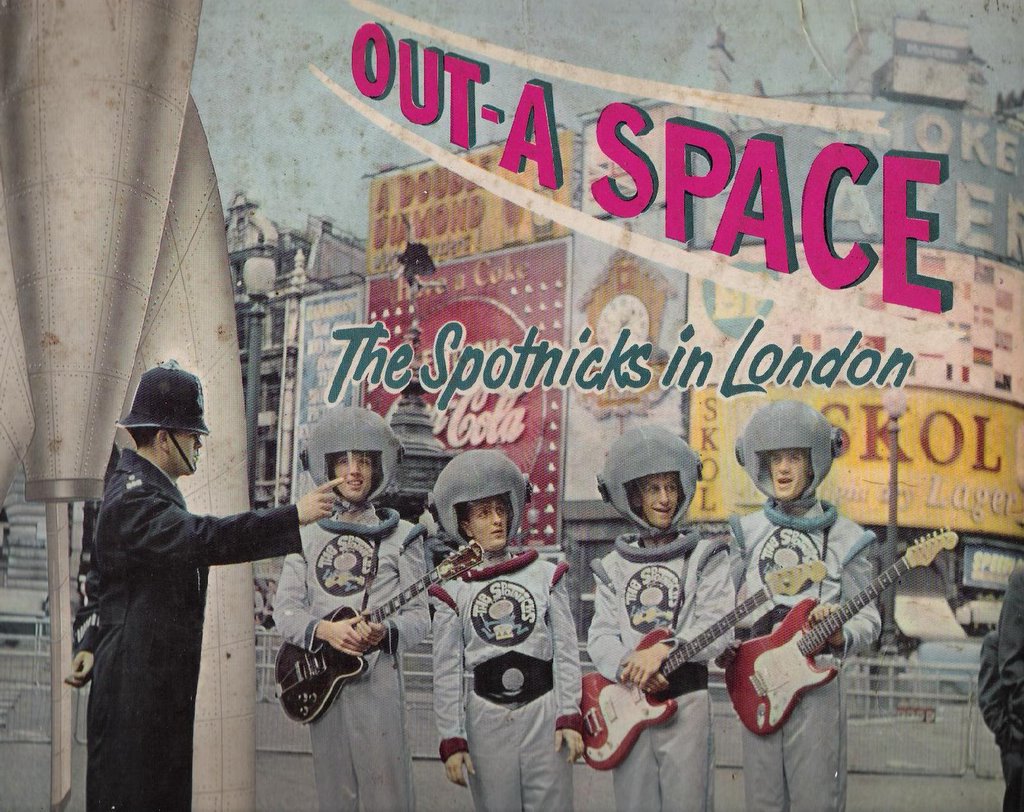
"The Spotnicks was formed in Göteborg, Sweden, in 1957, by guitarist and undisputed bandleader Bo Winberg. The other members were guitarist and singer Bob Lander, drummer Ove Johansson, and bassist Björn Thein, several of whom had already played together in local rock & roll bands like the Blue Caps, Rock Teddy, and the Rebels. The first year, they performed under the name the Frazers, but soon changed it to the Spotnicks. In 1961, they were signed by Karusell and released their first singles containing mostly instrumental covers of famous songs. The selection of songs was as varied as the performance was homogenous, including titles like "Hava Nagila" and "Johnny Guitar." Later the same year, the Spotnicks toured Germany, France, and Spain and in 1962, they released the debut album The Spotnicks in London, recorded on their first trip to England. Featured on this tour were the space suits that the band would wear on-stage until 1969. "Hava Nagila" became a hit in England in 1963 and the same year, Johansson left and was replaced by Derek Skinner. The rest of the '60s meant increasing success in Europe, the U.S., and Japan, and the band even managed to compete with themselves on the Japanese charts when the Spotnicks' song "Karelia" took the first position from the Feenades' "Ajomies." The song was the same, just recorded under different titles. The Feendes were a Finland-based side project to the Spotnicks, built on Winberg and Peter Winsnes, who had joined the Spotnicks in 1965. Winberg also released less successful recordings under the name the Shy Ones. Compared to the following decades, the '60s were a relative stable period for the group when it came to the lineup. Some new members were recruited though, like drummer Jimmie Nicol, bassist Magnus Hellsberg, and drummer Tommy Tausis, who had earlier played with Tages

In 1969, the Spotnicks disbanded, but Winberg continued to record using the name until the group reunited in 1972 on request by a Japanese record company. The same year, "If You Could Read My Mind" from the album Something Like Country became a big hit in Germany. The Spotnicks would keep their popularity there for a long time, even as it faded elsewhere. Only the Japanese audience proved more faithful and accordingly, the Spotnicks located most of their tours during the '70s to these countries. After the release of Something Like Country in 1972, by many fans seen as the Spotnicks' best album, they had practically ended being a band, consisting mainly of Winberg and various session musicians."

I must apologize for the terrible condition of this record. Found at Brick Lane flea market many years ago. The sleeve photo is a classic and the music is pretty good too despite the crackles and jumps!


The Spotnicks - Orange Blossom Special

The Spotnicks - Happy Henrik's Polka

The Spotnicks - Ol' Man River

The Spotnicks - Nightcap

The Spotnicks - High Flying Scotsman

The Spotnicks - Moonshot

Friday, January 08, 2010

Twisting The Oldies


An LP on the small Valmor label that put this out in the early 60's when the Twist dance craze was at it's height. All instrumentals of old rockers like Dream Lover, Splish Splash and Kansas City etc.

"The thrill of the late 1950s and the phenomenon of the early 1960s --the dance anyone can do-- was the twist. Nearly the hula-hoop movement without the hoop, the twist paved the way for the frug, watusi, monkey, pony, swim, snake, hully gully, etc., and even the limbo, mento, ska, and a new dance called the "regay" in some liners. Yes, these were the last days of teenagers and the older dancing generation sharing phonograph and stage.

The basics were Chubby Checker with the hit song (and endless variations), the Isley's "Twist and Shout," and Joey Dee & the Starlighters creating a scene at New York's Peppermint Lounge. All this healthy activity led to attempts at the twist by big bands, high-society orchestras, Latin artists, and of course rock and soul bands. (The list below excludes most of the obvious twist sources, such as the Champs, Coasters, Joe Houston, Louie Prima, Huey Smith, etc.)

The twist made its most interesting impact abroad, on French pop, Tahitian, and presumably even Indian and Hawaiian artists. It is a goofy legacy, but after all, it is where rock and social dancing parted company."

Valmor discography and brief history of the label HERE.


Night Owls - Be My Guest

Night Owls - Don't Be Cruel

Night Owls - I've Had It