Thursday, September 26, 2013

Alan Sherman

A welcome find was this LP on the Warner Bros. label from 1963.  I already have "My Son The Folk Singer" but not sure how many others in this series there are?   I expect Wikipedia will shed light on the subject.  Hello Muddah.... his big hit is on here but the other parodies of songs on here are just as amusing.  I love the sleeve art too. Another quid well spent!

"In 1951 Sherman recorded a 78-rpm single with veteran singer Sylvia Froos which included the songs "A Satchel and a Seck," parodying "A Bushel and a Peck" from Guys and Dolls, and "Jake's Song." The single sold poorly and when Sherman wrote his autobiography, he did not make reference to it. Later, he found that the song parodies he performed to amuse his friends and family were taking on a life of their own. Sherman lived in the Brentwood section of West Los Angeles next door to Harpo Marx, who invited him to perform his song parodies at parties attended by Marx's show-biz friends. After one party, George Burns phoned an executive at Warner Bros. Records and persuaded him to sign Sherman to a contract. The result was a long playing album of these parodies, My Son, the Folk Singer, which was released in 1962. It sold over one million copies, and was awarded a gold disc. The album was so successful that it was quickly followed byMy Son, the Celebrity, which ended with "Shticks of One and Half a Dozen of the Other," fragments of song parodies including Robert Burns' "Comin' Thro' the Rye": "Do not make a stingysandwich, pile the cold cuts high;/Customers should see salami comin' thru the rye" and "All day, all night Cary Grant," a takeoff on "Marianne."
In 1962, capitalizing on his success, Jubilee Records re-released Sherman's 1951 single on the album More Folk Songs by Allan Sherman and His Friends, which was a compilation of material by various Borscht Belt comedians, such as Sylvia Froos, Fyvush Finkle and Lee Tully, along with the Sherman material.
As suggested by the albums' titles, Sherman's first two LPs were mainly reworkings of old folk songs to infuse them with Jewish humor. His first minor hit was "Sarah Jackman" (pronounced "Jockman"), a takeoff of "Frère Jacques" in which he and a woman (Christine Nelson) exchange family gossip ("Sarah Jackman, Sarah Jackman,/How's by you? How's by you?/How's by you the family?/How's your sister Emily?" etc.) The popularity of "Sarah Jackman" (as well as the album My Son, the Folk Singer) was enhanced after President John F. Kennedy was spotted in a hotel lobby singing the song. By his peak with My Son, the Nut in 1963, however, Sherman had broadened both his subject matter and his choice of parody material and begun to appeal to a larger audience.
Sherman wrote his parody lyrics in collaboration with Lou Busch. A few of the Sherman/Busch songs are completely original creations, featuring original music as well as lyrics, rather than new lyrics applied to an existing melody. The Sherman/Busch originals – notably "Go to Sleep, Paul Revere" and "Peyton Place" – are novelty songs, showing genuine melodic originality as well as deft lyrics."

Tracks are as follows - 1. You Went The Wrong Way, Old King Louie  2. Automation 3. I see Bones  4. Hungarian Goulash No. 5   5. Headaches  6. Her's To The Crabgrass


Wednesday, September 25, 2013

Minstrel Show

I must admit this LP is pretty awful but I was attracted by the colourful and font rich sleeve.  That's my excuse anyway!   Always had a dislike of minstrels especially after enduring the Black & White variety on the telly in the 60's and early 70's.  This record is a sad reminder of those innocent pre- politically  correct days and what was considered family entertainment.  I only feature it here to remind you how dire it all was!

Minstrel Show  -  Side One

Friday, September 20, 2013

The Polyanka Russian Gypsy Orchestra


Another EP on the Concert Hall label featuring the massed balalaika's of the "Polyanka" RussianGypsy Orchestra in glorious stereo.  Its actually plays at 33 nd third which was why it sounded incredibly fast when I put it on first at 45 r.p.m.!   Even at 33 and third it sounds like they are going at break neck speed -their little Kossack legs all a blur!

Polyanka Russian Gypsy Orchestra  -  Side One

Polyanka Russian Gypsy Orchestra  -  Side Two

Monday, September 16, 2013

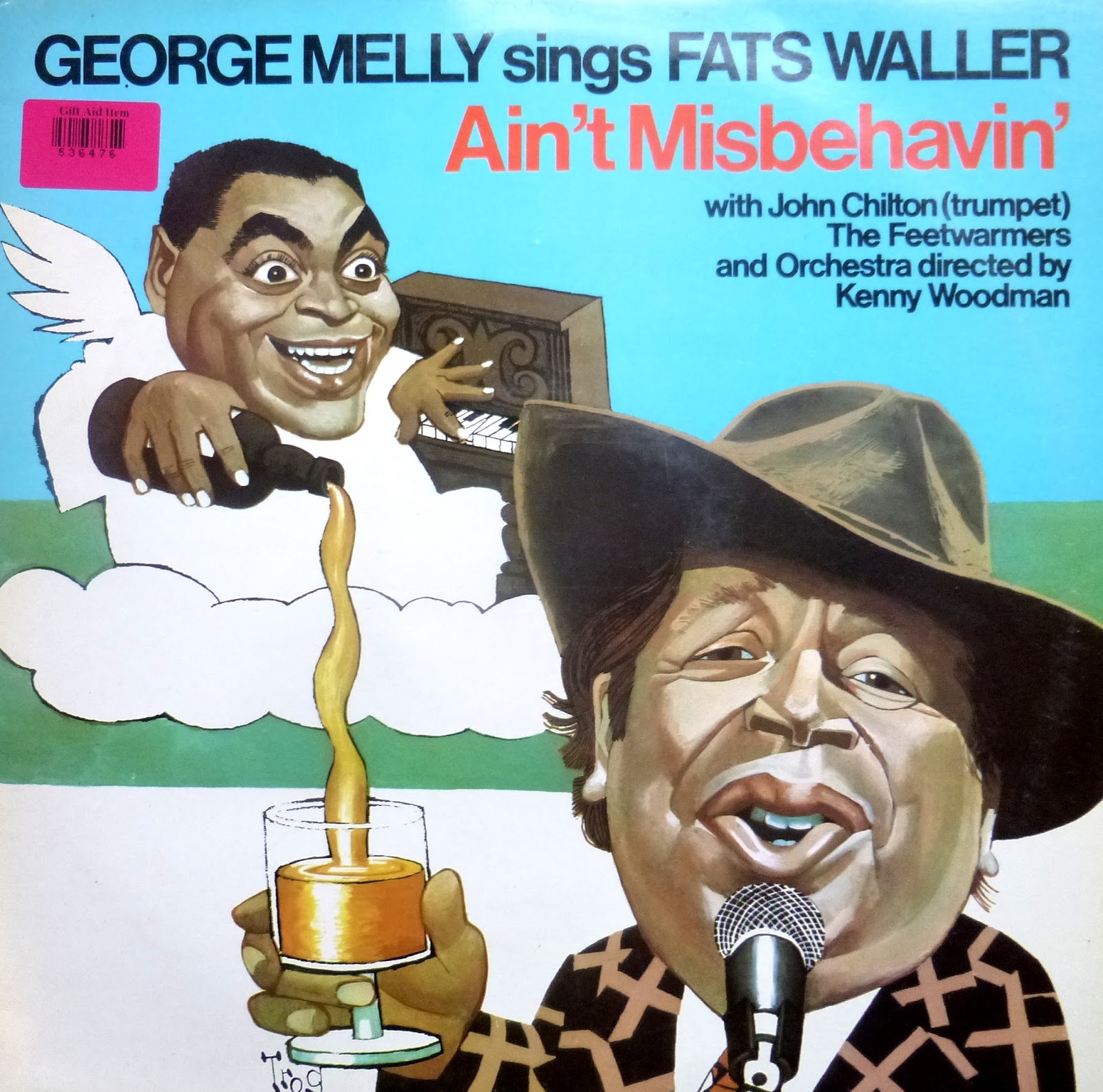
George Melly

A recent charity shop find for a mere pound.  I have several George Melly records but I have never seen this one before so grabbed it knowing I was in for a treat.

His Guardian obituary says  -  "....Alan George Heywood Melly was born in Liverpool. His father, an easy-going man, came from a large and well-known Liverpool business family, and made a comfortable living in the wool trade, which he hated. Tom didn't mind what anyone did, so long as it made them happy. Maud, George's Jewish mother, had once dreamed of a career on the stage, and remained a leading figure in Liverpool's amateur dramatics. (George's sister Andree was to become a well-known actress.) Maud was the friend of many theatrical queens, and visiting stars such as Robert Helpman, Frederick Ashton and Douglas Byng were often at the house near Aigburth Road, as was David Webster, then running a department store in Liverpool before taking over the Royal Opera House.
George wrote his autobiography backwards, starting with his early years in the jazz world, and working back to his childhood. Scouse Mouse (1984) is an affectionate account of 1930s middle-class Liverpool and its numerous Melly eccentrics. The snake in the Eden of Sefton Park was George's headmaster at Parkfield prep school, the alcoholic WW Twyne. A manic wielder of the house slipper, given to purple rages, Twyne deplored almost everything about the modern world except games. His denunciations of ballet and leftwing politics were so extreme that George knew at once that he would like both. Thus his interest in both anarchism and surrealism, developed at Stowe, can be traced to his comfortable Liverpudlian beginnings, just as his passion for fishing went back to family holidays in North Wales.
George clearly lacked officer-like qualities and was unable to qualify even as a naval clerk when he was called up in 1944. He remained a skiving Ordinary Seaman for most of his three and a half years service, leaving anarchist tracts on the messdeck to annoy his superior officers. He spent most of his leaves in London getting to know the Surrealist circle that gathered round the Belgian poet and gallery-owner ELT Mesens, and relishing an exuberant homosexual life made much easier by his uniform. Rum, Bum and Concertina (1977), his account of this period, is extremely funny. As a convinced surrealist George felt an obligation to be shocking and subversive, but his sense of reality and his sense of humour kept him out of serious trouble....."

Tracks are as follows -   1. Aint Misbehavin'  2. Squeeze me  3. I'm Gonna Sit Right Down And Write Myself A Letter  4. An Awful Lot My Gal Ain't Got  5. Your Feets Too Big  6. My Very Good Friend The Milkman  7. The Joint Is Jumpin'

George Melly  -   Sings Fats Waller  - Side One

Monday, September 02, 2013

Webb Pierce

EP on the Brunswick label from the 60's- a compilation of country hits from the mid to late 50's. Webb has a pleasing voice and delivery which put him in the top rank of country singers of his time.

Wikipedia says  -  "Webb Michael Pierce (August 8, 1921 – February 24, 1991) was one of the most popular American honky tonk vocalists of the 1950s, charting more number one hits than any other country artist during the decade.
His biggest hit was "In the Jailhouse Now," which charted for 37 weeks in 1955, 21 of them at number one. Pierce also charted number one for several weeks' each with his recordings of "Slowly" (1954), "Love, Love, Love" (1955), "I Don't Care" (1955), "There Stands the Glass" (1953), "More and More" (1954), "I Ain't Never" (1959), and his first number one "Wondering," which stayed at the top spot for four of its 27 weeks' charting in 1952.

For many, Pierce, with his flamboyant Nudie suits and twin silver dollar-lined convertibles, became the most recognizable face of country music of the era and its excesses.[1] Pierce was a one-time member of the Grand Ole Opry and was posthumously inducted into the Country Music Hall of Fame. A tribute in his honor (produced by singer/songwriter Gail Davies) was released in 2001 entitled Caught In The Webb - A Tribute To Country Legend Webb Pierce."

Monday, August 19, 2013

Ian Dury - Star Choice (Re-Up)

A radio show from 1978 on BBC Radio One. I think it was called "Star Choice" - where pop celebrities of the day played DJ for two hours and raided the BBC Archives. It was Ian Dury's turn and a wonderful eclectic mix it was too -including Max Miller , Roland Kirk, Kay Starr and Albert Ayler to name but a few.

Wikipedia says -

"Dury was born in north-west London at his parents' home at 43 Weald Rise, Harrow Weald, Harrow (although he often pretended, and indeed all but one of his obituaries in the national press stated, that he was born in Upminster, Havering). His father, William George Dury (born 23 September 1905, Southborough, Kent; died 25 February 1968), was a bus driver and former boxer, while his mother Margaret (known as Peggy, born Margaret Cuthbertson Walker, 17 April 1910, Rochdale, Lancashire) was a health visitor, the daughter of a Cornish doctor, and granddaughter of an Irish landowner.

William Dury trained with Rolls-Royce to be a chauffeur, and was then absent for long periods, so Peggy Dury took Ian to stay with her parents in Cornwall. After the Second World War, the family moved to Switzerland, where his father chauffeured for a millionaire and the Western European Union. In 1946 Peggy brought Ian back to England and they stayed with her sister, Mary, a physician in Cranham, a small village bordering Upminster. Although he saw his father on visits, they never lived together again.

At the age of seven, he contracted polio; very likely, he believed, from a swimming pool at Southend on Sea during the 1949 polio epidemic. After six weeks in a full plaster cast in Truro hospital, he was moved to Black Notley Hospital, Braintree, Essex, where he spent a year and a half before going to Chailey Heritage Craft School, East Sussex, in 1951. Chailey was a school and hospital for disabled children, and believed in toughening them up, contributing to the observant and determined person Dury became. Chailey taught trades such as cobbling and printing, but Dury's mother wanted him to be more academic, so his aunt Moll arranged for him to enter the Royal Grammar School, High Wycombe which he attended until the age of 16 when he left to study painting at Walthamstow Art College, having gained GCE 'O' Levels in English Language, English Literature and Art.

From 1964 he studied art at the Royal College of Art under British artist Peter Blake, and in 1967 took part in a group exhibition, Fantasy and Figuration, alongside Pat Douthwaite, Herbert Kitchen and Stass Paraskos at the Institute of Contemporary Arts in London. When asked why he did not pursue a career in art, he said, "I got good enough [at art] to realise I wasn't going to be very good."[citation needed] From 1967 he taught art at various colleges in the south of England.

Dury married his first wife, Elizabeth 'Betty' Rathmell (born 12 August 1942, Leamington Spa, Warwickshire), on 3 June 1967 and they had two children, Jemima (born 4 January 1969, Hounslow, Middlesex) and the recording artist Baxter Dury. Dury divorced Rathmell in 1985, but remained on good terms. He also cohabited with a teenage fan, Denise Roudette, for 6 years after he moved to London."


Ian Dury  -  Star Choice   Side One

Ian Dury  -  Star Choice Side Two

Wednesday, August 14, 2013

Elkes Owls Steel Orchestra

Another steel band from the West Indies on the Wirl label.  Released in 1973.  Attracted by the sleeve more than anything. Steel bands don't really transfer to vinyl very well - it all sounds a bit too tinny if you'll forgive the pun!

Wikipedia says  - " French planters and their slaves emigrated to Trinidad during the French Revolution (1789) from Martinique, including a number of West Africans, and French creoles from Saint Vincent,Grenada, Saint Lucia and Dominica, establishing a local community before Trinidad and Tobago were taken from Spain by the British. Carnival had arrived with the French, and the slaves, who could not take part in Carnival, formed their own, parallel celebration called canboulay.
Stick fighting and African percussion music were banned in 1880, in response to the Canboulay Riots. They were replaced by bamboo sticks beaten together, which were themselves banned in turn. In 1937 they reappeared in Laventille, transformed as an orchestra of frying pansdustbin lids and oil drums. These steelpans are now a major part of the Trinidadian music scene and are a popular section of the Canboulay music contests. In 1941, the United States Navy arrived on Trinidad, and the panmen, who were associated with lawlessness and violence, helped to popularize steel pan music among soldiers, which began its international popularization.
The first instruments developed in the evolution of steelpan were Tamboo-Bamboos, tunable sticks made of bamboo wood. These were hit onto the ground and with other sticks in order to produce sound. Tamboo-Bamboo bands also included percussion of a (gin) bottle and spoon. By the mid-1930s, bits of metal percussion were being used in the tamboo bamboo bands, the first probably being either the automobile brake hub "iron" or the biscuit drum "boom". The former replaced the gin bottle-and-spoon, and the latter the "bass" bamboo that was pounded on the ground. By the late 1930s their occasional all-steel bands were seen at Carnival and by 1940 it had become the preferred Carnival accompaniment of young underprivileged men. The 55-gallon oil drum was used to make steelpans from around 1947. The Trinidad All Steel Percussion Orchestra (TASPO), formed to attend the Festival of Britain in 1951, was the first steelband whose instruments were all made from oil drums. Members of TASPO included Ellie Mannette and Winston "Spree" SimonHugh Borde also led the National Steel Band of Trinidad & Tobago at the Commonwealth Arts Festival in England, as well as the Esso Tripoli Steel Band, who played at the World’s Fair in MontrealCanada, and later toured withLiberace and were also featured on an album with him."

Tracks are as follows  -  1.The First Time Ever I saw Your Face  2. Shaft  3. Wonderful |Song  4. St. Thomas Girl  5. Love Story  6. Drunk & Disorderly


Elkes Owls Steel Orchestra  -  Side One

Tuesday, August 13, 2013

Erroll Garner

LP on the cheapo Ember label from 1965 found at charity shop today.  Pleasant piano jazz - a compilation of show tunes and standards.

Wikipedia says - " Born in Pittsburgh, Pennsylvania, to an African American family in 1923, Erroll began playing piano at the age of three. He attended George Westinghouse High School, as did fellow pianists Billy Strayhorn and Ahmad Jamal. Garner was self-taught and remained an "ear player" all his life – he never learned to read music. At the age of seven, Garner began appearing on the radio station KDKA in Pittsburgh with a group called the Candy Kids. By the age of 11, he was playing on the Allegheny riverboats. At 14 in 1937, he joined local saxophonist Leroy Brown.
He played locally in the shadow of his older pianist brother Linton Garner and moved to New York in 1944. He briefly worked with the bassistSlam Stewart, and though not a bebop musician per se, in 1947 played with Charlie Parker on the famous "Cool Blues" session. Although his admission to the Pittsburgh music union was initially refused because of his inability to read music, they eventually relented in 1956 and made him an honorary member. Garner is credited with having a superb memory of music. After attending a concert by the Russian classical pianist Emil Gilels, Garner returned to his apartment and was able to play a large portion of the performed music by recall.
Short in stature (5 ft 2 in), Garner performed sitting on multiple telephone directories. He was also known for his occasional vocalizations while playing, which can be heard on many of his recordings. He helped to bridge the gap for jazz musicians between nightclubs and the concert hall.
Garner made many tours both at home and abroad, and produced a large volume of recorded work. He was, reportedly, The Tonight Show host Johnny Carson's favorite jazz musician; Garner appeared on Carson's show many times over the years.
Erroll Garner died from a cardiac arrest on January 2, 1977. He is buried in Pittsburgh's Homewood Cemetery."


Erroll Garner  -  Side One

Thursday, August 08, 2013

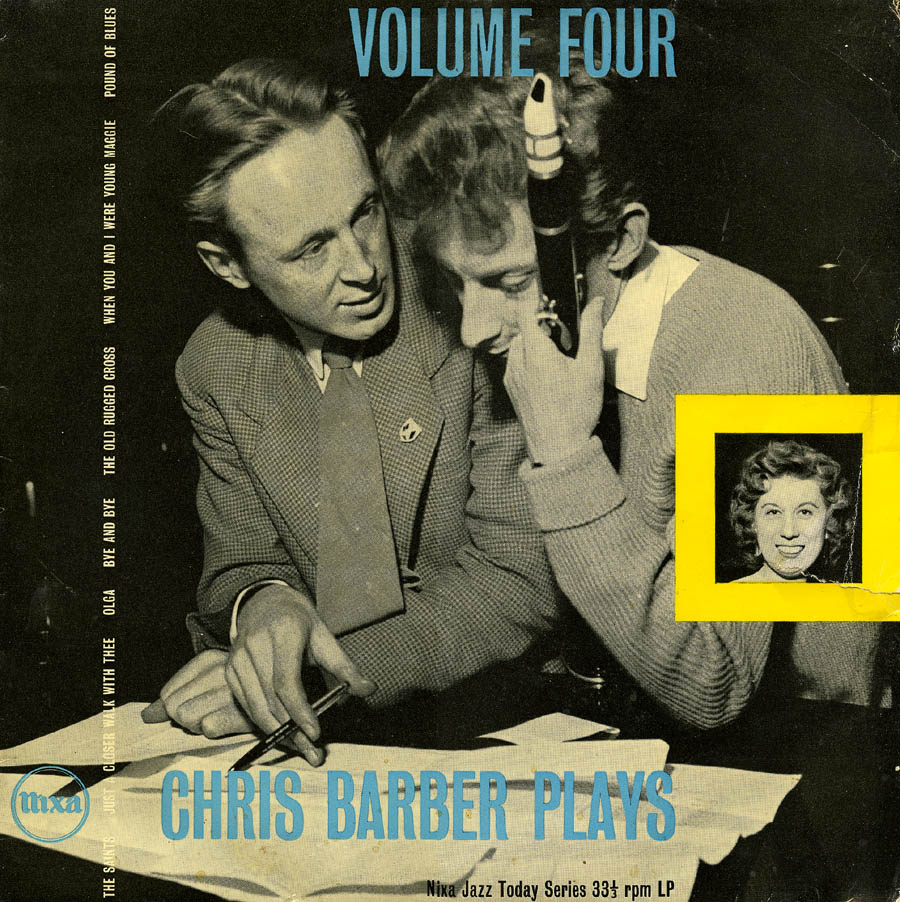
Chris Barber

10" LP recorded in the 50's on the Pye Nixa label. Found the other day in a Leek charity shop in The Peak District for 99p.  I have posted previously about Chris Barber but  not this record I don't think.  Mostly trad jazz instrumentals and one vocal by Ottilie Patterson on this side.

Wikipedia says - " Donald Christopher 'Chris' Barber (born 17 April 1930, Welwyn Garden CityHertfordshireEngland) is best known as a jazz trombonist. As well as scoring a UK top twenty trad jazz hit, he helped the careers of many musicians, notably the blues singer Ottilie Patterson, who was at one time his wife, and vocalist/banjoist Lonnie Donegan, whose appearances with Barber triggered the skiffle craze of the mid-1950s and who had his first transatlantic hit, "Rock Island Line", while with Chris Barber's band. His providing an audience for Donegan and, later, Alexis Korner, makes Barber a significant figure in the British rhythm and blues and "beat boom" of the 1960s."

Tracks are as follows -  1. Bye and Bye  2. Proud of Blues  3. When You and I Were Yound, Maggie  4. Just A Closer Walk With Thee

Chris Barber  -  Side Two

Friday, August 02, 2013

Barbados Steel Band

Rather disappointing steel band from Barbados. Was attracted by the sleeve and the 50p price tag.  A weird mixture of calypso, classics and folk songs which all sound very similar after a while.

"Steel band music originated in Trinidad & Tobago in the 1930s and spread to the rest of the Caribbean, becoming one of the sounds most associated with island music in the minds of many visitors to the region. Originally, bamboo tubes of varying sizes had been used as percussion instruments to accompany vocal songs -- mostly because of restrictions on genuine drums, designed by the white government to curtail the annual Carnival celebrations among the Afro-Caribbean and Indian (true Indian, not native American) population. Metal objects, however, produced much louder, livelier accompaniment, and so industrial leftovers -- various types of pans, containers, and drums (in the "barrel" sense of the word) -- became the new instruments of choice. Players learned that different pitches could be drawn from some of the containers, and eventually how to tune the instruments with slight modifications. By the 1940s, steel pan players were crafting instruments that could sound over a dozen pitches. Around 1946-47, steel bands discovered that discarded oil drums -- which were more sturdily constructed -- could be used to fashion excellent instruments, and by the time the '50s rolled around, steel drums made from oil containers boasted different pitches covering full chromatic octaves, plus standard concert-pitch tuning. Technical innovations and refinements continued through the rest of the decade, with ensembles trying to outdo one another at the annual Carnivals. The repertoire of steel bands grew to include not only calypso melodies, but the various styles of music broadcast on the radio -- American jazz, showtunes, and ballroom-dancing music, Latin-American dances, traditional Indian music, and European classical. When college-educated Trinidad & Tobago youth picked up on steel band music in the '50s, it achieved a new respectability among the middle and upper classes, and has remained an important part of the country's -- and the Caribbean's -- musical scene right up to the present day, even if soca has long since eclipsed steel band music in popularity."


Barbados Steel Band  -  Side One

Monday, July 22, 2013

Josh Mcrae

Lp on the Golden Guinea label from 1965 found at boot sale.  I have fond memories of "Messing About On The River" from the radio in the early 60's. That splish splosh beat was very unusual for the time.

Glasgwegian singer McRae was extremely influential in the early days of the Folk Revival. He was a member of the Reivers group, the foremost singer of the Glasgow Eskimos, and had Top Twenty success with several songs, including ‘Messing About On The River’ and ‘Talking Army Blues’. The latter song was satirically critical of conscription.

On the sleeve notes Josh writes -   " I was born in Glasgow in 1933 and apart from army service have lived there all my life. After leaving school I went to Glasgow School Of Art. It was at art school I learned to play the guitar and learn about folk songs.."

The songs featured are -  1. Messing About On The River  2. I've Got A Love  3. High Class Feelin'  4 Baron James Mc Phait  5. Let Ramensky Go  6. Sky High Joe  7. The Wee Ferry


Josh Mcrae  -  Side One

Saturday, July 06, 2013

Yma Sumac

The last of last weeks boot sale goodies. The extraordinary voice of Yma Sumac and  orchestra conducted by Les Baxter from 1956 of the Regal label.

Wikipedia says  -

"Zoila Augusta Emperatriz Chávarri del Castillo was born on September 13, 1922, in Callao, a seacoast city in Peru.
Stories published in the 1950s claimed that she was an Incan princess, directly descended from Atahualpa. Her New York Times obituary reported that "the largest and most persistent fabrication about Ms. Sumac was that she was actually a housewife from Brooklyn named Amy Camus, her name spelled backward. The fact is that the government of Peru in 1946 formally supported her claim to be descended fromAtahualpa, the last Incan emperor".
Chávarri adopted the stage name of Imma Sumack (also spelled Ymma Sumack and Ima Sumack) before she left South America to go to the United States. The stage name was based on her mother's name, which was derived from Ima ShumaqQuechua for "how beautiful!" although in interviews she claimed it meant "beautiful flower" or "beautiful girl".

Yma Sumac first appeared on radio in 1942. Sumac and orchestra and bandleader Moisés Vivanco were married that year. She recorded at least 18 tracks of Peruvian folk songs inArgentina in 1943. These early recordings for the Odeon label featured Moisés Vivanco's group, Compañía Peruana de Arte, a group of 46 Indian dancers, singers, and musicians.
In 1946 Sumack and Vivanco moved to New York City, where they performed as the Inka Taky Trio, Sumack singing soprano, Vivanco on guitar, and her cousin Cholita Rivero singingcontralto and dancing. She was signed by Capitol Records in 1950, at which time her stage name became Yma Sumac.
During the 1950s, Yma Sumac produced a series of lounge music recordings featuring Hollywood-style versions of Incan and South American folk songs, working with the likes of Les Baxter and Billy May. The combination of her extraordinary voice, exotic looks, and stage personality made her a hit with American audiences. Sumac appeared in a Broadway musical,Flahooley, in 1951, as a foreign princess who brings Aladdin's lamp to an American toy factory to have it repaired. The show's score was by Sammy Fain and E. Y. "Yip" Harburg, but Sumac's three numbers were the work of Vivanco with one co-written by Vivanco and Fain.
Capitol Records, Sumac's label, recorded the show. Flahooley closed quickly, but the recording continues as a cult classic, in part because it also marked the Broadway debut of Barbara Cook. During the height of Sumac's popularity, she appeared in the films Secret of the Incas (1954) and Omar Khayyam (1957). She became a U.S. citizen on July 22, 1955. In 1959 she performed Jorge Bravo de Rueda's classic song "Vírgenes del Sol" on her album Fuego del Ande."

Tracks are -   1. Taita Inty  2. Ataypura!  3. Accla Taqui 4. Tumpa!

Yma Sumac  -  Side One

Jimmy Durante

More scratchy vinyl from the boot sale. I think I have featured Jimmy before but not sure what songs were on the blog post.  This LP has many of his hits and a few obscure numbers I'd not heard before like  I'll Do The Strut Away in My Cut Away.

Wikipedia says -

"Durante was born on the Lower East Side of New York City. He was the youngest of four children born to Bartolomeo and Rosa Durante, both of whom were immigrants from Salerno, Italy. Bartolomeo was a barber, and his wife Rosa was the sister of a woman who lived in the same boarding house.Jimmy Durante served as an altar boy at Saint Malachy's Roman Catholic Church, known as the Actor's Chapel.
Durante dropped out of school in eighth grade to become a full-time ragtime pianist. He first played with his cousin, whose name was also "Jimmy Durante". It was a family act, but he was too professional for his cousin. He continued working the city's piano bar circuit and earned the nickname "Ragtime Jimmy", before he joined one of the first recognizable jazz bands in New York, the Original New Orleans Jazz Band. Durante was the only member not from New Orleans. His routine of breaking into a song to deliver a joke, with band or orchestra chord punctuation after each line, became a Durante trademark. In 1920, the group was renamed Jimmy Durante's Jazz Band.
Durante became a vaudeville star and radio personality by the mid-1920s, with a trio called Clayton, Jackson and Durante. Lou Clayton and Eddie Jackson, Durante's closest friends, often reunited professionally. Jackson and Durante appeared in the Cole Porter musical The New Yorkers, which opened on Broadway on December 8, 1930. Earlier that same year, the team had appeared in the movie Roadhouse Nights, ostensibly based on Dashiell Hammett's novel Red Harvest.
By 1934, he had a major record hit with his own novelty composition, "Inka Dinka Doo", with lyrics written by Ben Ryan to music that Durante himself composed. It became his theme song for the rest of his life. A year later, Durante starred on Broadway in the Billy Rose stage musical Jumbo, in which a police officer stopped him while leading a live elephant and asked him, "What are you doing with that elephant?" Durante's reply, "What elephant?" was a regular show-stopper. This comedy bit, also reprised in his role in Billy Rose's Jumbo (1962, based on the 1935 musical) likely contributed to the popularity of the idiom the elephant in the room. Durante also appeared on Broadway in Show Girl (1929), Strike Me Pink (1934) and Red, Hot and Blue (1936).
He began appearing in motion pictures in a comedy series pairing him with silent film legend Buster Keaton and continuing with The Wet Parade (1932), Broadway to Hollywood (1933),The Man Who Came to Dinner (1942, playing Banjo, a character based on Harpo Marx), Ziegfeld Follies (1946), Billy Rose's Jumbo (1962, based on the 1935 musical) and It's a Mad, Mad, Mad, Mad World (1963). In 1934 he starred in Hollywood Party, where he dreams he is 'Schnarzan', a character in parody of 'Tarzan', extremely popular at the time due to the Johnny Weissmuller films."

Tracks are as follows -   1. Bill Bailey  2. What You Goin' To Do When The Rent Comes 'Round?  3. A-Razz-A Ma-Tazz  4. I'm A Vulture For Horticulture  5. It's My Nose's Birthday  6. I'll Do The Strut Away In My Cut-Away


Jimmy Durante  -  Side One

Friday, July 05, 2013

Stan Freberg

Recent boot sale find on the cheapo Music For Pleasure label from 1963.  Many of his best songs and characters here. I'd forgotten just how funny he was.

Wikipedia says  -  "Freberg was born Stanley Friberg in Pasadena, California, the son of Evelyn Dorothy (née Conner), a housewife, and Victor Richard Friberg (later Freberg), a Baptist minister.He is of Swedish and Irish descent.
Freberg's work reflects both his gentle sensitivity (despite his liberal use of biting satire and parody) and his refusal to accept alcohol and tobacco manufacturers as sponsors—an impediment to his radio career when he took over for Jack Benny on CBS radio. As Freberg explained to Rusty Pipes:
After I replaced Jack Benny in 1957, they were unable to sell me with spot announcements in the show. That would mean that every three minutes I'd have to drop a commercial in. So I said, "Forget it. I want to be sponsored by one person", like Benny was, by American Tobacco or State Farm Insurance, except that I wouldn't let them sell me to American Tobacco. I refused to let them sell me to any cigarette company.
Stan Freberg's first wife, Donna, died in 2000. He has two children from that marriage, Donna Jean and Donavan. He married Betty Hunter in 2001, and she adopted the personal and family names Hunter Freberg."

Tracks are as follows  -   1,   The Yellow Rose Of Texas  2. John & Marsha  3. St. George & The Dragonet  4. C'est Si Bon  5. Trouble  6. Tele-Vee-Shun

Stan Freberg  -  Side One


Tuesday, July 02, 2013

Big Ben Banjo Band

Last of the EP's you'll be glad to know!  This time a medley of old music hall tunes by the Big Ben Banjo Band on Columbia again from the 50's.

"The Big Ben Banjo Band were at the height of their popularity, from 1955 to 1958. They were formed towards the end of 1954 by Columbia A & R man Norrie Paramor and were purely intended as a recording unit. Basically they were a Dixieland-style outfit with banjos predominant. Norrie had the pick of the top session musicians, and his original line up included George Chisholm on trombone, Tommy McQuater (trumpet) and Bert Weedon (guitar). They continued to record prolifically, right through into the 1970s."

Big Ben Banjo Band  -  Medley

Flanagan & Allen

Another EP from the weekends record haul at the boot sale in Cheshire.  This time a sort of mini Greatest Hits by Flanagan & Allen on Columbia from the late 40's.

allmusic.com says  -  "Bud Flanagan (b. Reuben Weintrop [Robert Winthrop], 14 October 1896, Whitechapel, London, England, d. 20 October 1968, Kingston, Surrey, England) and Chesney Allen (b. William Ernest Allen, 5 April 1896, London, England, d. 13 November 1982, Midhurst, Sussex, England). One of Britain’s best-loved comedy-singing duos during their heyday in the 30s and 40s. Allen was the straight man, with a neat, well tailored image complete with trilby, while comedian Flanagan wore a voluminous mangy fur coat and a battered straw hat. The son of Jewish refugees from Poland, Flanagan took a job as a call boy at the Cambridge Music Hall when he was 10, and made his first stage appearance at the London Music Hall - as conjuror Fargo, the Boy Wizard - in 1908. After winning singing competitions sponsored by the popular musical hall artist Dora Lyric, Flanagan made up his young mind to run away to America, and, at the age of 14, found himself washing dishes in the galley of the S.S. Majestic bound for New York. Once there, he worked as a Western Union messenger, newspaper vendor, and prizefighter (billed as ‘Luke McGlook from England’), before forming a vaudeville double act with Dale Burgess. They toured the USA, and appeared in Australia, New Zealand, and South Africa, before Flanagan returned to England just after the outbreak of World War I, and enlisted in the Royal Artillery. Posted to Northern France, where he first met Chesney Allen briefly, he took his future stage name from a particularly obnoxious, anti-Semitic Sergeant-Major Flanagan. After his release in 1919, he worked with various stage partners and was a taxi driver for a spell in the early 20s, before taking over from Stan Stanford as Chesney Allen’s partner in Florrie Forde’s revue and pantomime company in 1924.
Allen, whose father was a master builder, had been articled to a solicitor before opting for a stage career. As well as performing in Forde’s shows, he was also her manager. When Forde decided to retire, Flanagan and Allen’s first inclination was to follow their main interest and start up as bookmakers, but they accepted D.J. Clarke’s offer of a week in variety at the Argyle Theatre, Birkenhead, in January 1931. Their performances were so well received, especially their rendering of Flanagan’s composition, ‘Underneath The Arches’, that they were swiftly booked for the Holborn Empire and the London Palladium. Flanagan and Allen also appeared at the Palladium in their first Royal Variety Performance in 1932. Flanagan’s impulsive appeal for ‘three cheers’ for their majesties King George V and Queen Mary at the end of the show, marked the beginning of his long reign as an affectionately regarded ‘court jester’. Also on the bill that year were the comic duo, Nervo And Knox, and that pair’s subsequent appearances with Flanagan And Allen, Eddie Gray, Caryll And Mundy, and Naughton And Gold in the Palladium’s Crazy Month revues, saw the birth of the legendary Crazy Gang. The team was reduced to seven after Billy Caryll lost a leg and died. In the 30s, as well as touring in variety and appearing together in their own shows such as Give Me A Ring, Happy Returns, Life Begins At Oxford Circus, and Swing Is In The Air, Flanagan And Allen were part of the Crazy Gang (although in most cases the artists were each billed separately) in popular revues such as Round About Regent Street, O-Kay For Sound, London Rhapsody, These Foolish Things, and The Little Dog Laughed (1939). During World War II Flanagan And Allen entertained the troops with ENSA, and were seen in the revues Top Of The World, Black Vanities and Hi-Di-Hi. They also starred in a series of comedy films - sprinkled occasionally with songs - which had begun in the 30s with A Fire Has Been Arranged, Underneath The Arches, Okay For Sound, Alf’s Button Afloat, and The Frozen Limit, and continued in the early 40s with Gasbags, We’ll Smile Again, Theatre Royal, Here Comes The Sun, and Dreaming (1944)."


Flanagan & Allen  -  Hey Neighbour/ Umbrella Manhttps://www.box.com/s/2y11w0z315iymcxr4h3i

Monday, July 01, 2013

Felix Mendelssohn & His Hawaiian Serenaders

An interesting batch of EP's from a recent boot sale included this gem from Felix Mendelssohn on the Columbia label from the late 40's I would guess.

"Felix Bartholdy Mendelssohn, a direct decendent of the great composer, was born at Brondesbury Park, London. He worked for a while in the London Stock Exchange before joining the navy at the age of seventeen. On leaving the Navy he became an actor and opened Club Felix in London which became the haunt of stage personalities in the early 1930's. In 1938 he realised his long standing ambition, first kindled on a visit to the South Sea Islands, to form a Hawaiian band. He once said “I believe that soft music allied to glamour and showmanship is a sure recipe for success” as in these easy listening fusions of Celtic and Hula. Aloha Alloa?
“Gifted with a capacity for organisation and an appreciation of the value of publicity, it was his particular genius that helped to elevate Hawaiin music to heights of popularity in England during the late 1930's and through the 1940's that have never been equalled.”
His first recording for Parlophone was in November 1939.
In the early 1940's broadcasting and recording work was directed by George Elliott, a superb plectrum guitarist who also played steel guitar. Guitar was splayed by Kealoha Life, Ivor Mairants and Wally Chapman, among others. In 1944 the band were joined by steel guitarist Jimmy McCulloch of Ayr although he never recorded with the group."

Felix Mendelssohn  -  Hawaiian War Chant/ Aloha Oe